
Montreal 1976 - 50th Anniversary Of A Game-Changing Games
Where Munich 1972 had witnessed 30 World records, Montreal 1976 added 29 to the books & rates No2 on the all-time rankings of Games that produced the most new global standards in the pool. It all unfolded 50 years ago this week - &remains a milestone in swim history, for reasons good, bad & ugly

Those 1970 scores on the record books coincided with innovations in suits, goggles, lane lines, blocks, timing systems, pool technology and training methods - and all of that meant that even the 25 new standards witnessed at Beijing 2008 when the program was bigger and the poly in shiny, booster bodysuits put the kettle on pioneering pace couldn't catch up.
In that and all other context, the 1976 total is particularly remarkable given there were only 13 events per gender at the time, more than at many Games before that but far fewer events than later Games. Sadly, doping played a big part in the picture; and, tragically, not a single generation of blazers since has ever had the courage to reach for the truth, reconciliation and recognition process essential to healing the harm down to athletes, coaches, parents, families and communities.
The headline pioneers on the record books were John Naber (4 individual WRs) and Kornelia Ender (4 individual WRs), while Shirley Babashoff was the queen of would-be-haulers-of-gold in generations of women swimmers denied by GDR doping, and her teammates in the 4x100m free, Kim Peyton, Jill Sterkel, Wendy Boglioli set her up for delivering "The Last Gold" and only win for the USA women's team.
Our SOS Timeline is following the flow of the records as each day of events in Montreal passes 50 years on:
 Craig Lord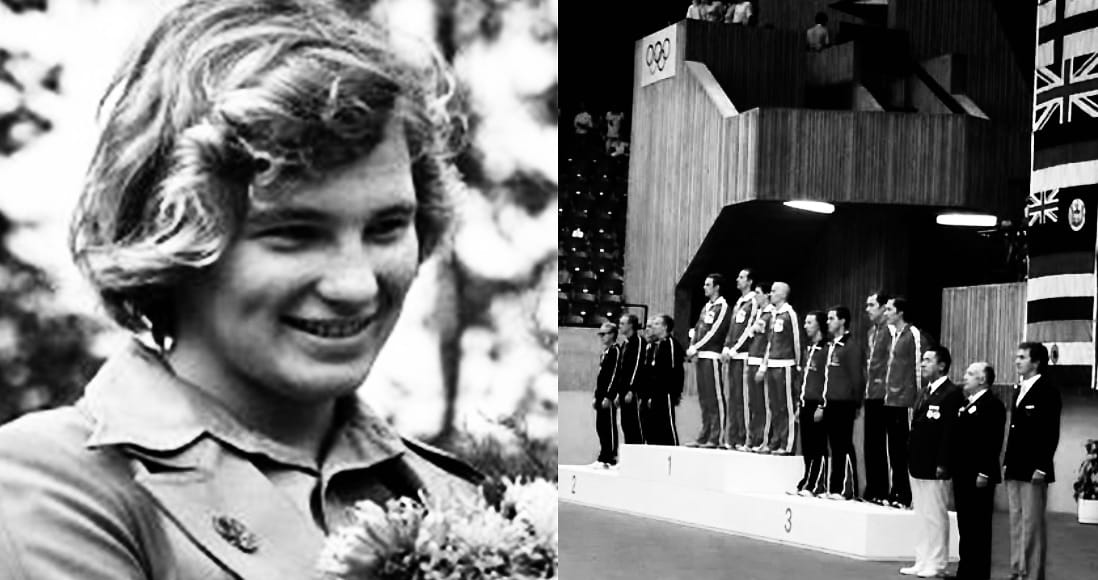
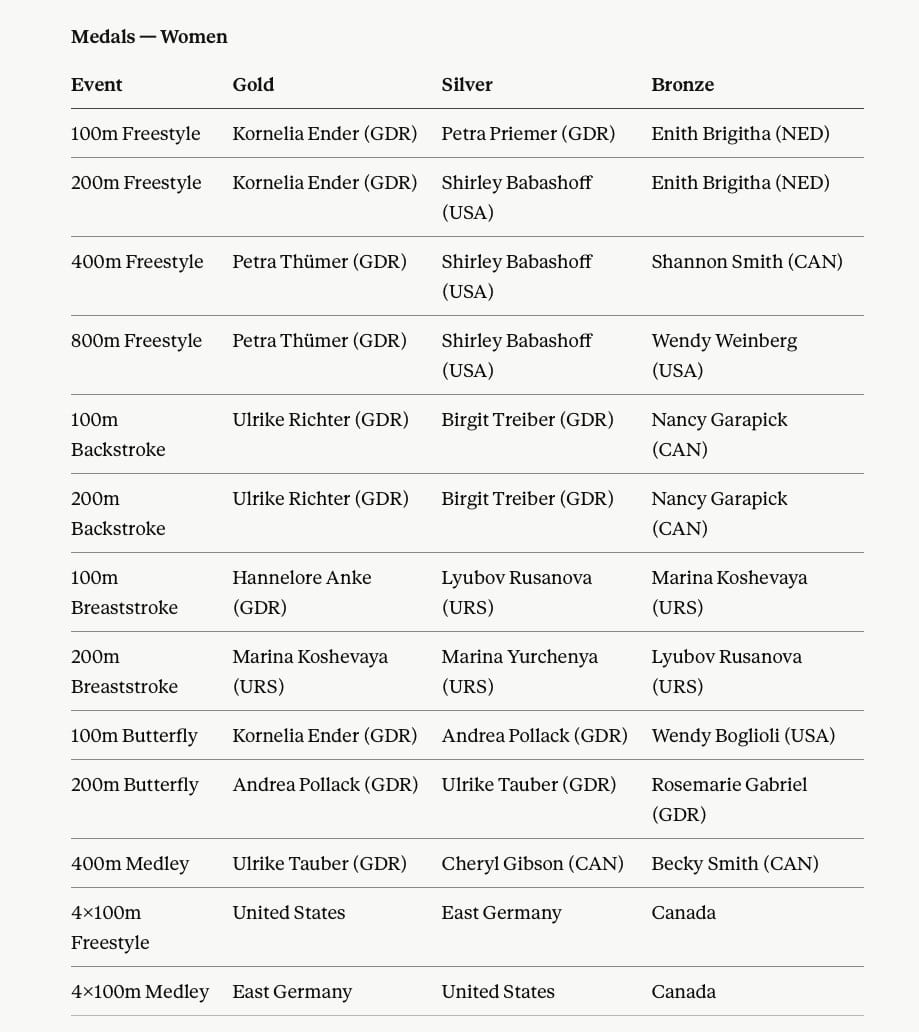
The dominant East German women's programme claimed 11 of the 13 golds up for grabs and broke records across the board as the darkest chapter and biggest heist in swimming history unfolded in plain sight. On the men's side, David Wilkie, of Great Britain, stood out as the only non-American to claim gold.
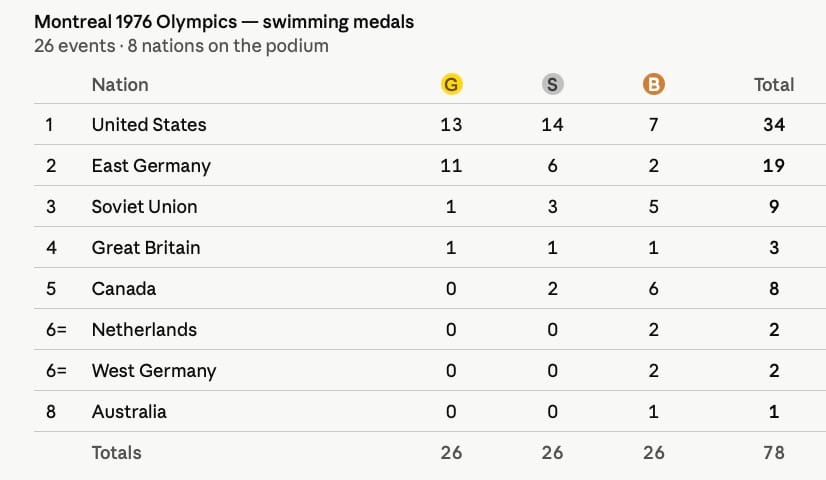
The medals table is a stark picture: of the 78 medals in total, 53 went to the USA (34) and the GDR (19), no other nation getting to double digits, only two of 26 gold medals going to swimmers outside the USA and GDR teams at the height of the Cold War in Olympic sport that lasted between 1973 and 1989. The event that broke the mould was the 200m breaststroke, golds going to Wilkie and the Soviet Union's Marina Koshevaya.
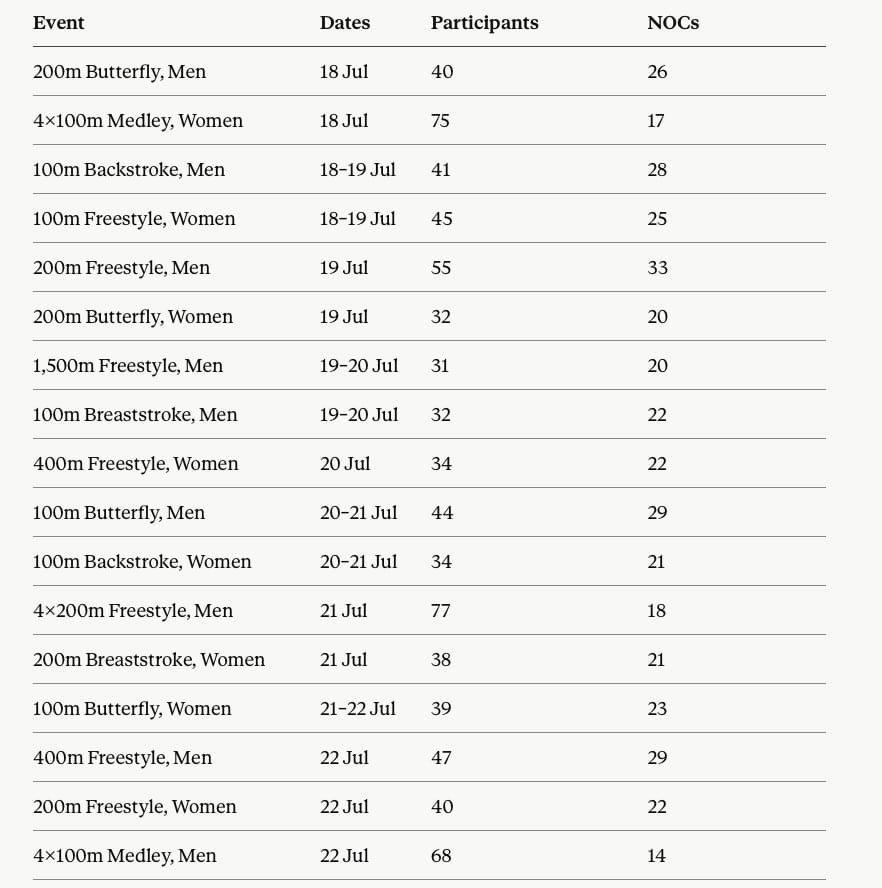
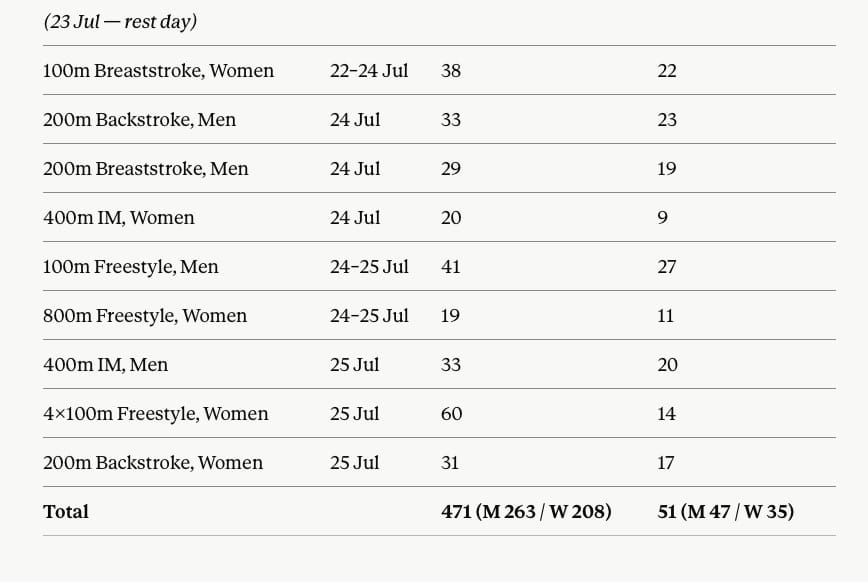
Among quirks of the program: No 200IM, and no 4x100m free for men, while the seven-day schedule including a rest day after 5 sessions of finals , with two to go, the finals of events that featured semis on day 5 not contested until two days later.
Here's the medals table with just eight nations making the podium - and a short overview of the whole week follows that before our day-by-day coverage of the swimming at the Montreal Games 50 years ago this week.
An Overview of An Extraordinary Week Of Swimming
If the world thought Mark Spitz was the end of a journey, then the US men’s team in Montreal proved him to have been a catalyst for achieving greater heights at the start of a new dawn in speed, dedication, determination and depth.
It was, Mark Schubert said years later in a career that included head coach to the USA, “the greatest male team we ever saw”. Montreal's 29 new standards included a record 18 pioneering efforts among men. Indeed, just one male global mark in events on the Olympic program was left standing by the end of it all: Spitz’s 100m butterfly survived until 1977.
I remember watching every session of the swimming on our new telly, one of my main aims to see if I could spot my dad, who was there as a coach, and the swimmers he was there with, including Paulo Frischknecht, selected to represent his country at 14, and just turned 15 when he raced in there 100 and 200 'fly in Montreal. Fifty years on:
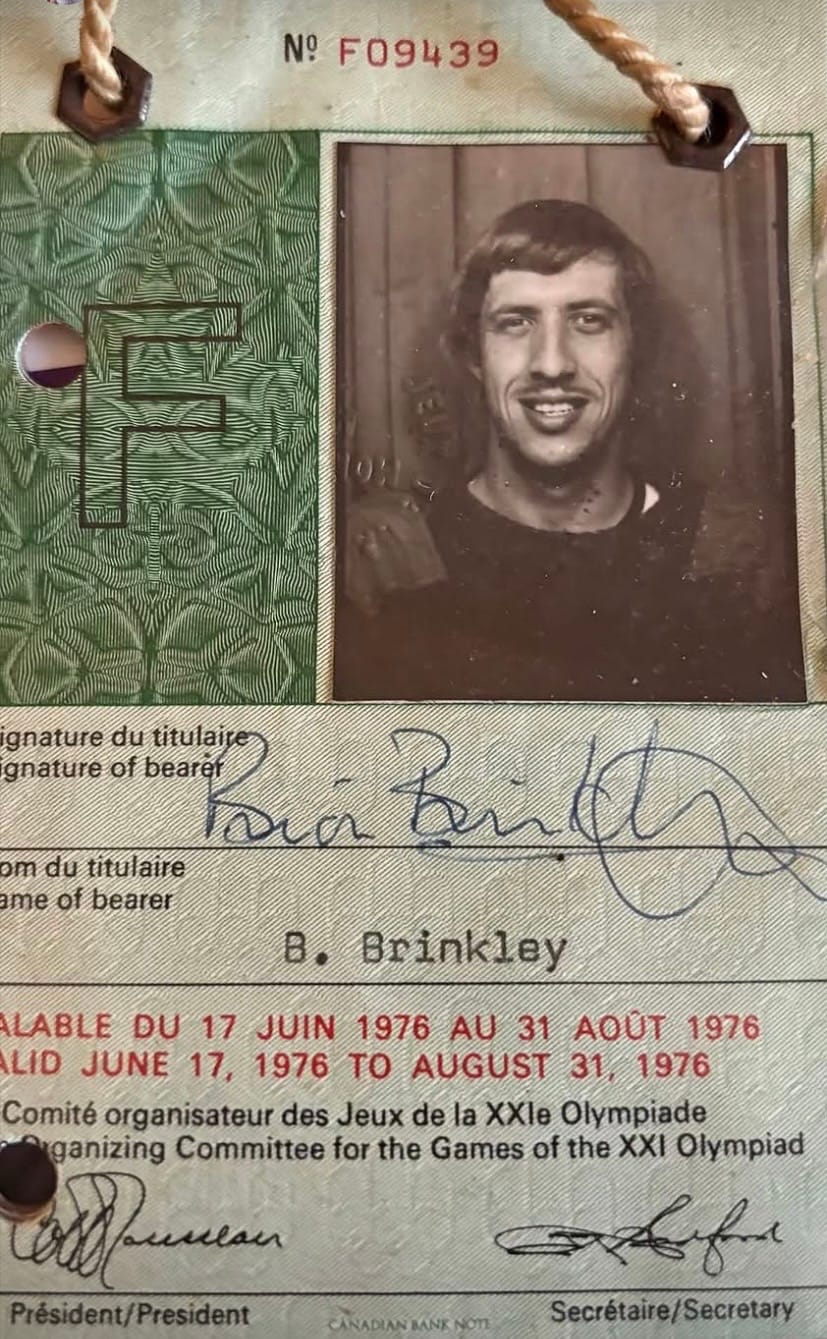
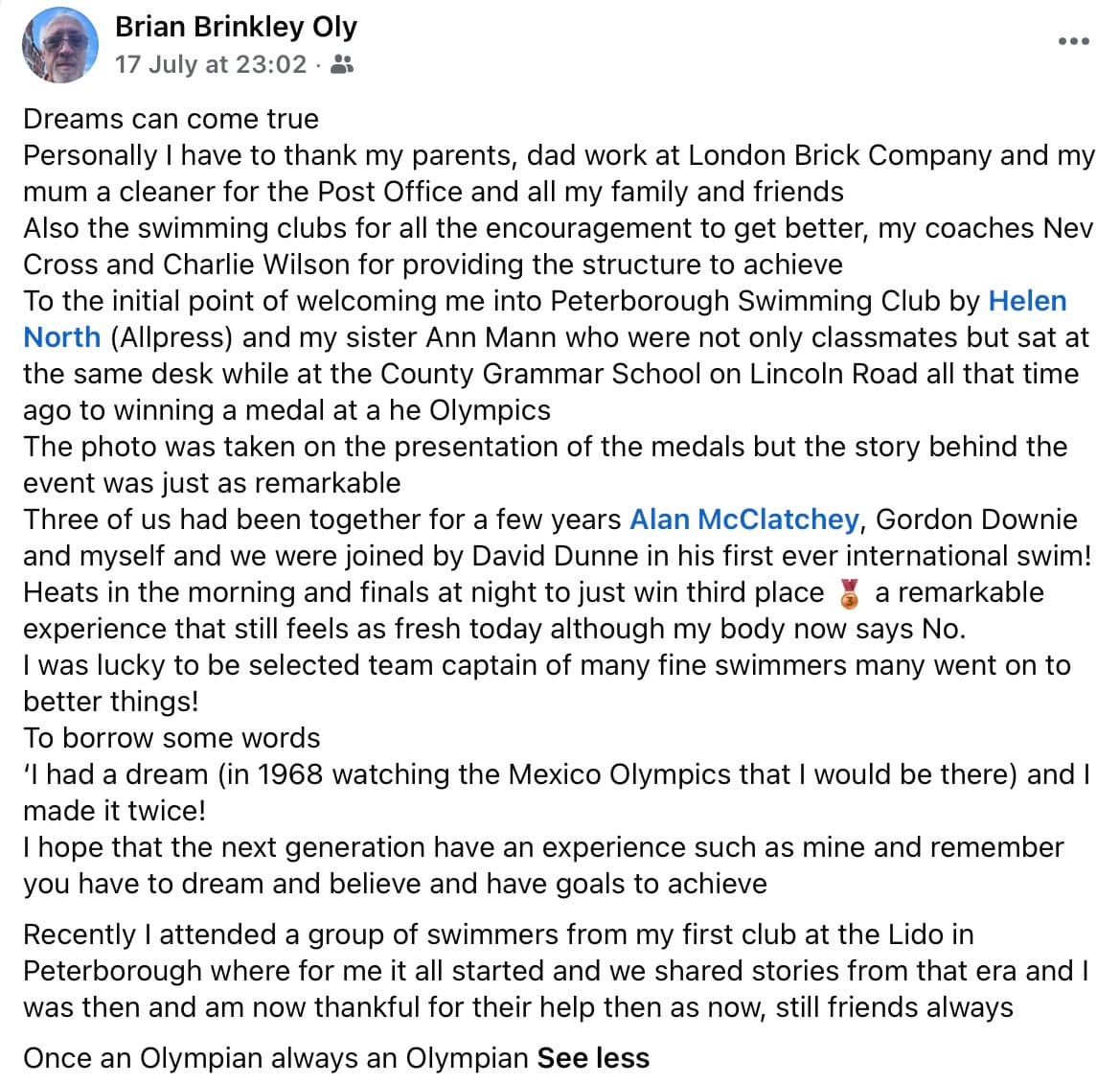
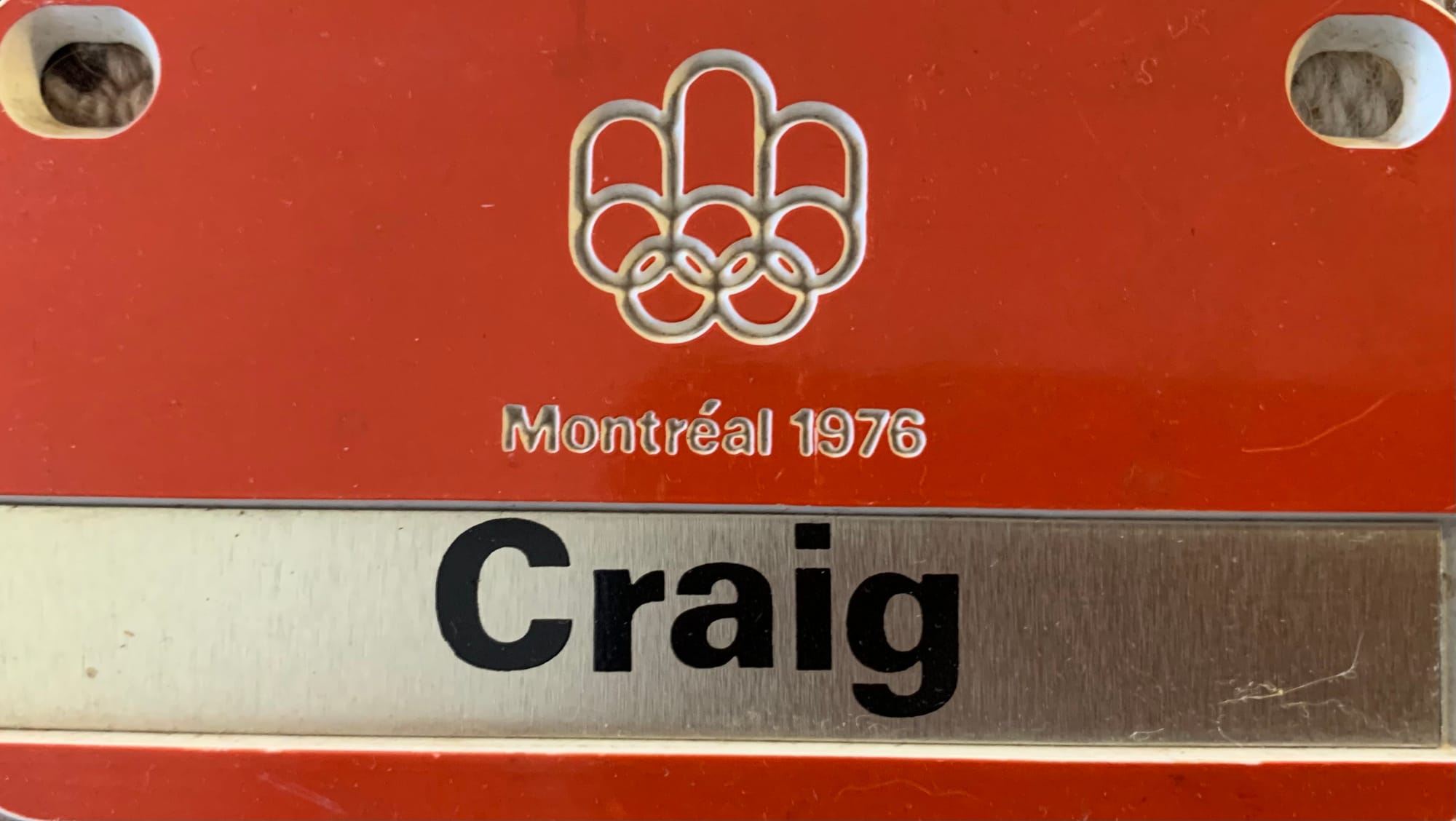
Each of us, whether am Olympian, a swimmer back home, a parent, a teacher, a school friend, and on and on, will cherish some memory from those times that transcends sport and reaches to the meaning of family, the shared hopes and dreams, the toil and commitment to a goal, the often steady, consistent, quiet support given to those reaching for lofty goals. Here's Brian Brinkley's post on what it means, in his words, his accreditation to the left, his 6th place in the 200m 'fly final among his treasures, alongside bronze with teammates Alan McClatchey, David Dunne and Gordon Downie in the 4x200m freestyle 0.16sec ahead of West Germany, with the USA taking gold in that World record as mentioned above, and the Soviet quartet second, the GBR medal screamed home by families back home, my treat to get to stay up late into the night of July 21, 1976, a week before dad came home to tell us what it had been like to be there as we opened the Olympic treasures he's brought home with him.
Brian Brinkley - Dreams Can Come True
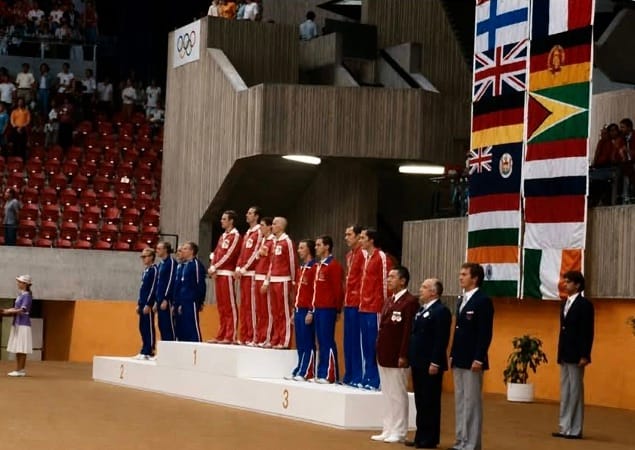
Of the 51 nations entered, 47 sent men and 36 women. The Bahamas, the Virgin Islands, Morocco, Nicaragua, Paraguay and Tunisia made their Olympic debut at the pool overlooked by 9,200 seats (6,988 were temporary) and designed by French architect Roger Taillibert.
An African boycott of the Games did not affect events in the pool, while New Zealand was barred after its rugby team toured apartheid South Africa. Montreal staged the Games that sounded the death knell of the clean sweep: six events witnessed all three medals won by swimmers from the same nation, four of those by American men, and one each by women from East Germany and the Soviet Union.
Fear of poor attendance at the boycotted 1980 and 1984 Games allowed the three-entries per nation rule to survive a little longer, but the seed of a cut to two-per-nation in 1988 was sown in Canada, where the USA and the GDR won 53 of the 78 medals on offer between them.
The 200m medley for both sexes and the men’s 4x100m freestyle were dropped from the programme until 1984, and there was no 4x100m free. Among innovations was the introduction of a red warning light connected to the touch pads to signal a false start.
If Marina Koshevaia (URS) was the thorn in the side of GDR women in the 200m breaststroke, then the same event for men saw David Wilkie (GBR) hammer a chink in the armour of an American squad that won every gold medal barring that for the 200m breaststroke, in which the Scot produced one of the two most memorable swims in history.
He wiped 3.1sec off the world record, while wearing goggles, an innovation seen in Olympic waters for the first time in Montreal and credited with some of increase in speed across the board. On July 20, Wilkie, 22, finished second to John Hencken (USA) over 100m, the American having set world records of 1:03.88 and 1:03.62 in heats and semis on his way to a 1:03.11 victory in the final, over the Scot’s 1:03.43.
Four days later in the 200m final, defending champion Hencken, 1972 champion ahead of the Scot, raced inside his own world record by a terrific 0.95sec. But his 2:17.26 effort left him in a world behind Wilkie, who surged down the last lap for a 2:15.11 victory, 3.1sec inside Hencken’s previous best and a record that would survive six years. The time would still have won a medal three Games on, in 1988, and placed him in the 1996 final 20 years later. Born in Ceylon (now Sri Lanka), Wilkie went on to develop a successful green health and cosmetics company. He passed away in 2024:
 Craig Lord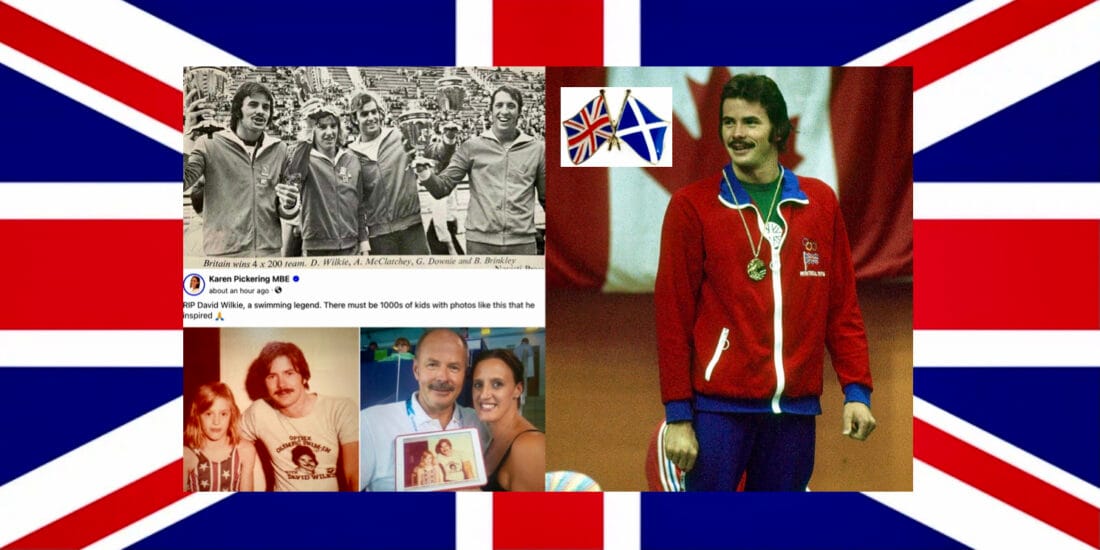
In 2026, David's son Adam Wilkie is on a mission to raise money for the next generation in hour of his father and the wonderful legacy he left:
 Craig Lord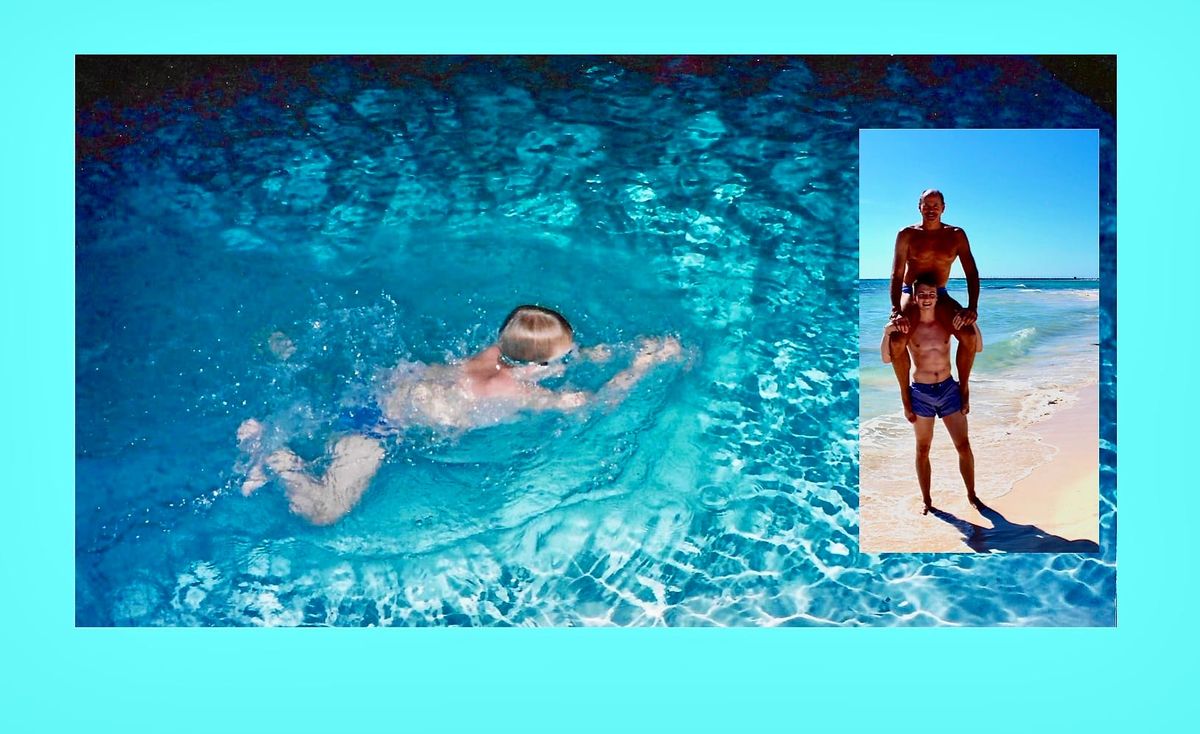
If anything got beyond Wilkie on the scale of impression made, it was the historic 49.99sec effort of American Jim Montgomery over 100m freestyle.
Where John Naber (USA), with four gold medals and a silver, was the man of the meet after bringing the curtain down on the most successful backstroke career in history, that of Roland Matthes (GDR), then the woman Matthes would marry, Kornelia Ender, stole the show among women with the same tally as Naber.
Just two women’s titles went beyond the GDR; the first to Koshevaia in the most decisive 200m breaststroke victory in Olympic history, her 2:33.35 world record leading a Soviet sweep by 2.73sec and maintaining a national tradition; and the second to the USA 4x100m freestyle quartet, through which Shirley Babashoff achieved one of her two Olympic gold medals among six silvers in a world record of 3:44.82 alongside Kim Peyton, Wendy Boglioli and Jill Sterkel, with Jennifer Hooker the heats swimmer who helped her teammates arrive in the final in shape to face their against-the-odds challenge.
Naber was one of the biggest presences at the 1976 Olympic Games – literally: 1.98cm (6ft 6) tall and weighing in at 87kg (195lb). Having clocked 56.19 in the semis to end Matthes’ nine-year world-record reign, Naber took another axe to the clock in the final to win in 55.49.
Matthes finished third behind Peter Rocca (USA) to become the only backstroke swimmer ever to win a medal at three separate Games. For Naber, victory was the fulfilment of a childhood dream: at nine he visited Olympia in Greece and told his parents that his destiny was to be an Olympic champion.
An hour after the 100m final, Naber took silver over 200m freestyle 0.21sec behind Bruce Furniss (1:50.29) and 0.08sec ahead of Montgomery in a USA sweep and the tightest podium finish in the history of the event. The 'race' continued in the warm-down pool, where Naber and Furniss found themselves speeding up in response to each other's attempt to ease down ahead of their closest opponent. No stopping the will to race and win.
Two days later, Naber and Furniss took gold as members of the 4x200m freestyle quartet (7:23.22, world record) with Bruner and Montgomery. One day after that, it was another gold for Naber, in the 4x100m medley (3:42.22, world record), and on July 24 he brought his campaign to a close with a fourth gold, lowering his 2:00.64 world record over 200m backstroke to 1:59.19 to become the first man below 2 minutes. He then retired. Naber now works as lead commentator for Olympic sports broadcaster WSCN.
The electronic clock was set to fast-forward in Montreal and nowhere was that more obvious than in the men’s 1,500m freestyle. Beyond what remains the tightest podium finish in history - Brian Goodell (USA) took the first of his two gold medals, in a world record of 15:02.40, 1.51 ahead of teammate Bobby Hackett and Stephen Holland (AUS) 0.75sec further back - 15 men raced within the 15:52.68 world record in which Mike Burton had claimed the 1972 crown. Two days later, Goodell edged out his teammate and world champion Tim Shaw (USA) over 400m by 0.61sec in 3:51.93.
On butterfly, Matt Vogel (USA), in 54.35 (0.08sec slower than Spitz in 1972) got the touch in the 100m over teammate Mike Bottom, who in 1977 would break Spitz’s world record, while the 200m went to Mike Bruner in 1:59.23 (world record) ahead of teammates Steven Gregg and Bill Forrester, who produced the first sub 2-minute podium. Rod Strachan completed the American gold rush with a 4:23.68 win by 0.94sec over Tim McKee in the 400m medley.
Each of those races holds its own epic tale, and as we build the SOS Hall of Fame, each will be granted the words we can muster to honour such soaring achievement.
Not all events surrounding Montreal belong in the Hall of Fame, of course. Indeed, think Hall of Shame the place for those who orchestrated the crime and those who have failed and continue to fail to put the power they have and any trust in them that remains in the community of athletes, caches and others, to good use in the interest of justice and fair play. The message has long been: we know the fraud was real, but we intend to do nothing about it. The reasons given, including 'legal risks' are monstrous red herrings with excuses for scales.
Below is a basic overview of the stats from the 1976 Games, and a reminder of the darkest chapter in swimming history, one that governors at IOC and World Aquatics levels, and all below them, have done nothing about for half a century, 36 years of which have passed with massive amounts of truth told and yet not a single effort to do the right thing by athletes and the sport of swimming by reaching for a truth, reconciliation and recognition process that would go along way to healing the wounds and harm of while lifetimes, some of which, like that of Canada's Nancy Garapick, have passed.
 Craig Lord
 Craig Lord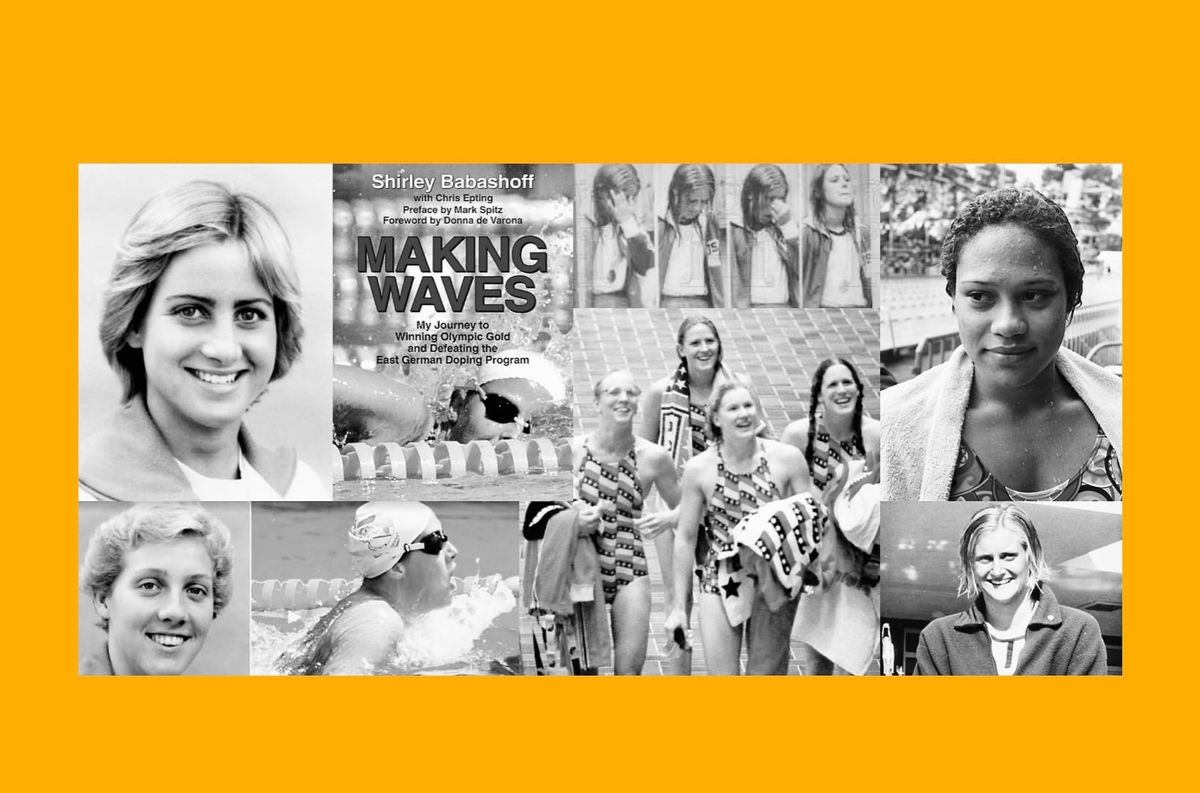
 Craig Lord
A short extract from Unfair Play by Sharron Davies, with Craig Lord:
East German officials dumped the leftover serum and syringes in the St. Lawrence River, newly uncovered documents indicate.
A chance discovery in the Berlin archives of the notorious Stasi, the East German secret police, led University of Waterloo history professor Gary Bruce to a 95-page file on the spy service’s operations at the Montreal Games.
A Stasi officer’s final report on the Games contains a none-too-subtle reference to the drug program under the subheading, “Destruction of the Rest of the Special Medicine.”
About 10 suitcases of medical packaging, needles, tubular instruments, etc. were sunk in the St. Lawrence River.
Bruce explained:
"The documents make it clear that Stasi chief Erich Mielke saw the Games as a means to improve East Germany’s standing in the world by ensuring all went well on the athletic field and that nothing went wrong away from it. He put the fabled Markus Wolf, head of the Stasi’s foreign espionage wing, in charge of Operation Finale, a tightly controlled effort to monitor East German athletes in the years leading up to the ‘76 Olympics as well as during the 16-day sporting festival… Officers from the Stasi and other East Bloc security services met at KGB headquarters in Moscow before the Games to coordinate efforts."
"To the GDR, sport was about business, power and politics. For me, the Montreal Games were all about soaking up the incredible experience. Four years later at 17, I would be a contender and the significance of GDR cheating would sting me and my teammates not just on the day but for decades after." - Sharron Davies
"My Olympic-debut focus was the 200m backstroke. I entered as the third-fastest on the Britain team and left the competition the fastest Brit, mid-field among all the world’s best swimmers. A key definition of satisfaction in performance sport is seeing the rewards for all your hard work.
"The East Germans worked hard, too, some of them enduring regimes that were beyond what many of us could manage without breaking down, without sustaining serious injury or without burning out. The big question, one that ran through our heads at every passing competition, was: how were they getting away with it?" - Sharron Davies
The truth started to flow not long after the fall of the Berlin Wall in 1989 – but not everyone wanted to hear it.
 Craig Lord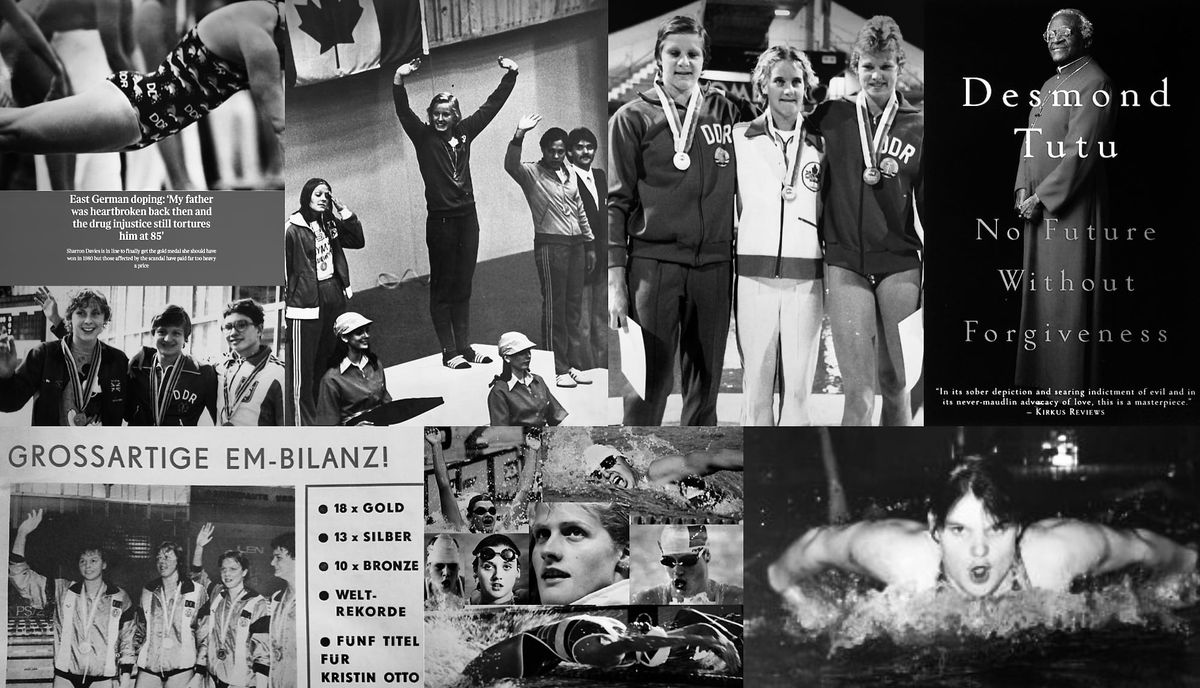
And so, to the stats... Montreal 1976:
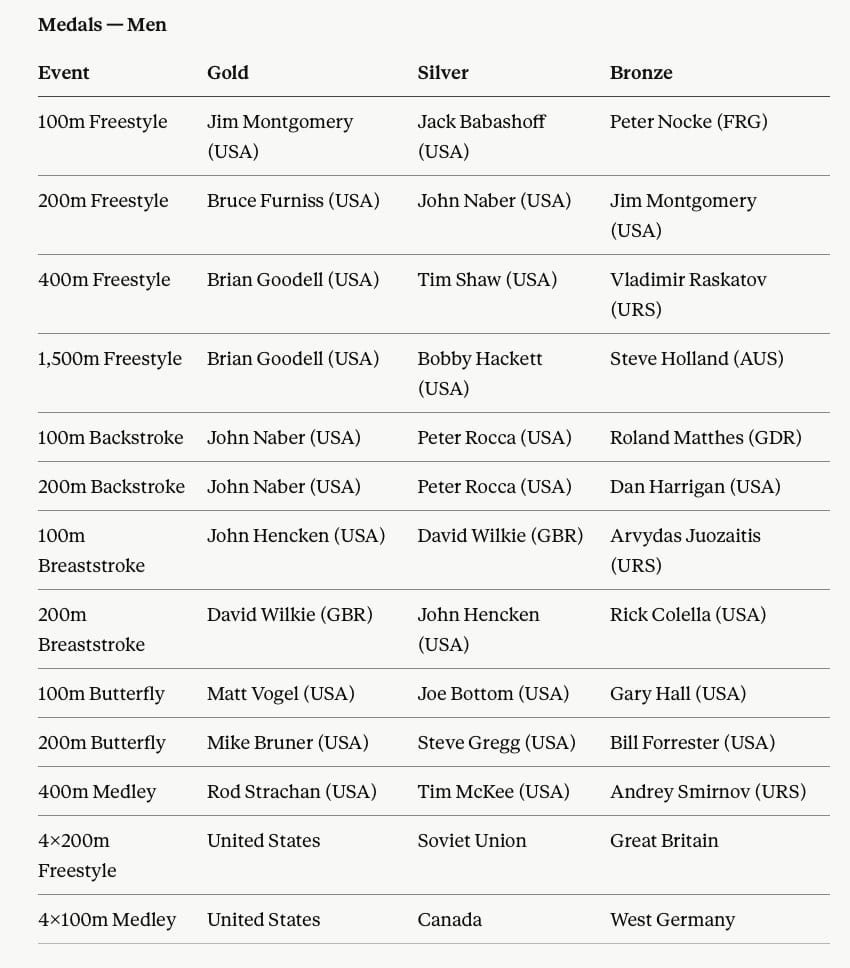
(subscribers have access to the full Timeline content in our daily trawl of pioneering moments in swimming history - and the accompanying profiles in our SOS Hall of Fame as we build the library).


