Subscribe to Our Newsletter

Success! Now Check Your Email

To complete Subscribe, click the confirmation link in your inbox. If it doesn’t arrive within 3 minutes, check your spam folder.

Ok, Thanks
Mark Spitz's Seventh Heaven Immortalised On Olympic Heights
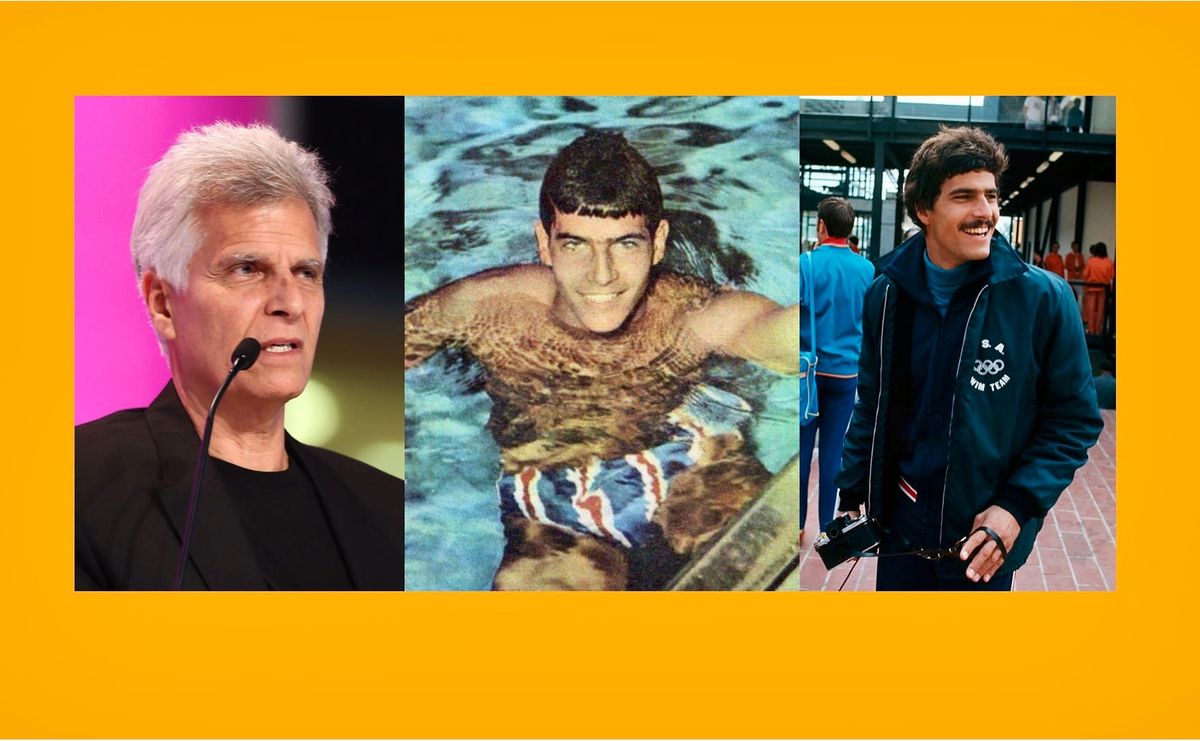
Mark Spitz: at Doha Stadium Plus Qatar, photo by Vinod Divakaran - posted, Flickr 2012; Spitz depicted by Panini Cards, Italy, circa 1968; and Spitz and his camera snapped in in the Athlete Village at Munich 1972 by Giorgio Lotti (Mondadori Publishers) - all public domain

Mark Spitz's Seventh Heaven Immortalised On Olympic Heights

For 36 years, Spitz's 7 golds in 7 WRs at Munich 1972 was the high bar of all Olympic sport. And when Michael Phelps made it 8, with 7 WRs in 2008, Spitz said: "Bob [Coach Bowman] & Michael... what you did tonight was epic, and it was epic for the whole world to see how great you really are... "

Craig Lord profile image
by Craig Lord

Today, June 25, 2026, marks the 59th anniversary of the world record that put the name Mark Spitz in the swimming World-record book for the first time: it all:

On This Day ... Mark Spitz opens His World Record Account
January - April- The SOS Daily Trawl of official World long-course records (plus all pre 1954 standards, all pools and metrics) set this day throughout history.

An overview of the legend's career follows for our SOS Hall of Fame:


Born: February 10, 1950, Modesto, California


There is no perfect way to measure perfection in sport, so many are the methods of assessing excellence. But between 1972 and 2008, if there was one Olympic performance that surpassed them all on all counts and came as close to elusive 'perfect outcome' as possible in the pool, it was the Munich 1972 Olympic campaign of Mark Spitz.

Seven swims, seven golds, seven world records – a record that would be unmatched in any sport in the Olympic realm for 36 years, until fellow American Michael Phelps took the all-time, all-sports record haul at one Games to eight golds, with seven World records in the mix, at Beijing 2008.

The records went Spitz's way in the 100m and 200m on both freestyle and butterfly, and through his work as a member of three victorious USA relay quartets, the men's 4x100m free, 4x200m free and 4x100m medley. That achievement transcends his sport and grants him a hallowed place in the pantheon of greats, not only in the pool but in world sporting history.

Between 1965 and 1972, Spitz won nine Olympic gold medals, one silver and one bronze; five Pan-American golds; 31 National AAU titles; and eight NCAA Championships. During those years he set 33 world records. He was voted Athlete of the Century in water sports and one of six Greatest Olympians by Sports Illustrated in 2000, and in 1999 was ranked No. 33 on ESPN's SportsCentury 50 Greatest Athletes of the 20th Century – the only aquatic athlete to make the list.


Early Life and the Making of a Champion

Mark Spitz was born in Modesto, California, on February 10, 1950, to Arnold and Lenore Spitz, the eldest of three children. The family moved to Hawaii when Mark was two and it was there, in the birthplace of Duke Kahanamoku, that he learned to swim – almost daily at Waikiki Beach.

When he was six the family returned to California and settled in Sacramento, not far from the Arden Hills Swim Club, owned and coached by Sherm Chavoor, a man who would go on to coach legends-to-be Debbie Meyer, Mike Burton and Spitz himself to 15 Olympic gold medals and 47 metric world records. Before Mark was ten, he already held 17 national age-group records and one world record.

The swimmer's formidable work ethic stemmed from Chavoor's drive and from his father's unrelenting philosophy: first place meant victory, anything else meant losing. Spitz pursued perfection from the outset.

When Mark was 14, his father – having heard great things about George Haines and the Santa Clara Swim Club – moved the family again so that the Spitz children could train alongside men who would win Olympic gold in 1964: Richard Roth, Steven Clark and the swimmer young Mark idolised, Don Schollander, the first swimmer ever to claim four gold medals at a single Games, his victories in the 100m, 400m, 4x100m and 4x200m free including three World and four Olympic records.

During his four years at Santa Clara, Spitz held national high school records in every stroke and every distance – an unprecedented achievement. It was Schollander's 1964 triumph and pioneering campaign that lit a spark in the young mind of Mark Spitz and set him dreaming of the day he might surpass it.


Junior Brilliance and the Rise to World Standing

The 1965 Maccabiah Games in Israel marked Spitz's first international competition. At 15, he won four gold medals and was named the most outstanding athlete. He returned to the Maccabiah Games in 1969 – following the Mexico City Olympics – and this time claimed six gold medals, again being named outstanding athlete of the Games. He would later light the torch to open the 1985 Maccabiah Games and remain a proud ambassador for the event throughout his life.

In 1966, aged 16, Spitz won the 100m butterfly at the National AAU Championships – the first of 24 AAU titles. Then, on June 25, 1967 – 59 years ago today – he set the first of his 33 world records: a 4:10.6 over 400m freestyle at a small meet in California. It would prove the opening shot of a sustained volley of pace-setting performances like no other solo world-record setter in swimming history had produced.

That same summer, at the Pan American Games in Winnipeg, he won five gold medals – setting world records in the 100m and 200m butterfly at the first competition to test full electronic timing with touch pads. The feat set a Pan American Games record that stood for 40 years, until Brazilian Thiago Pereira won six golds at Rio 2007.

His success in Winnipeg prompted the young Spitz to boast publicly that he would exceed Schollander's four-gold tally at the coming Olympics. It was a bold prediction that would have to wait.


Mexico City 1968: A Hard Lesson

Mexico City stands at 7,350 feet (about 2,240m) and the conditions tested everyone. Spitz arrived as a significant medal prospect but illness, altitude and the demoralising reality of fierce competition intervened. He took silver in the 100m butterfly, bronze in the 100m freestyle and gold in both the 4x100m and 4x200m freestyle relays.

For a debut of any other teenage swimmer it would have been a triumph; measured against the public prediction and the pressure placed on him, it was branded otherwise. His father and the US media called Spitz "a failure" – a verdict the swimmer, conditioned by years of his father's win-or-lose philosophy, was in no position to dispute. Respond, however, he could - and would.

Two ways forward: quit, or get up off the floor, dust himself down, restore belief and try again. Spitz chose the latter, accepting a scholarship at Indiana University rather than the USC place he had initially planned on. At Indiana he came under the tutelage of James "Doc" Counsilman – one of the great coaching minds in swimming history and a pioneer of scientific thought on speed.

Counsilman honed Spitz's technique and worked methodically on the psychological aspects that would prove crucial to handling a seven-event programme in Munich. Teammates nicknamed him "Mark the Shark."

By 1971 the transformation was complete. Spitz collected the Sullivan Award, presented each year to the AAU's outstanding athlete across all sports, and the bulk of his world-record catalogue was growing race by race.


The World Record Progression, 1967–1972

From that first 4:10.6 on June 25, 1967, to his final Munich performance in September 1972, Spitz compiled one of the most sustained world-record sequences in the history of sport ... ending with 33 official global standards to his name:

#DateEventTimeVenueNotes
125 June 1967400m free4:10.6HaywoodFirst WR — debut on the world stage
27 July 1967400m free4:08.8Santa Clara
326 July 1967200m fly2:06.4WinnipegPan American Games
431 July 1967100m fly56.3WinnipegPan American Games
512 Aug. 1967200m fly2:06.4Oak ParkEqualled own WR
612 Aug. 19674x200m free7:52.1eOak ParkWith Ilman, Wall, Schollander (Santa Clara SC)
77 Oct. 1967100m fly55.7Berlin
88 Oct. 1967200m fly2:05.7Berlin
923 June 1968400m free4:07.7Haywood
1030 Aug. 1968100m fly55.6Long Beach
1117 Oct. 19684x100m free3:31.7Mexico CityOlympic final — with Zorn, Rerych, Walsh
1217 Oct. 19684x200m free7:52.3Mexico CityOlympic final — with Nelson, Rerych, Schollander (ratified under new electronic criteria)
1312 July 1969200m free1:54.3eSanta ClaraElectronic time
1422 Aug. 1970200m fly2:05.4Los Angeles
1523 Aug. 1970100m free51.9Los AngelesHand time
1625 Aug. 1971100m fly55.0Houston
1727 Aug. 1971200m fly2:03.9HoustonBroke and equalled on same day
184 Sept. 1971200m free1:54.2Leipzig
1910 Sept. 1971200m free1:53.5MinskRelay leadoff, classed as WR
2010 Sept. 19714x200m free7:43.3MinskWith Heidenreich, Tyler, McBreen
212 Aug. 1972200m fly2:01.87ChicagoHeat, pre-Olympic trials
222 Aug. 1972200m fly2:01.53ChicagoFinal, pre-Olympic trials
234 Aug. 1972100m fly54.72ChicagoHeat, pre-Olympic trials
244 Aug. 1972100m fly54.56ChicagoFinal, pre-Olympic trials
255 Aug. 1972100m free51.47ChicagoHeat, pre-Olympic trials
2628 Aug. 1972200m fly2:00.70MunichOlympic gold #1
2728 Aug. 19724x100m free3:28.84MunichOlympic heat — with Fairbank, Conelly, Heidenreich
2828 Aug. 19724x100m free3:26.42MunichOlympic gold #2 — with Edgar, Murphy, Heidenreich
2929 Aug. 1972200m free1:52.78MunichOlympic gold #3
3031 Aug. 1972100m fly54.27MunichOlympic gold #4
3131 Aug. 19724x200m free7:35.78MunichOlympic gold #5 — with Kinsella, Tyler, Genter
323 Sept. 1972100m free51.22MunichOlympic gold #6
334 Sept. 19724x100m medley3:48.16MunichOlympic gold #7 — with Stamm, Bruce, Heidenreich

Summary by Event

EventWRs setPeriod
400m freestyle31967–1968
200m freestyle41969–1972
100m freestyle31970–1972
200m butterfly81967–1972
100m butterfly61967–1972
4x200m freestyle relay31967–1972
4x100m freestyle relay31968–1972
4x100m medley relay11972
Total331967–1972

Spitz was also ranked world top three in the 1,500m freestyle and 100m backstroke throughout this period – an extraordinary breadth of ability that would, had he focussed on it, have made him a formidable medley swimmer too.

During his career, those 33 official World records (26 solo and 7 relays) are said to have been part of a tally of 35 moments he swam inside World-record pace: two global high bars were reported to have been surpassed in training time trials - and, of course, did not count as official standards.


Munich 1972: Seven for Seven

Spitz arrived in Munich a heavy favourite in several individual events and a cornerstone of all three US relay teams. Before a gun fired, he played a celebrated psychological card in what he would later call "The Great Moustache Caper." In an era when swimmers were shaving down every advantage – some even their heads – Spitz sported a full moustache. A Soviet coach asked him to remove it. Spitz refused, claiming research showed it made him more streamlined. There had been no research, of course – but according to Spitz, half the Soviet men's team arrived at the 1973 World Championships wearing moustaches.

The moustache stayed. And then the Games began.

Day One: In the 200m butterfly Spitz produced a stunning 2:00.70 world record, teammate Gary Hall taking silver. That same evening he anchored the US 4x100m freestyle quartet – with David Edgar, John Murphy and Jerry Heidenreich – to gold in 3:26.42. Two golds, two world records.

Day Two: The 200m freestyle, 1:52.78 – gold and world record number three.

Days Three and Four (rest).

Day Five: The 100m butterfly, 54.27 – gold and world record four, followed in the same session by Spitz anchoring the 4x200m freestyle alongside John Kinsella, Fred Tyler and a shaven-headed Steve Genter to a world record 7:35.78. Five golds, five world records.

At that point Spitz froze. He had become the most decorated winner in Olympic swimming history with a golden count he did not want to spoil with anything less. Two events remained: the 4x100m medley – a fairly safe gold in relay – and the 100m freestyle. He recalled the dilemma vividly:

"I was thinking of scratching. I'd won five golds and, barring a DQ, I knew we would take the medley relay. So I felt assured of winning six golds, all in world record time. No one else had ever won more than four. I figured six-for-six was infinitely better than six golds plus a silver or bronze, and I knew my teammate, Jerry Heidenreich, was going to be very hard to beat."

Coach Don Gambril pulled him back: "

"Why are you thinking of scratching when no one in that field can touch you? If you scratch, you will never forgive yourself."

The message was reinforced by coach Peter Daland. Their message got through.

Spitz competed. He won in 51.22, a world record; Heidenreich took silver in 51.65; Vladimir Bure (URS) was third in 51.77. Then, with the 4x100m medley, came the seventh: Spitz swimming butterfly after Mike Stamm (back) and Thomas Bruce (breast), with Heidenreich finishing it off in a world record 3:48.16. Seven swims. Seven golds. Seven world records. A standard unmatched in any sport in the Olympic Games for the next 36 years.

(A footnote to the 200m free: Spitz, in a rush during the medal ceremony, carried his shoes to the podium. He waved them to the crowd after the anthem. The Soviet team lodged an official complaint citing "product placement." The shoes were old and the IOC rejected the complaint.)


The Iconic Poster and a Dark Day

Two days after Spitz claimed his seventh gold, Palestinian terrorists seized and later murdered 11 Israeli athletes in the Olympic village – the darkest day in Olympic history. As the world's greatest Jewish athlete, Spitz was considered a potential target and was spirited out of Munich to London and then home to California. It was during his brief London stopover that he posed for the photograph that would become one of the most recognisable images in sporting history: draped in seven gold medals, clad in his Speedos, that famous moustache worn with quiet pride. The poster sold more than five million copies and remains the abiding image of a 22-year-old at the absolute apex of his sport.


Life After Munich

Spitz postponed dental school at USC and moved into acting – a venture his thespian skills were not quite equipped to sustain. He did, however, land several lucrative endorsement deals – among them Xerox, Kodak, Bausch & Lomb, General Motors, General Mills and Swatch – reported to have earned him around $7 million in the two years after Munich. He married his college sweetheart Suzy Weiner, a UCLA theatre student and part-time model, and the couple have two sons, Matthew and Justin, neither of whom became competitive swimmers. He built a successful real estate business in Beverly Hills.

At 41, he attempted a comeback for the 1992 Olympic Games, racing at the Canet leg of the Mare Nostrum Tour among other events, but fell well short of the qualifying cuts. He took the experience with good grace and used the platform to argue that swimming needed more 50m sprint head-to-heads to attract wider attention to the sport.

In 2006 he received well-deserved critical acclaim for his narration of Freedom's Fury, produced by Quentin Tarantino and Lucy Liu – a documentary about the US Olympic water polo team's famous Blood in the Water match against the Soviet Union at the 1956 Melbourne Games.

He remained a significant and sometimes pointed voice on matters of governance in the sport. In 1998 he called out FINA's inaction during the China crisis on doping, and continued to challenge both FINA and the IOC on the integrity of anti-doping efforts, arguing that television revenue and ratings interests created a fundamental conflict with the duty to clean up sport.


The Phelps Moment

When Michael Phelps claimed his seventh gold in Beijing 2008 – on the way to eight, surpassing Spitz's Munich tally – Spitz was not among the invited guests, a slight he addressed with characteristic directness. But in the moment that mattered, he was generous and eloquent:

"You know, Bob [Coach Bowman] and Michael, I wondered what I was going to say at this monumental time... the word that comes to mind is 'epic'. What you did tonight was epic, and it was epic for the whole world to see how great you really are... You weren't born when I did what I did, and I'm sure that I was a part of your inspiration, and I take that as a full compliment... You have a tremendous responsibility for all those people that you are going to inspire over the next number of years, and I know that you will wear the crown well. Congratulations, Mike."

The awe of Phelps's flight into the outer orbit of sporting achievement did not take away the shine of the first. It never could.


Legacy

Mark Spitz is enshrined in the International Jewish Sports Hall of Fame, the United States Olympic Hall of Fame, the San Jose Sports Hall of Fame, the National Jewish Museum Sports Hall of Fame, and the Indiana University Athletics Hall of Fame. He won the Sullivan Award in 1971 as the top amateur athlete in the United States. He remains a world-renowned public speaker and a proud ambassador for swimming and Olympic sport.

His own voyage began in Hawaii, travelled through California and on to seven magical moments in Munich – moments that have rippled through his life ever since and will survive all of us in the Pantheon of Sporting Greatness.


Craig Lord profile image
by Craig Lord

Become an SOS+ Reader

For details of free sign-up and subscription packages, click on the floating subscribe button

Success! Now Check Your Email

To complete Subscribe, click the confirmation link in your inbox. If it doesn’t arrive within 3 minutes, check your spam folder.

Ok, Thanks

Read More