Aussie Andrew 'Boy' Charlton, Breaker Of The 1500 WR By The Biggest Margin Ever
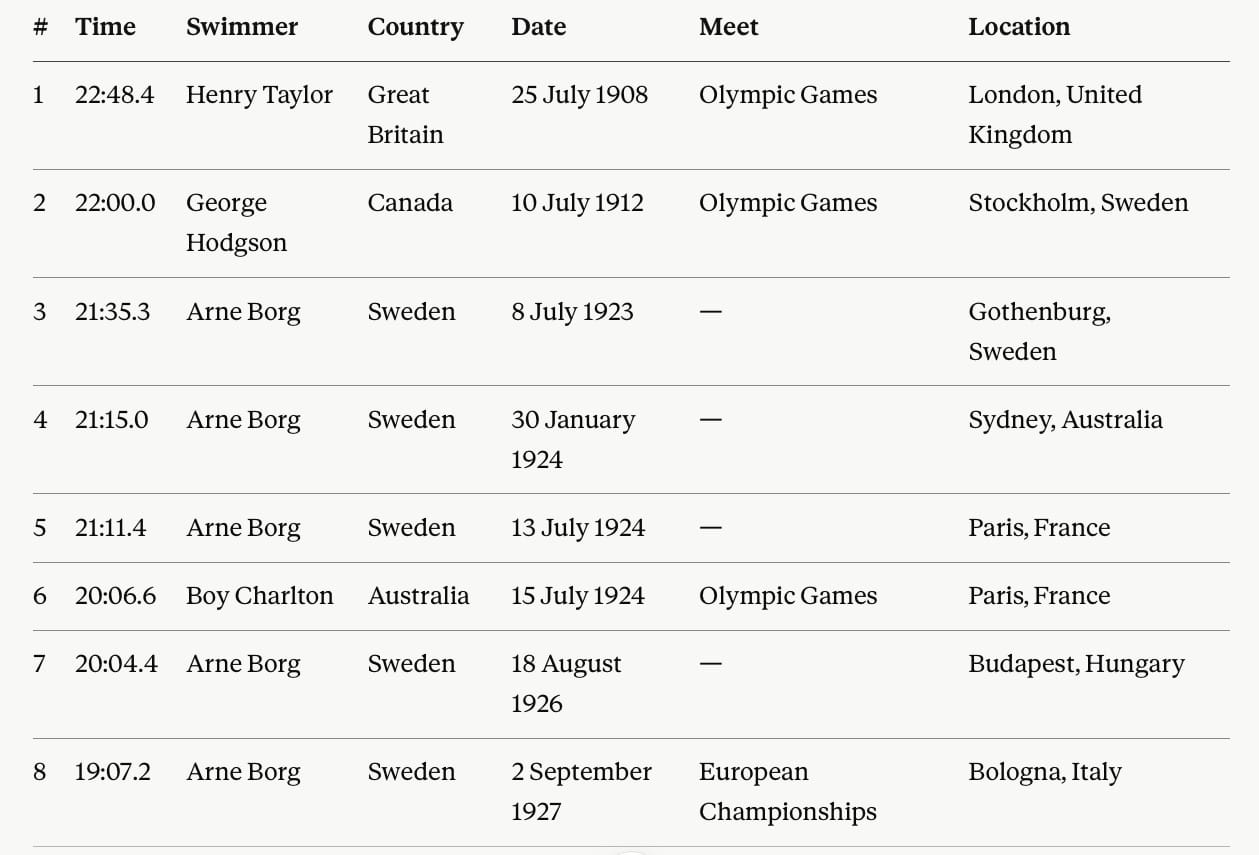
Andrew Boy Charlton won five Olympic middle- and long-distance medals and set five world records between 1923 and 1928. His gold-winning 1500m free battle with Arne Borg at Paris 1924 102 years ago today remains the biggest margin by which the World record ever fell over 30 laps: 1min 04.8


It was July 15, 1924 when Boy Charlton, "the Sydney Seal" and the first great Australian swimmer of the 1920s, took a sledgehammer to his opponent Arne Borg's World 1500m freestyle record to claim Olympic gold in 20mins 06.6sec.
The Sydney Seal Vs The Swedish Sturgeon is part of swimming lore and legend.
The old 1500 standard was left gasping for air: 21.11.4, the World record Borg set in heats, hacked back to 20:06.6, Borg, the Swedish pioneer who set five of his own World records in the event, shattering his own European record in 20:41.40, while the big name of Aussie swimming before Charlton, Frank Beaurepaire, gave Australia a second bite of the cherry, for bronze in 21.48.4
There was a second world record in the race, too: in those days, the 1000m free was an official distance, and Charlton went through in a pioneering 13min 19.6sec.
There had been bigger 1500 winning margins at five of the previous six Olympics back to 1896, when the race at sea was won by more than 2mins 40sec. But there would never be a bigger winning margin than Charlton's ever again, nor is there a bigger trouncing of a World 1500m record in the history of the sport.
Boy Charlton came from a poor part of Sydney. His talent in the swim, however, was recognised by Tom Adrian, himself a noted swimmer who took 'Boy' under his wing, fed him, and coached him to Olympic gold and fame well beyond his own shores. Some sources suggest that Adrian 'adopted' Charlton, who was from 'a poor part of Sydney', but none of that was true.
The Australian Dictionary of Biography notes:
- His parents are Oswald Murray Charlton (a bank manager) and Ada Maud Charlton (née Moore). The family is described a "Middle Class"
- He grew up with his family in Manly, New South Wales, where his early love for the surf began, and he lived with his family until he married and started his own farm
 G. P. Walsh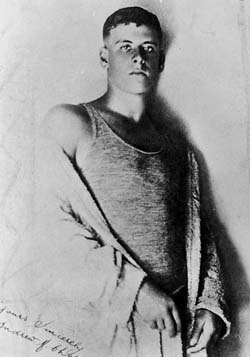
A child prodigy, Charlton was just five when he won his first race. Charlton shot to prominence at 14 in 1921 when he won the 440yd freestyle in the open division at a New South Wales Swimming Association competition in 5min 45sec. That youthful success led to him being given the nickname "Boy".
He would go on to break the first of his three world records in the 880 yards when just 15 - and by the time of the Paris Olympics of 1924 had grown to a "sturdy 12 1/2 stone" competitor who was "totally dedicated to his sport", according to Pat Besford, one of the world's leading swimming journalists of the post-War period up to her death in 1988 after nearly four decades as the swimming writer for the London Daily Telegraph.
Besford also tells the story of near disaster striking on the way from Australia by boat to Europe.
[His coach "... had a nervous breakdown and threw himself from the liner into the sea. Fortunately, Adrian was rescued ..."
The liner from Australia docked in the UK and when the Australian team left for Paris, Adrian stayed in London. Some were concerned this might all knock Charlton's chances, but the drama of it all seemed only to make him all the more determined when up against an opponent who'd made a point of travelling to Sydney in January to show the "Boy" wonder and Australia what they were up against: 21.15.0 - the second of Borg's five global 1500 standards.
It was not only Borg who shone that month Down Under, however.
The Start Of The Borg Vs Charlton Duel
In 1922, when Charlton would turn 15, Bill Harris, the bronze medallist in the 100m freestyle at the 1920 Olympics in Antwerp behind fellow Americans Duke Kahanamoku, the Father of Surf, and Pua Kela Kealoha, visited Australia from Honolulu.
Harris wanted to compete against the likes of Beaurepaire and Moss Christie, but the stiffest challenge came from 'Boy": Charlton defeated Harris at the New South Wales Championships, winning the 440 yd in 5 min 22.4 s. He then set a world record of 11m 5.4s in the 880yd event, as well as winning the one mile race in 23 min 43.2 s. Charlton used a trudgen stroke at the time, modern crawl yet in its cocoon, particularly among long-distance swimmers, the skills and style of the likes of Johnny Weissmüller considered to be best suited to what we now know as "sprinters".
In 1923, still 15, Charlton swam for the first time against Beaurepaire, who had won 35 Australian championships and broken 15 world records. The Manly Baths was filled to capacity for the 440 yd - the "Boy" doing gone again: he won it by two yards, in 5m 20.4s. Beaurepaire predicted that Charlton would break world records in 1924. Spot on!
In January, Arne Borg docked in Sydney to race the 16-year-old Charlton over 44oy at the New South Wales Championships. The Domain Baths were filled to capacity, once more, contemporary records citing crowds of up to 8,000, and queues "400m long" forming outside the venue before the duel.
Borg held the lead for the first half of the race; then Charlton drew level and took the lead at the 320yd mark before speeding away to "equal Borg's world record of 5 min 11.8". The latter is not recorded as such in official World-record history, possibly because the swim was never submitted or because at the time, evidence suggests, an equalled record did not count because the standard had to be broken, not matched.
Nonetheless, Charlton was given a lap of honour as Borg rowed him around the pool in a small boat, according to The Argus of 1924, as shown in the the great collection of newspaper and gazette archives at The National Library of Australia's Trove:

The article starts:
"SYDNEY, Sunday. — Possibly never in the history of swimming in Sydney has so much interest been taken in any match as that between "Boy" Charlton, the youthful Manly swimmer, and Arne Borg the Swedish champion of Europe and holder of several world records. These two youthful champions met on Saturday for the first time."
The rivals raced again over again in the 880yd and 220yd events, with Charlton winning the former in a world record time of 10 min 51.8 s and the latter in an Australian record of 2 min 23.8 s. It was at the same event that Borg set the 1500m World record (1650y), without Charlton in the race.
That was January 30, and Charlton was not there. The two had met - and at the same competition, Charlton beat the visitor in the 440y, broke the World record in the 880y and set an Australian 220y standard in the bargain. Charlton did not swim the 1650 when Borg set the "1500 world mark - and there was evidence that the Australian was under instruction.to keep his powder dry. Medical guidance was reported to have recommended the 16-year-old pace himself on the rise to the top. Here's The Daily Telegraph of Sydney's report, via and courtesy, one more, of The National Library of Australia's excellent newspaper and gazette resource, Trove:
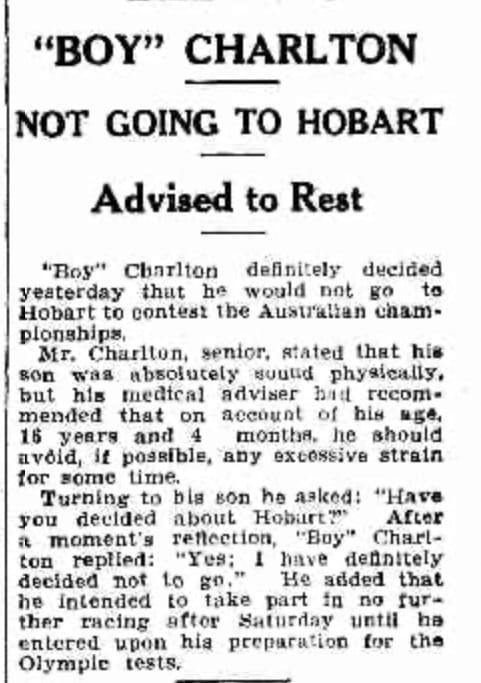
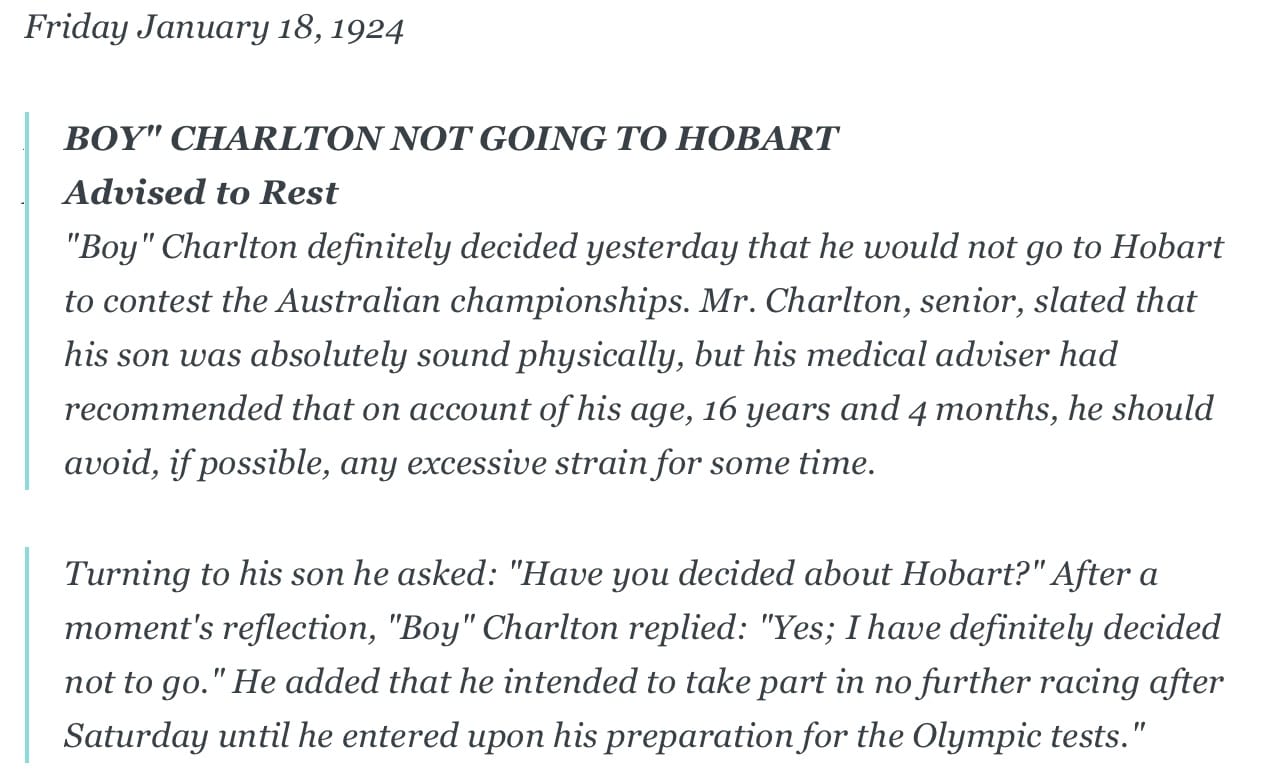
Australia's Daily Telegraph Archive 1924
It was not until heats inParis that Boy hinted at the massive progress he'd made when he clocked 21.20.8 at the helm of his line-up. Game on. In the next heat, Borg's 21.11.4 marked his third career World record in the event. Game on.
It was Charlton's hour and he changed the game in 1500m swimming at a time when freestyle, particularly in the longer-distance events, was still evolving in significant ways.
A hint of how Charlton swam can be found in this description from Besford:
"Except when sprinting, Charlton's style had all the external appearance of a classic Trudgen of a decade earlier while incorporating the fundamentals of the crawl of the future."
Borg would take back the standard in 1926, 100 years ago this August, by 2.2sec, but a year later, he would not only take the pace of 1500 below 20mins, but do so by a margin almost as vast as Charlton's leap past him in Paris for the ultimate prize: 19:07.2 for European gold in what went down in history as "The Miracle of Bologna":
 Craig Lord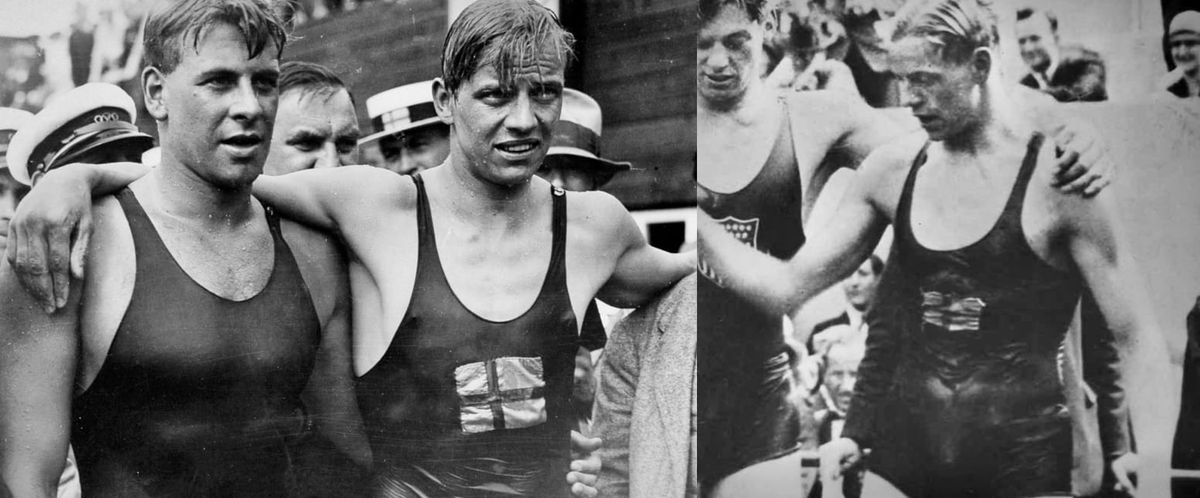
The shoulders all 1500 pioneers stand on:
The Charlton Vs Borg duel would end in Amsterdam at the 1928 Olympic Games, where gold went to The Swedish Sturgeon, also known as "Big Bad Man"in the first Olympic sub-20, a 19:51.8, the Australian taking silver in 20:02.6.
 Craig Lord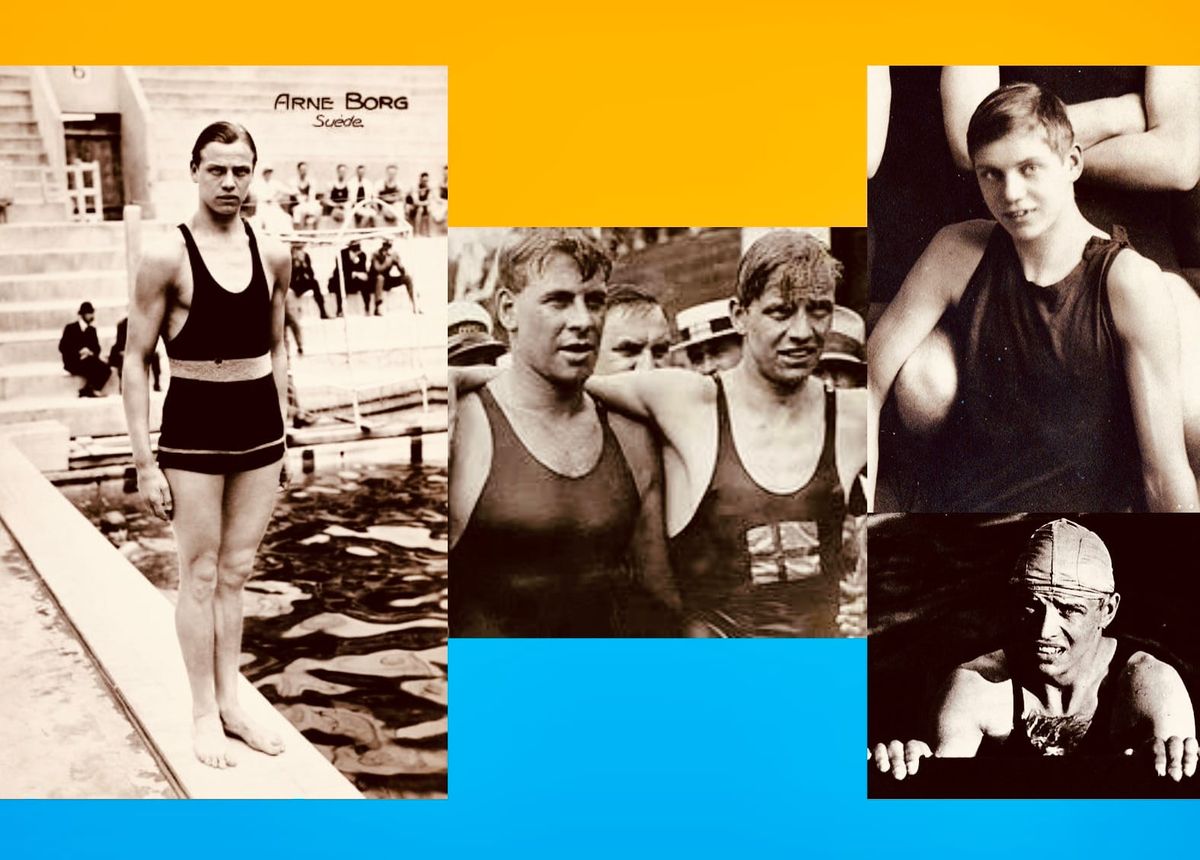
Their duel was a part of this 400-1500 battle for supremacy among pioneersHis sparring partners over 400m, 800 and 1500m were Australia's Andrew "Boy" Charlton, known as the , and American Johnny Weissmuller on his way to becoming the first "Tarzan" of the silver screen.
In Olympic waters, it went like this:
Paris 1924:
400 m freestyle
Johnny Weissmuller USA - Arne Borg SWE - Boy Charlton AUS
1500m freestyle
Boy Charlton AUS - Arne Borg SWE - Frank Beaurepaire AUS
Amsterdam 1928:
400 m freestyle
Alberto Zorrilla ARG - Boy Charlton AUS - Arne Borg SWE
1500 m freestyle
Arne Borg SWE - Boy Charlton AUS - Buster Crabbe USA
And here is how it went the World record books in events and distances still official to his day:
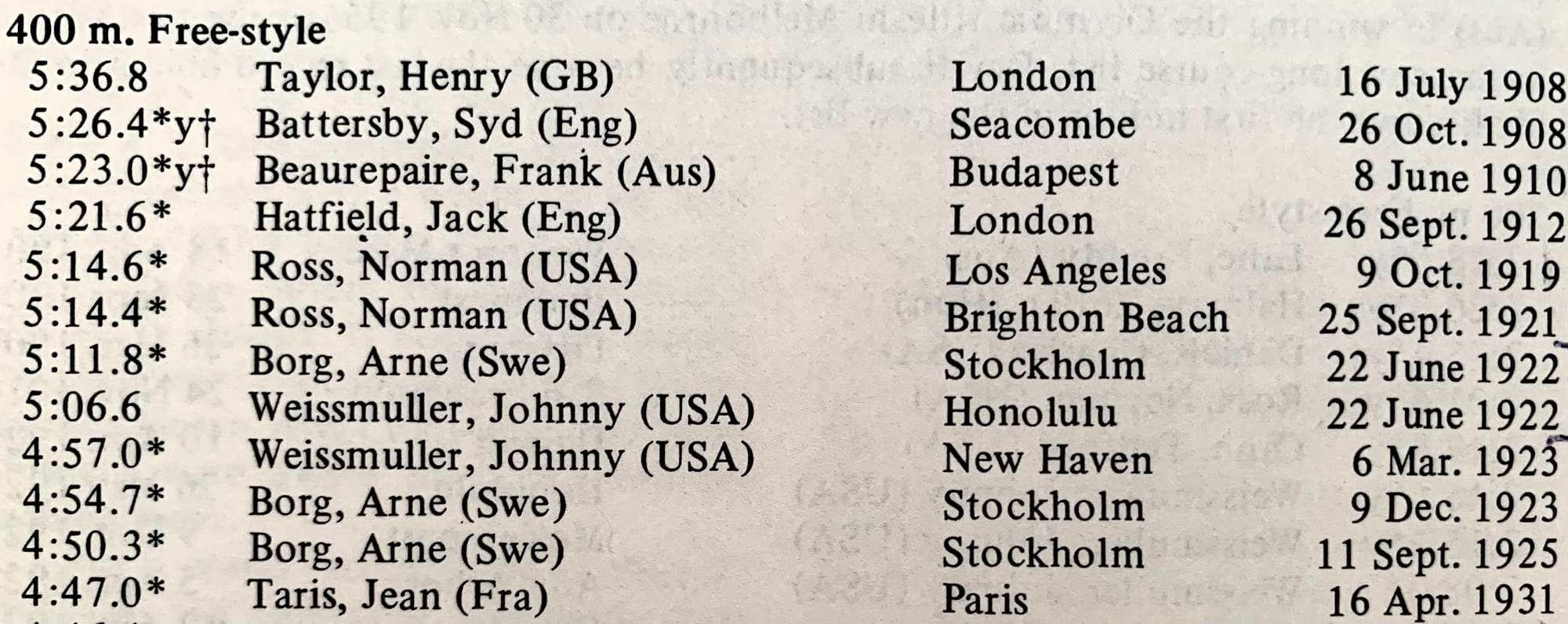
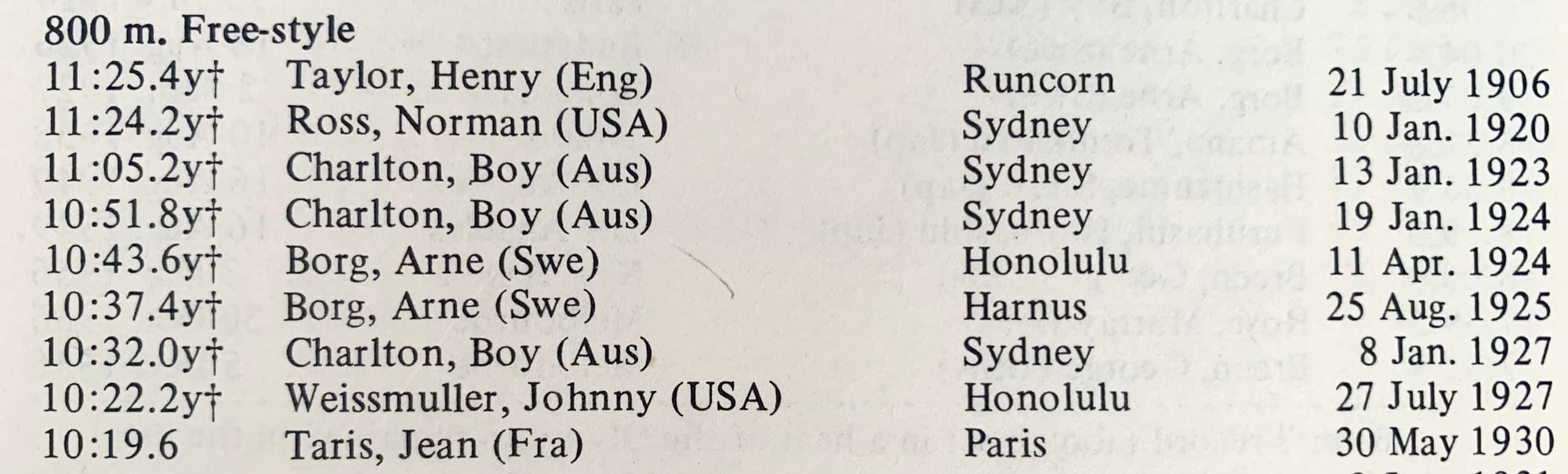
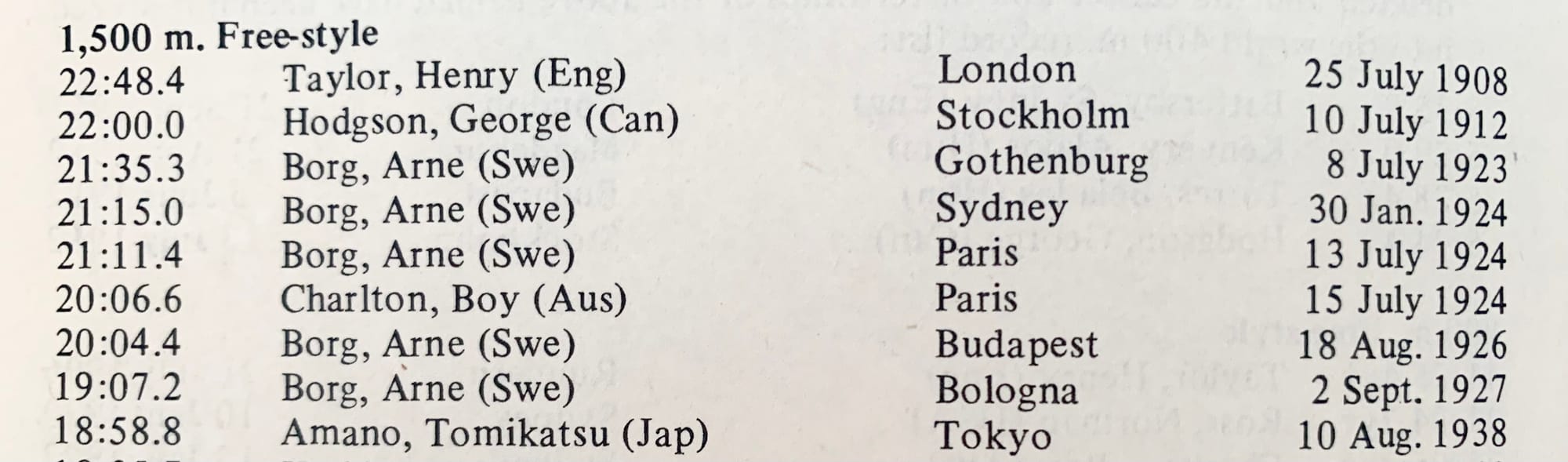
Extracts from the Encyclopaedia of Swimming by Pat Besford
Oddly, Charlton never won an Australian senior title. Meanwhile, physiologists who attended the Paris Olympics as part of their research tested Charlton's lung capacity: the 16 year old produced the highest reading they had ever seen.
The Australian Dictionary of Biography has this to say on his style:
"Charlton's stroke was a four-beat, trudgen crawl, called by some at the time the single trudgen crawl. There was very little leg movement: the wide scissor kick was made horizontally at the end of the left arm drive with the body turned well sideways, then followed two or three vertical kicks. His powerful arms and withering final sprint made him a champion, despite the fact that he rarely trained, preferring to surf instead."
This British Pathé film features Boy Charlton:
A fuller profile of Boy Charlton follows for The Sydney Seal's slipstream into our SOS Hall of Fame:


