
Forum: A Measure Of Medals In A Fund That Favours The Fed
As athletes call for Olympic fair pay for fair play to keep the Enhanced wolf from the door, World Aquatics launches a post-career compensation fund that feels a lot like a World-Cup attendance incentive scheme in a retirement wrapper for the few not the many needed to build a growth economy

It's been a good week to sit back from the fray; dealing with the rest of life, not idle on the waterfront, but simply watching, waiting to see where the tide turns in a demand from athletes for a fair share of revenue in the multi-billion-dollar Olympic industry they fuel.
What's the word from Olympic guardians and regulators? Well, nothing of a direct nature, an attempt to explain how fair play for fair play can be achieved without athletes expecting direct compensation for their moment(s) at the Games.
A reminder - the dam at bursting point, the cat out of the bag, among the pigeons and sharpening its claws ahead of an inevitable scrap:
 Craig Lord
 Craig Lord
Follow the links in those files for the whole series, and related editorials such as this one:
 Craig Lord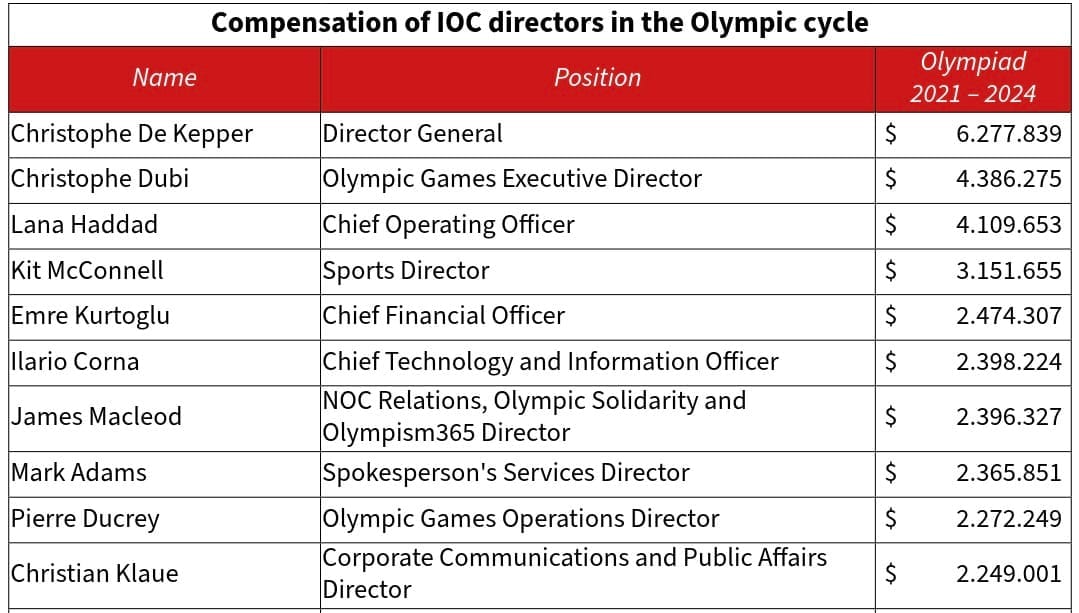
The pushback from IOC boss Kirsty Coventry's groupthink mantra, that she doesn't believe athletes should be paid on the occasion of their greatest challenge and career game-changer, was for her to double down on that status-quo view. The work may be professional, and soaring is the contribution to a movement run by a private-members club that votes itself into and keeps itself in power without any direct reference to stakeholders.
Pay? Forget it! After all, why would the IOC have to pay athletes from the money "we raise" when the international federations that "we" compensate "and other organisations and events" offer appearance and prize money, world-record bonuses ... and so on.
No, no. The Games are sacrosanct - and must remain free of that grubby stuff we make so much of. Money! At least for athletes. And especially for the elite winners and podium placers who hail from countries that are in no need of 'solidarity', the kind of places wealthy enough for the Bank of Mum and Dad, public funds and lottery money to subsidise Olympic sport to a greater hidden degree than seems palatable at a time of global economic challenge in 2026.
Since Coventry's double-down there's been relative calm, but Friday gave us a hint of what drives the smooth majesty of a swan in a rush: webbed feet moving like a runaway train just below the surface.
Olympic sports governance is well versed in the art of sailing through a storm as if you're the steadiest ship on the ocean. As the open water swimmer might tell you, drafting off the efforts of others can be most rewarding - and so, it came as no surprise to see what looked like a message in a bottle sent 'on behalf of a friend'.
It came from Coventry's own sport, World Aquatics and a realm that worked so hard to get their swim queen on the Olympic throne when up against candidates who had already said they did believe in paying athletes, and had actually already done so: Seb Coe led World Athletics across that particular Rubicon at Paris 2024.
It all seemed too easy to defeat the British peer and former track and field Olympic champion in a world where amateur values and 'solidarity' models in a highly lucrative business provided the comfort of an old and familiar blanket so beloved of those who never need to rely on the votes of constituents to stay in their seats of power.
How to persuade the athlete, the sport, the wider Olympic Movement, that Coe had it all wrong in 2024 and 2025, and that Coventry had their back because she better understood the spirit of the French baron Pierre de Coubertin, who presided at a time when everyone, mostly women, but any athletes and all aspiring blazers, too, knew their place because it was handed to them like the gift of Hobson when making his choice.
Media inboxes received the World Aquatics press release of its year-old compensation fund last Friday. The vast majority of media ignored it altogether, the media archive shows with a following wind, while niche players in the U.S. pumped it out without addressing the burning question athletes are asking: how will this help us and does it take into account the nature of us and our sport?
They ask such questions because they're happy to have anything that speaks to fair play for fair pay but are unhappy about seeing alternatives such as the Enhanced Games making banned substances a more attractive proposition than Olympic sport when it comes to asking themselves, after 10-15-20 or more years of dedicated pursuit of sporting excellence, how they're going to pay their mortgage, childcare and further education costs, cars, soaring food bills, and all the rest of what the rest of life brings when you're part of and doing your bit to support a family ... if you're lucky.
Here's the solution as set out by World Aquatics, which for fiscal 2024 reported a record surplus of US$51.17 million on the strength of $107.83 million in total revenues, with total assets at $241.51 million:
What World Aquatics Offers its Athletes: A Unique Post-Career Compensation Fund and Record-Breaking Prize Money
Supporting athletes financially, both during and after their careers, is a key priority for World Aquatics. In recent years, the International Federation has offered some of the largest prize pots in international sport, proudly awarding USD $10.70 million to performances at the highest level in 2025, including a record $6.1 million at the World Aquatics Championships – Singapore 2025.
That support is set to continue in abundance. But World Aquatics recognises that increasing prize money is simply not enough.
“We know that athletes face real challenges once their careers come to an end – it’s a major change in their lives and often in their income too,” explained World Aquatics President Husain Al Musallam at the launch of the Post-Career Compensation Fund at the World Aquatics General Congress in Singapore last year. “We have spoken with many athletes who have helped us better understand that their real financial difficulties begin once they retire. Our aim is to ease that transition wherever we can, and financial support is one of the most important routes through which we can help”, said President Al Musallam.
The Post-Career Compensation Fund
In a landmark move, World Aquatics launched the Post-Career Compensation Fund, beginning with an initial investment of USD $10 million. The fund is the first of its kind from an International Federation and provides a lump sum payment to athletes upon retirement, based on sustained participation in World Aquatics events throughout their career and contributions tied to prize earnings.
Each sport will have different qualification criteria, with athletes considered eligible once they have competed in 80% of events organised by World Aquatics over a four-year period. The more athletes participate in World Aquatics events, the more contribution World Aquatics will make to those athletes to assist with their post-career transition.
Further details can be found here.
More information about the World Aquatics Post-Career Compensation Fund and other support available to athletes will be provided at all World Aquatics Events and through the World Aquatics Athletes’ Committee.
Prize money in 2026
Prize money is structured to reflect the nature of the competition format in each sport, with the clear principle that athletes stand to earn meaningful sums throughout the season at World Aquatics World Cup events and World Aquatics Championships.
At the 2026 Swimming World Cup there is a prize pool of USD $1.2 million on offer across the Silk Road Tour, with an additional $10,000 bonus for World Record-setters and Crown winners.
Last season alone, athletes broke 12 World Records, equalled one and claimed 23 Crowns, resulting in a total payout of USD $1.57 million.
Across the other five aquatic sports, significant prize funds are also available throughout the 2026 season. Water Polo's total prize fund of USD $695,000 is a record for the competition, while Diving's Super Final in Xi'an saw a total pool of $956,000. Open Water Swimming, Artistic Swimming and High Diving all offer structured prize money at every stop of their respective World Cup circuits.
Full prize money details for each sport can be found below:
- Swimming World Cup 2026 Prize Money
- Open Water Swimming World Cup 2026 Prize Money
- Similar pages exist for the other aquatics disciplines - see the World Aquatics website]
World Aquatics, of course, is free to offer whatever financial/compensation models it wishes to offer to athletes.
However, it is fair to note that they appear, basically, to have pegged their foundation fund to their World Cup event / World Aquatics competition in a way that simply fails to appreciate the choices athletes and coaches make in response to their reality. To get to that 80% line, the swimmer with LA2028 in mind, would likely have to include the World Cup in their preparation and travel plans. To what end, for the sake of how much in their future fund? What are the risks to the goal? The questions run deep.
The swimmer's best shot at a decent return and lasting status in sport is the ultimate one - the Olympic Games. It's what they dream of, what they work towards, painstakingly for years. All preparation is geared accordingly. FINA/World Aquatics governors have known this for a very long time and yet have done little to structure season and pitch mid-cycle events that enable deeper participation in major global competition.
Swimming seasons are planned and timed and paired with college commitments, academic and sporting, age of athlete, and much else. The subsidy or lack of subsidy available to them to get to events such as the World Cup has also played a huge part in decision-making by athlete/coach/parent/program.
Where a tennis player can make the first and second round of most majors and make a decent living that easily covers their travel costs, nothing remotely like that is available in swimming. As we noted in the piece below, first-round losers in the main draw of the US Open and Australian Open are looking at payouts of well over $100,000:
 Craig Lord
The World Aquatics compensation model is, one might easily conclude, built to control the athlete, not create an economy where many athletes can participate and excel in that market as professional athletes. It is also built to reward the most rewarded and will do nothing to create a deep economy of compensated athletes, let alone compensated teams.
So, let's turn to official World Aquatics own records and data on its website, the history of its events and the terms and conditions it sets out for its post-career compensation project.
To illustrate the nature of the new fund and what it asks of athletes, who it will benefit and who it will not benefit, I turned to seven well-known swimmers to make the case for many more. The exercise takes the careers of those seven elite swimmers and asks how much the new scheme will be worth to them.
Two of the swimmers are now retired, five still in the race. They are part of this exercise because they highlight that the fund is not retroactive, and will not benefit any of the stars of swimming recently retired and more likely to be in the age-group and stage in life when turning to 'enhanced' solutions may be the only vehicle for capitalising on their athletic success left open to them. There is no retrospective element in it for the five swimmers still in the race either, but we offer a prospective compensation for each in the coming few years up to the kick-in date for the fund of 2030, based on their choices and record in swimming to date.
Let's get something out the way first - and pray tell me how and where you feel any of the following bullets is either inaccurate or misleading:
The implicit admission
World Aquatics reduced the World Cup to 3 stops precisely because the longer circuit was acknowledged to be unworkable for most athletes. Good for World Aquatics. Showing understanding and then.taking action on it has been a rare skill in global governance of swimming. However, that institutional admission that the participation demands of the old circuit were unreasonable leaves us with this reality:
- Not being retrospective, the scheme supposed to compensate athletes for careers spent serving World Aquatics measures eligibility only from 2025 onwards using the new reduced structure. Every swimmer who built their career during the era of 6, 8, or 10 stop circuits — the very era when participation was most financially punishing — is excluded entirely.
- Hosszú built her 461 World Cup medals across the era of the extended circuit.
- The prize pool collapse: the drop from $2.5 million (2019) to $672,000 (2024-2026) is a 73% reduction in total prize money — at precisely the moment the fund launches and starts measuring "qualified earnings." So the fund is pegged to an era of dramatically reduced prize money. Even a swimmer who qualifies under the new 3-stop format earns a fraction of what the circuit paid in its peak years, meaning their 10% fund contribution is a fraction of what it would have been in 2017-2019. The current prize money figure is $1.2m if you stretch to world record bonus money, and that's a fair point to make, of course, but so are the other direct comparatives.
- The per-event structure matters enormously: at $12,000 for first place per event in 2024-2026, a swimmer winning every individual event at all 3 stops — an exceptional performance — earns perhaps $36,000 plus a shot at the $100,000 series winner bonus. The 10% fund contribution on that is $3,600-$13,600. Over four years that's a maximum fund accumulation of roughly $14,000-$54,000 for the very best performers. For anyone finishing second or third, it's far less.
- the total prize pot at theWorld Cup has effectively fallen in real value over the past 20 years. While nominal prize pools remain roughly comparable, swimmers today are required to race far fewer rounds and meets to access it, shifting the earning dynamic entirely.
- With only 3 stops per year, the total World Cup prize pool is smaller, the earnings per athlete are lower, and therefore the 10% fund contribution on qualified earnings is proportionally reduced from what would have been the sum at a time of many more rounds.
Of course, World Aquatics is responding to a need to reduce the number of events - but pegging compensation so heavily to the World Cup may have the opposite effect of what's intended: swimmers who feel that compensation may be too low to make any impact on their future lives will be in the same position of having to calculate that their best bet is to stick to the one big, Olympic, goal - and not get distracted from it.
There are many ways and angles and lenses through which we might consider the issues and possible outcomes, but this is where we've got to so far and it's a strong enough starting point with which to launch further discussion and debate.
Along the way, I asked a couple of trusted financial sources for guidance. I also ran career data and the changes we've witnessed during our small study period to the World Cup formats and size and type of money prizes offered through an excellent Anthropic AI service to test the figures and the conclusions we might draw from the data and facts.
The Test - Seven Swimmers:
The three who secured a successful settlement after pursuing a class-action against FINA for compensation in the row between the global regulator and the International Swimming League (ISL).

Katinka Hosszu, of Hungary, and Americans Tom Shields and Michael Andrew are excellent examples in an exercise that asks whether we should see the World Aquatics post-career compensation fund as a mechanism for growth of the sport of swimming or regard it more as a World-Cup attendance incentive scheme in a retirement wrapper made to favour the Fed (federation and those already well fed as a result of careers that stand out as exceptional among the deeper ranks of the extraordinary at the world-class end of the pool. A reminder of the ISL-related action:
 Craig Lord
To add to our overview on the new compensation fund, I chose, for specific reasons, Sarah Sjöström, of Sweden, Caeleb Dressel, of the United States, Adam Peaty, of Great Britain, and Cameron McEvoy, of Australia.
More detail below..,starting with a table of comparison that tells its own tale of the reasons why all models of financing swimmers need to come hand in hand with an explanation and clarification of who benefits, why and what it means for the athletes and the decision-makers they work with in pursuit of the Olympic glory that, as things stand, is more likely to secure them a living wage and a decent pension than any other moment in their athletic careers:


