FORUM: Beautiful Game(s) , Beastly Governance. Time For Change
We extend our latest mini-series, one stretching along a spectrum from what swimming might do to achieve real growth to the Fair Pay for Fair Play debate, with a concluding Part 7, using the Beautiful Game as a guide to ugly structures and patterns long past their sell-by date
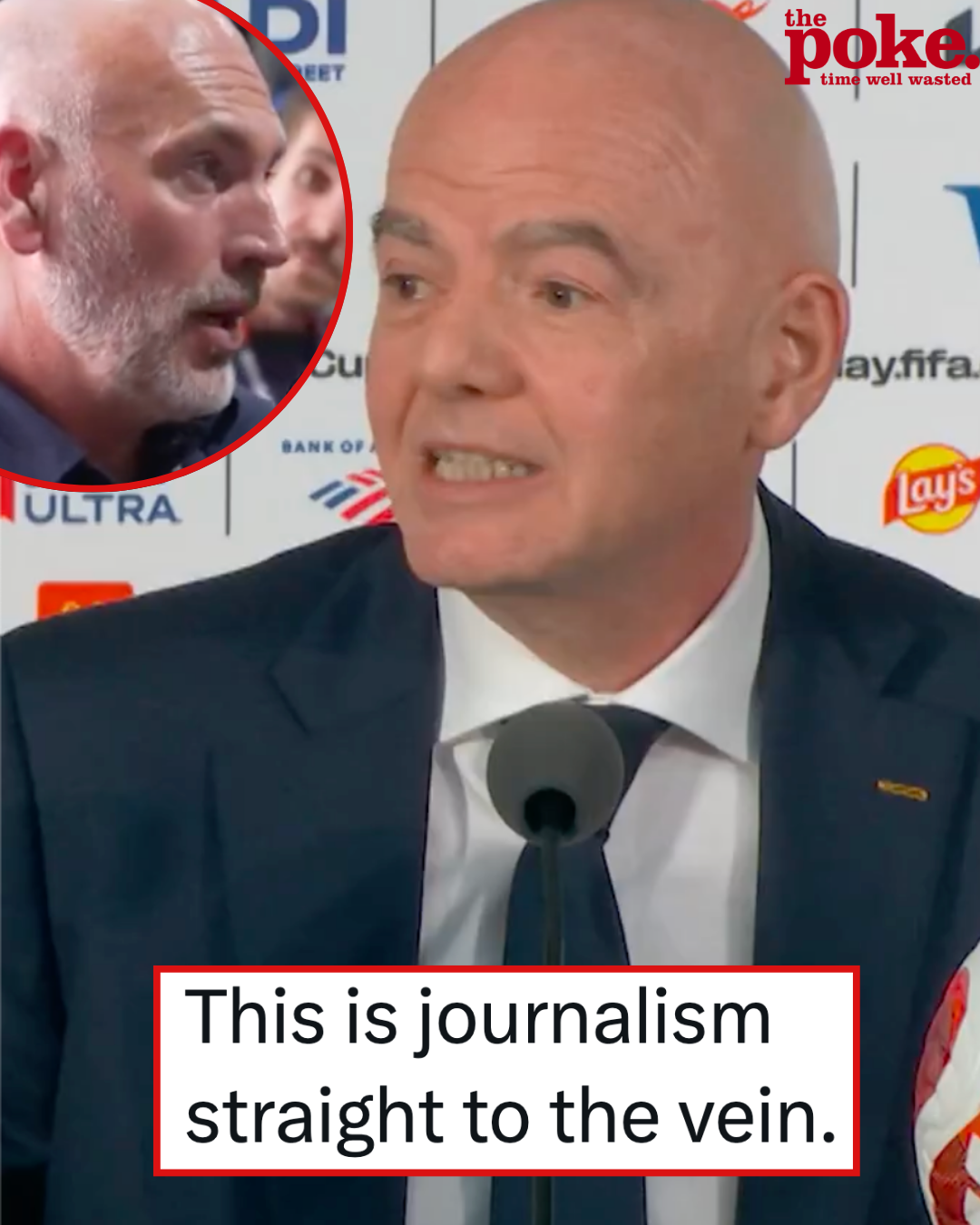
Sunday Essay: When BBC journalist Dan Roan asked FIFA's follically challenged bigwig Gianni Infantino whether he thought he'd lost control of 'his' event, AKA the World Cup, he wasn't being as brave as some social-media pundits and players seem to suggest the morning.
Don't get me wrong. Good for Dan for asking, what with referees, whole teams, scores of media refused entry or struggling to get into the United States to do their jobs in sport at the tip of a challenging ICE-berg era.
So, good for Dan for asking and doing his basic job. It's more than too many sitting alongside him in the media seats at major sporting events would do (or do do). Still, no act of courage was required. After all, we'd known the answer since sycophancy seized the day in Washington D.C on December 6 last year, when the football president gave the American holder of the same status in the United States, Donald Trump, the first FIFA Peace Prize, ensuring more headlines for that that the reason for the occasion: the draw for this year's World Cup.
Pass the sick bag - but don't forget to consider why Infantino would even dream of grovelling in public.
Among many clues as to what the man on the Clapham Omnibus may think are the number of brown noses and brown envelopes mentioned aplenty in the comments section of the following and many more posts and site like it - follow the social links if you must but you can also take my word for it if you choose :) ...

None of it will have escaped Kirsty Coventry's notice, one would hope, as we look to the horizon of LA2028. Olympic solidarity? We'll see how that pans out in the political playbook soon enough.
Meanwhile, here's Kirsty answering a question from the Guardian's Sean Ingle, and doubling down on her view that 'at the Games', she does not believe that athletes should be paid, her view that it's for others to pay at their events, but not for the IOC to pay at its own showcase:
The @guardian’s @seaningle to @iocmedia President Kirsty Coventry about athlete compensation:
— Rob Koehler (@RobKoehler2) June 10, 2026
"I don't believe in prize money at the @Olympics."
Yet Kirsty supports prize money at continental games, international federation events, and World Cups — just not for Olympic athletes. pic.twitter.com/tyzxQK22rC
She mentions World Cups... of course, she doesn't - and cannot - mean THE World Cup now underway in the USA, Canada and Mexico. For example:
FIFA pays $0 directly to individual football players. Instead, FIFA pays prize money to the competing national federations and compensates the players' club teams via the Club Benefits Programme. Players receive their income for playing in the World Cup from two indirect sources:
- National Federation Bonuses: Each country's football association negotiates its own player contracts. They usually offer a set match fee/appearance fee and performance bonuses (e.g., a massive bonus for winning the tournament) using the prize money they receive from FIFA.
- Club Compensation: Through the FIFA Club Benefits Programme, FIFA pays clubs roughly $11,000 per player, per day for releasing them to the tournament, ensuring the players' normal club salaries continue.
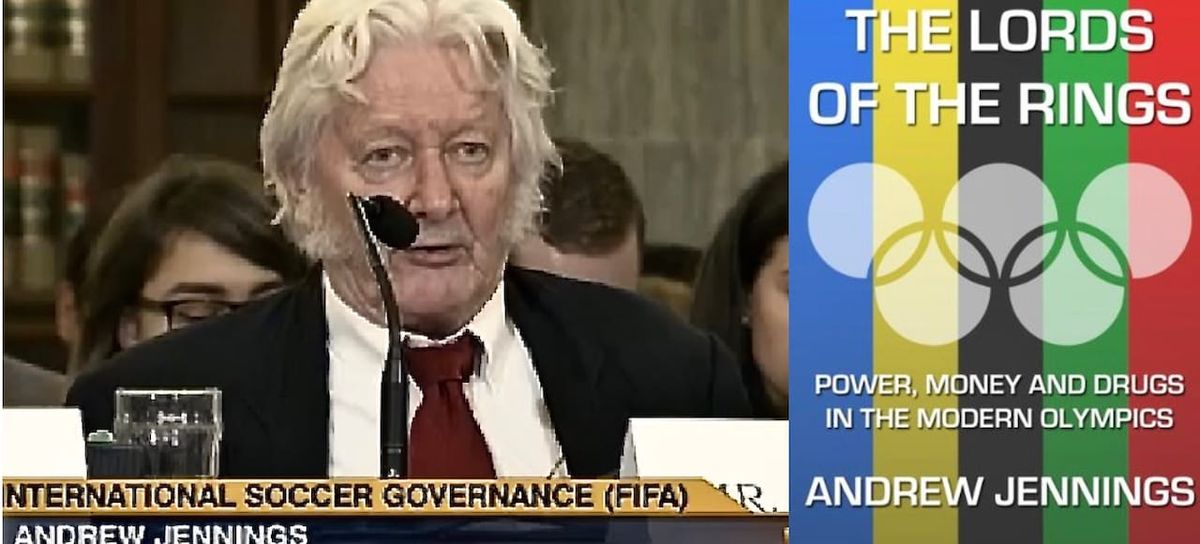
Individual player earnings vary wildly, of course, but that's other-orgs money, not FIFA's. And in making sure the players get paid but doing so in a way that bypasses direct payment to players and compensates, in vast amounts, the federations whose delegates FIFA's leadership relies on for the votes that keep the FIFA leadership in power, in agreement and the status quo alive and kicking (- pun intended, though as Andrew Jennings once noted successfully - because people actually went to jail - alive and 'kickbacking':


We're a little over a decade on, Sepp Blatter gone, Gianni Infantino the head honcho at the helm of a global federation that is part of an economy that includes this:
Typically federations retain about 50% to 80% of the prize funds. A more detailed breakdown clarifies how the money is split:
1. Federation vs. Player Distribution
- The Player Share: Players do not have a set FIFA salary. They are paid by their respective national federations through negotiated bonuses, appearance fees, and percentages of the prize money.
- The Average Split: The typical player pool ranges from 20% to 50% of the team’s total World Cup prize money.
- Notable Outliers: Some federations share much higher percentages. For example, U.S. Soccer pools and shares 80% of their FIFA prize money directly with the Men’s and Women’s National Team players, retaining 20% for the federation.
- Remaining Federation Share: Therefore, national federations typically keep 50% to 80% of the FIFA money. They use this retained revenue to fund operational costs, youth academies, coaching staff salaries, and broader football development in their country.
2. What Happens to Club Compensation?
- Club Benefits Programme: Aside from the prize money pool, FIFA allocates a massive, separate fund (e.g., $355 million for the expanded 48-team format) for the FIFA Club Benefits Programme.
- Who Gets Paid: This money is paid directly to the clubs (including lower-league teams) for releasing players to the World Cup and qualifying matches, not the players or national federations.
3. Guaranteed Payouts
- Federations are guaranteed millions in participation and preparation grants before they even advance in the bracket, with performance-based bonuses scaling up as the team advances in the tournament.
Typically federations retain about 50% to 80% of the prize funds.
A more detailed breakdown clarifies how the money is split:
- Federation vs. Player Distribution
The Player Share: Players do not have a set FIFA salary. They are paid by their respective national federations through negotiated bonuses, appearance fees, and percentages of the prize money.
The Average Split: The typical player pool ranges from 20% to 50% of the team’s total World Cup prize money.
Notable Outliers: Some federations share much higher percentages. For example, U.S. Soccer pools and shares 80% of their FIFA prize money directly with the Men’s and Women’s National Team players, retaining 20% for the federation.
Remaining Federation Share: Therefore, national federations typically keep 50% to 80% of the FIFA money. They use this retained revenue to fund operational costs, youth academies, coaching staff salaries, and broader football development in their country. - What Happens to Club Compensation?
Club Benefits Programme: Aside from the prize money pool, FIFA allocates a massive, separate fund (e.g., $355 million for the expanded 48-team format) for the FIFA Club Benefits Programme.
Who Gets Paid: This money is paid directly to the clubs (including lower-league teams) for releasing players to the World Cup and qualifying matches, not the players or national federations. - Guaranteed Payouts
Federations are guaranteed millions in participation and preparation grants before they even advance in the bracket, with performance-based bonuses scaling up as the team advances in the tournament.
All of which translates to a different variety of outcome at each federation/in each nation (just as in Olympic sport, there are continental considerations and choices op take into account but we're not getting into that for the opposes of this particular clarification)
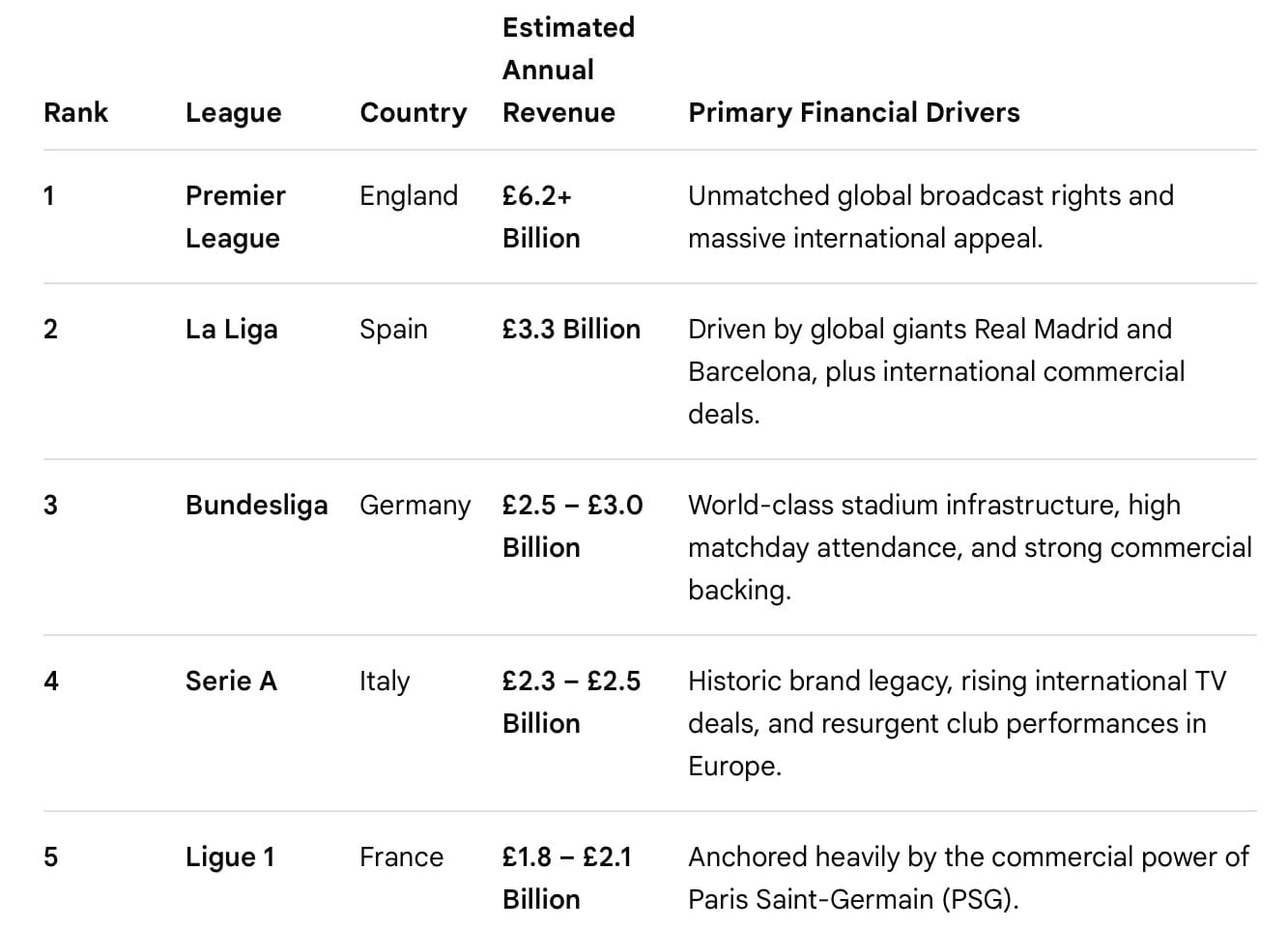
The two examples of FIFA/national federation interface below sit within a complex world of vast economic difference that reflects, among other things, the gap in the wealth of national leagues and the choices made as a result of the nature of and relationship between national and club economies in a global football economy that generates an estimated economic output of $40 billion to $80 billion annually during major tournament years as a dominant driver of an overarching global sports industry estimated as a US$2.3 trillion market. A huge part of that market is the world this top 5 of national leagues inhabits:
Here are two national federations as examples of how their economies are arranged in relation to the economy of FIFA and the World Cup :
- England (The Football Association - FA)
England has a highly lucrative home market via the English Premier League, meaning the players are already multi-millionaires who do not rely on international tournament earnings.
The Setup: England players traditionally receive a modest standard appearance fee of around £2,000 per match. However, since 2007, England players have famously donated 100% of their match fees to charity via the England Footballers Foundation.
The Tournament Bonus: The FA negotiates a "performance-only" bonus pot tied strictly to how far the team advances. For example, players only earn a significant payout (upwards of £400,000 to £500,000 each) if they actually reach the final or win the tournament. If they exit early, the players make next to nothing.
What the Federation Keeps: Because players do not take a flat percentage of the overall qualification or early group stage money, the English FA retains an estimated 80% to 90% of early FIFA payouts. They use this massive surplus to fund the national football pyramid, lower-league development, and grassroots coaching infrastructure.
- Nigeria (Nigeria Football Federation - NFF)
Nigeria represents a classic "exporter nation." The domestic Nigerian Professional Football League (NPFL) does not have lucrative TV rights, so nearly all top national team players move abroad to play in the English Premier League, Serie A, or Ligue 1. However, because the national federation is less financially stable than England’s, player payments are structured very differently.
The Setup: African nations like Nigeria, Senegal, and South Africa typically negotiate a Revenue Share System. Because players understand the financial volatility of their home federations, they demand locked-in percentages of whatever prize money the team brings in, regardless of whether they win the trophy.
The Tournament Bonus: Negotiations are often highly contentious. During international tournaments, players usually demand a 30% to 50% flat share of the total prize money. For instance, during recent Africa Cup of Nations and World Cup cycles, the Super Eagles players and the NFF famously haggled over whether the players' pool would be 25% or 30% of the federation's multimillion-dollar prize payout.
What the Federation Keeps: The NFF typically retains around 50% to 70% of the FIFA money. While this is a lower percentage than what England's FA keeps, this retained FIFA cash is vital. For an exporter nation, these FIFA payouts represent the primary source of funding to keep the federation afloat, including covering vast travel costs across the African continent, and payments to international coaches, among others.
So, there it is, even in the 'beautiful' game: an Olympic-style model - the money, no matter how big or small the sums are, is driven from one part of the machinery to another without going directly to the folk providing the fuel.
A good moment to remind ourselves of what underpins a certain form of dependency at national-federation level, the very place where the votes that decide the structures of who governs what and who gets what are cast.
Many sports are built on a similar model in which the way the international federation organises its money and power comes first as 'the thong that must be protected' (you can add the silent 'at all costs' as and where you wish).
The athlete asking for a better and fairer share but getting a 'we don't believe in paying athletes', most particularly in Olympic sports where the economy, its draw/popularity and marketplace pale (often massively) by comparison to those and every related statistic in football, represents the reality of a strict red line that Olympic leaders have drawn when it comes to the meaning of 'athletes first':
The economy "WE" (not "YOU") build is untouchable, along with anything else that might alter or affect its related power structure, where the votes come from and who gets to share the pot in a way that protects the status quo that always comes first.
THEY believe THEY generate the money. And THEY get away with it safe in their certainty that the next wave and generation of athletes will be along straight after the next and the next and there will always be gladiators to place in the arena who are grateful of the chance they're being given to be victor or vanquished.
Those who object will simply be given a thumbs down, fall by the wayside - and the show will go on. Besides, athletes don't really care nearly enough to seriously press the point; there are rules and in-house controlling structures to keep athletes in their place - and all that using other athletes to protect the establishment. If push comes to shove, the solidarity card will be played as an explanation of why the gladiatores, plebs, populus, 'spectatores' and turba (a tumultuous crowd, mob, or throng) in the arena can all be grateful for the generosity of the IOC.
Roman emperors thought so. It didn't last. All things that rise will one day fall, and what Kyle Chalmers this week agreed was a tipping point for the Olympic Movement might yet turn out to be Waterloo for Baron de Coubertin's private members club.
As said, organisations rely on athletes caring only about the money, so, object as Coventry and others do to any changes to business-as-usual at Olympic HQ in Lausanne, they may well have to - or even, eventually, be happy, to come to some kind of deal on recompense for athletes.
Until athletes make their move decisive, until the IOC responds with actual action, don' hold your breath, and always remind yourself of the library loads of lessons that include those that tell us of the experience of folk in football who raise red flags.
At which point, I turn to Fair Play Publishing in Australia owned by Bonita Mersiades, and a note from her in a post on some of the books some would rather you didn't read:

The relevance of all that to the current Fair Play for Fair Pay debate in Olympic sport is manyfold. Above is a snapshot of a FIFA structure that underpins some of the key reasons that make the challenge of genuine reform within the Olympic-style model of governance such a steep one.
We've covered a lot of ground in the past couple of months on the theme, but now draw this particular series to a close, at least as part of our latest FORUM, with a part 7 and two snapshots of what we see from and for athletes in 2026 before we repeat a call for athletes and coaches he's to raise their voices with the message we began Part 1 with: Time for Change.
The first of the two snapshots is a reflection from of one of the world's premier sprinters in the past 12 or more years in which Australian Bronte Campbell waves a fond farewell this past week; the second a case of amateur night in New Zealand, where two women selected for the 4x200m free at the Commonwealth Games on a high A cut standard at domestic champs and trials will, apparently, not be allowed to race in the 1500m once they've travelled halfway across the world to Glasgow even though they are ranked in the top 8 in the Commonwealth.
The belligerence of blazers embedded in their neural pattern since the dawn of the modern Olympics, is alive and kicking and refusing to hand over the baton to professional management.
- Bronte's farewell. Yes, the Olympics gets as solid a mention as you'd expect: a dream fulfilled, no less. But consider the long list of those she thanks, who truly meant something to the former double freestyle sprint world champion, and then consider the investment of heart, mind, professional expertise and the love of family and friends that combine to make the Olympic athlete's life worth having. Absent from that is any sense of the "beautiful venues, beautiful villages" etc that Kirsty Coventry spoke of when speaking with her feet in the clay of history on 'no pay for athletes at a Games'. I feel sure Bronte was enriched by her Olympic experience, but as she makes her way into the rest of life from the very professional commitment she has made to the sport in which she excelled, she will never have had a single direct cent paid top her from the showcase where her presence, let alone her excellence, was a part of the very essence of what brings in the billions, puts bums on seats, in venues and living rooms and bars and in parks and place where the big screen is the window to the world of Olympic athletes. Her future will include the benefits of that clever OLY branding because of her own efforts, but her way will not be lined by any advantages secured through Olympic solidarity, nor by a very large state pay day, nor a leg up into domestic politics, nor a $350,000 a year wage at the helm of the multi-billion-dollar industry. It's 2026. Time for change.
- The stupidity no money in the world can save swimming from. As they say in Tennis: "New Balls Please!"
I hand over to journalist Dave Crampton (Kiwi Swimming) on this one, and simply add one line to his words that you'll find below mine:
Sarah Hardcastle, Olympic medallist, World champion for Great Britain and Commonwealth champion for England (a swimmer with 14 podium honours at Olympic, World, European and Commonwealth levels) and her coach Mike Higgs knew some fine examples of blockheaded blazers in their day. Sarah claimed her biggest honours, including Commonwealth golds, in the 400 and 800m freestyle. Her time of 8:24.77, a European record in the days of GDR doping, in the 800m freestyle in 1986 was the second-fastest all-time at the time, just 0.15 seconds outside the stunning world record held by Tracey Wickham:

So, fast-forward 40 years to the northern summer of 2026 and we find the 'guardians' of Sarah's daughter, Eve Thomas, the New Zealand and Commonwealth authorities, staring at a moment at which they can say 'Here's Eve at the dawn of a new era in swimming, the daughter of Sarah Hardcastle in the final of the first 1500m freestyle for women ever held at a Commonwealth Games or its predecessor Empire Games'. New times, new energy, thread of history in place. Lore, the stuff that makes the family feel like they belong. As in:

And yet, and yet... the pattern of blazer neuroscience will not be budged - or will it?
From Kiwi Swimming:
A few more updated thoughts on the Commonwealth Games team. As predicted on this page, and as it turned out, just three swimmers met A times. I believe one more possibly could have, but didn't. This of course meant that in the case of Caitlin Deans, who had met the Pan Pacific standard in 1500m freestyle, was also trying to meet a standard for the Commonwealth Games at NZ Champs - but she didn't. But she qualified for the relay and may have thought she'd get to swim the 1500m too, as she's top six potential, just like Cam Gray was when he won a medal in 2022. But selection criteria says you can't seek a nomination in a Commonwealth Games event if you don't swim it at opens so she competed there.
She may as well not have, as Swimming NZ had already decided it wanted to enter a 4x200m freestyle relay, it appears that swimmers in that relay, including Deans , were never going to be allowed to enter the 1500m freestyle anyway, even if they were highly ranked - even though the 1500m is making its Commonwealth Games debut on a different day to the relay. They decided swimmers were not going to do both, unless they made the NZ A time, which few Commonwealth swimmers have done this year. Wonder if Deans was told that before NZ Champs?
And so I get the media info on the Commonwealth Games team which says that Deans is a distance swimmer, and Eve Thomas has " performed consistently in the 1500m freestyle". But they've just told us earlier in the release that these two swimmers have not qualified in distance events and in the case of 1500m they aren't even allowed to swim it as a secondary event because their key event is a 200m distance. So they are not selected for distance swimming at all, nor permitted to start in 1500m and the media release never said why not.
But it says Thomas has performed consistently in the 1500m, which isn't that helpful. In fact for Commonwealth Games purposes, it's as irrelevant as the colour of her fingernail polish. She is ranked inside the top 6 in the 1500m this year in the Commonwealth. But not as high as she could be due to a very good swim by a Singapore swimmer in Australia recently.
Had Thomas come 5th in the 200m freestyle at trials she would not have been selected for the relay, and would subsequently have had permission to swim the 1500m, in which her best time is ranked 4th into Glasgow.
That's because Australia's second ranked 1500m swimmer did not compete at trials so may not be competing that event at Glasgow - just like NZ's second ranked 1500m swimmer, but she did trial and met the qualification criteria to swim as an extra event, as she is doing in the 400m freestyle.
What this tells me is that we don't want fourth placings, and 'A' qualified swimmers are potential medallists, but the relay is likely to be seeded fourth too. And females ( except para swimmers) have not placed higher than fourth in individual Commonwealth Games events since 2014 and now we won't get the opportunity to have two in the top three or four, or three in the top six, in this 1500m event.
You can't compete if you go to a competition and you are not entered in events you can do well in. You can't even participate. You can only watch. And Thomas is not funded by High Performance Sport NZ to go to competitions and watch events she is good at and is qualified to swim in.
End of Kiwi Swimming's note.
So, did SOS give the folks under scrutiny a right of reply? No. Not on this occasion, though they know where to write to. I've spent just shy of 40 years asking bureaucratic blockheads about their behaviour, their lack of logic, their failure to place the athlete first, and much else. Largely, responses have failed to address the question; and in the past 20 years, the habit of simply ignoring questions has grown, despite reform process and commitments, own word only, to what former Olympic legal eagle François Carrard, the now-late head of the FINA Reform Committee, described as a need to end the 'non-communication communication' with stakeholders and media.
Sadly, that's another neural pattern the leadership blazers appear unwilling to let go of.
So - Time for Change - and time to end an era in which an Olympic leader of a multi-billion-dollar industry that pays its top 10 directors more than $30 million in one Games cycle can say 'we don't believe athletes should be paid' and get away with it.
The message to athlete is clear: as in.the actual sport, you get out of it what you put in. The Athlete Voice and the Coach Voice are critical to change. Use it. Governors take credit for 'reform' processes, but before shiny suits were sunk came a message from Bob Bowman and Michael Phelps, WSCA, ASCA, European coaches who pool resources to secure a return to swimming for the swimmer; and before the end of the FINA era came this from Cate Campbell, another fine example of an athlete using a window of opportunity to air the Athlete Vouch in decisive, honest and fearless fashion:

And years before that, after Sun Yang's first fall from grace and in the midst of the Russian doing criss and FINA mishandling, this from Bill Sweetenham in an open letter we broke on SwimVortex in 2015:
Sweetenham’s March 8, 2015, letter to FINA in full:
FINA Use by Date? – By Bill Sweetenham
I have listened to the comments by many credible and professional experts on their view about the FINA organisation. These are comments from people who have greater credentials, knowledge and experience than I do.
One cannot be more impressed with those who are speaking out. Before making my observations it is important for me to acknowledge that history will indicate that FINA has achieved much good for all concerned in its long history. However, like all businesses and organisations, the system unless it faces modernisation of strategies within the complexities of improvement or change is soon left with its stakeholders and customers struggling to understand the future and opportunity for the organisation to maintain its strength.
The corporate world, the armed forces and the sporting world have learnt that continual evolution and a requirement for improvement, visionary leadership and change is tied to constant evaluation. Audits, reviews and performance analyses all play a part in designing strategies and success for their future and hopefully successful operation.
In sport and in particular, Olympic sport every successful nation has the opportunity to review and address improvement every four years as a consequence of their own Olympic performance in terms of successful strategies and organisation. At the 2000 Olympics in Sydney, Australia learnt across many sports that change was happening and coming in many different formats. The sports which had continued success on the international scene from Australia as a result of the Sydney Olympics learnt that sport must become an entertainment industry as much as a sporting culture and organisation.
The challenge, of course, for sports that learnt this lesson was to stay true to their core values while addressing improvements and change. This is not an easy thing to do. Many a head coach has lost their position due to the perceived under-achievement of their nation’s Olympic team. However, very few national CEOs have endured the same outcome. Only the head coach is held accountable and responsible, quite often for environmental or leadership issues beyond their control.
Society across all facets of life has changed significantly in the last 15 years. The coaching and management of young men and women has had to address both cultural and social change in the modernisation of applied athlete management and technical coaching of the individual. The 4-year audit of the Olympic Games shows that the performance and accurate decision making is a consequence of a very complex period of change and improvement.
Not just our sport of swimming, but many sports have moved forward with new technology and application. At least partly because of this strategy, I have been involved with coaching successful athletes at every Olympic Games since 1976. In doing this, no two Olympic Games have ever been the same and no two athletes have been the same. The coach must be visionary in addressing performance needs and apply strategies of improvement from one Olympics to the next. For young coaches in today’s world, they are going to require enormous amounts of assistance and support in their vision of what the successful coach and winning athlete look like in 2024. It certainly will not resemble what we see in today’s world.
Given the facts and opinions that have been published recently, it certainly would not give the young coach or the winning athlete a feeling of confidence that we are being led into the future by an organisation that can be trusted or respected. In my younger years of coaching, particularly towards the end of the 70s and early 80s, we were told that we were simply not good enough as coaches as the East Germans were dominating swimming and not long after, the Chinese did the same.
- The leadership of FINA did little to assist and support coaches through this era of cheating and unfortunately, it must be said that it was on the watch of FINA’s leadership that this was allowed to occur.
- In recent times, the cheating swimsuits were not only approved but it appears that in the opinion of many were encouraged by FINA.
- We have seen a decrease in standards in terms of penalties incurred due to drug testing, and according to those with the knowledge many problems are foreseen with Kazan and its drug testing facilities.
I am not going to highlight all the negatives and complaints that I continually hear about FINA, as we all in the coaching world are well aware of the failures in recent times, but for some of us who have been in the sport a long time we try to ignore the failures and highlight the great things FINA has achieved in earlier times – and we note the good work that is still done by officials and others in the organisation of FINA events.
However, it is very clear that many national bodies will bow to FINA in fear of retribution, regardless of its frequency of failure. I have many good friends in FINA and I know that they are good people, but they are all comfortable in their positions.
Time For Independent Review
Perhaps it is time for FINA to have an independent , external in-depth review and audit of its operation across all its sections of operational authority.
I feel certain that the members of the FINA Bureau want to hold their heads high and be respected by the swimming fraternity, clients and stakeholders. However, it is very clear that they currently face ridicule and lack of respect due to poor decision-making and inaccurate policies for swimmers and coaches on the world scene. Certainly, it can be argued that it is time for this review and that we need more practical and applied people with historical success to be on the FINA Bureau.
It is impossible for anyone to ignore the documentary recently completed regarding drug cheating and Russian sports, including a link to swimming at a time when Russia’s doping count is considered the highest in our sport.
Is it time for swimming which has little or no relativity to water polo, diving or synchronised swimming to have its own world governing body?
I am sure these three other sports would also like to have their own world governing body. In my view and from opinions that I hear from all my travels, there is the question of “repair or replace?”
Before this decision can be made, a complete overhaul and review of the organisation must be carried out. The findings of this in-depth, transparent and independent audit and review can then determine the question whether to repair FINA or replace it.
Many like myself would greatly like to see FINA evolve and make the necessary improvements and changes so that it truly can become the world-leading body for the sport of swimming. Should this not be possible, then I believe the swimming world will dictate and demand that consensus, consultation and negotiation on all technical matters for world swimming should be handled by a different organisation.
This would alleviate the concerns and opinions of many who are concerned about the leadership and process of FINA as it now stands. I would be pleased to hear from coaches similar in experience and age to me express their views in order to support the successful future of our sport. The new generation of coaches and swimmers deserve this commitment from FINA to improve and modernise itself.
I am happy to accept the majority vote on this issue but of all the countries and coaches that I currently visit, there can be no question that FINA has lost much ground and respect. FINA can reverse this negative perception of many by having the independent review/audit conducted by a competent and highly recognized company in this field.
The stakeholders and clients of the sport of swimming throughout the world have earned the right and deserve the opportunity to have an inclusive, transparent and strong world governing body. It would certainly seem, given all the complaints, that this is not the current situation.
Perhaps it is time for the needs of the athletes and the coaches to be given what they deserve, and perhaps the “use by” date for FINA has come and gone?
The letter ends there. Bravo!
In 2019, Sweetenham had another go., I broke the story that would lead to Sun Yang's second and larger falls from grace, here in the Sunday Times. WADA intervened to challenge FINA's inaction when acton was sorely needed ... it all led to Sun going to the sin bin for four years and three months, his coach landing a third WADA penalty, via the Court of Arbitration for Sport.
Sweetenham called on FINA to apologise to Mack Horton and Duncan Scott for treating them to cold shoulders and warnings instead of dealing with the problem in the picture they refused to be a part of: Sun Yang and a Chinese Swimming Association and entourage around the swimmer that ought to have been penalised along with him, at every turn.
There was never any apology from FINA, nor response to Sweetenham's letter, but any reform measures that have come to pass can be put down to those who forced response from FINA. Ultimately, they had no choice - and change happened. It has not gone nearly far enough - and old habits die hard.
Footballers can afford silence. You, the swimmer and the swimming coach cannot. Professional representation is the key.
Once more - Time for (real) Change!