
Time For Athletes To Make A Stand: Fair Pay For Fair Play Or No Show
FORUM: Have chance of an Olympic athlete boycott grown? Yes. Would it be easy? No. Would it work? Yes. Why? The perfect storm is building. The question is whether Olympic sports bosses see athletes for what they are: the hand that feeds that must be fed

THEMA: Pay The Piper Or Pay The Price
In the past 10 days, we've witnessed the following competing forces:
- The Enhanced Games paying $6.6 million to actors (as in a participant in a specific situation) for a pumped up damp squib that is anathema to clean Sport; and then watched the $1.2 billion valuation of its parent company suffer an immediate and massive $800 million drop in its market capitalisation.
- IOC president Kirsty Coventry, saying she doesn't believe in paying athletes
- Athletes kicking back and making it very clear that they disagree and feel insulted by a president who rose to the throne as an athlete representative who represented the authority and in-house messaging ahead of the views of athletes and their independent representatives.
- One of those independent bodies, Global Athlete, telling its community that a threat of boycott may be the only way to move the mountain
- Aussie sprint ace and pioneer of pace Cameron McEvoy noting that the problem could be resolved by a model that would allocate a budget of $180 million or so directly to athletes at the Olympic Games, in the form of a one-off fee and podium prize money. "The Professor" as the Bachelor of Science, Physics and Mathematics double major is known because he has an academic brain to match his sporting brawn, pointed out that $180m is a relative pittance set against a cyclical $1 billion plus surplus generated from the show athletes fuel; and would still leave plenty of dosh for an Olympic Solidarity program (NB: a program that needs to be far more transparent that it is, and subject to independent checks and balances).
- And, then, in the midst of the spork above, we had World Aquatics sending out a press release to tell us they plan to trial some "new concepts", that term stretching the definition of new to bursting point (using all 10 lanes in semis and finals at some events; introducing wild card entries,, etc). Set against the rising tide of events, such 'concepts' are unlikely to keep a drop of rain back, let alone the inevitable flood of a game-changing watershed moment for Olympic sport.
More on the bigger outside-the-box vision and debate World Aquatics needs to embrace later on, but the tinkering 'concepts' described fit perfectly with the perfect storm of a moment swimming needs its leaders to read the room and understand the value of spice, understand that while 'development' has its place and much merit, the shop window generating the sales includes seriously world-class athletes who are largely cut out of international waters by virtue of being born American, or Australia, and in some events other nations, like Germany right now in distance freestyle. It's time to meet the perfect storm with brain-storming the sport (and all Olympic sport) into a future long overdue.
Leadership of Olympic sport starts with Kirsty Coventry right now. Great that she followed up so well on a commitment to women's sport for females only, but such things are real;atively low-hanging fruit. Time to go bold. Her response to events was woefully out of step with athletes and the times we live in and the challenges the Olympic Games faces to stay relevant in the decades ahead (and the many people thinking that are huge supporters of the Olympic Games - they just what the realm to catch up with the professionalism of all the folk who make the Games the show of human endeavour and money-spinning venture it is.
Under the circumstances, it was no surprise to see Rob Koehler at the helm of Global Athlete posting this:
It’s time for athletes to organize a boycott to demand pay and collective bargaining.
— Rob Koehler (@RobKoehler2) May 28, 2026
Putting a strike fund together would be a start. https://t.co/fX5sFYdasI
The last thing Coventry and the International Olympic Committee should do is bristle. All energy should now be put into inviting Global Athlete and others representing athletes and conveying their message, to a brain-storming session that leads to a new Olympic era.
Will we see such a moment? Unlikely, as things stand, yet if Coventry wishes to be the athlete's athlete putting athletes first, she could do no better than take up McEvoy's maths and give the suggestions of the Aussie sprint king from her own sport some serious thought.
The plan is simple: $10k fee for every athlete that gets to the Games, and then $100k for gold, $60k for silver and $25k for bronze. McEvoy works out that's about $180m in total. His approximates add up. Two points sprang to mind:
- I'm not opposed to the idea of a fee but it has some complexity in the mix, including issues such as 'what is being rewarded'? In Cam's pool, it's obvious that a fee would be rewarding a school of world-class Dolphins, but should the same fee go to the son of a politician in country X, which has left better athletes back home, selection influenced by who you know? An Olympic Solidarity fund overseen by an independent body and a truly independent integrity unit would be the natural budget source for Solidarity athletes, so we're talking about 600 athletes at each Games as things stand. There's also this: the Olympic Movement includes, as stated above, folk who are ranked in the top 10 in the world but, for example, swim in a nation and at a time of a Phelps and a Lochte, a status of 4th or 5th fastest on the planet guaranteeing Olympic anonymity. Of course, that matter can be resolved quite easily at World Aquatics and in-sport level, the idea of wild cards a good one, but in need of a vision a bit more showy and wild than a blade of grass, but there's no reason the Olympic Games cannot also have wild-card elements to it. Imagine 200m free heats with all of Britain's 4x 200m champions; imagine 800m free heats with all of Germany's distance force; imagine getting rid of semis and entertaining the crowd with a B final stacked with a field of the frustrated. Such things need discussion, debate, and airing. Is anyone in governance having those conversations? If not, why not?
- What would Cam's sums look like in swimming? They'd add up to about $7 million, for the 102 medals up for grabs in individual events and the seven relays. In Paris, we'd have seen stars like Léon Marchand, Summer McIntosh and Katie Ledecky pick up prize money in the range of 250,000 to 400,000+, for far more effort in far more challenging and thrilling circumstances than the enhanced pot lent itself to. Could World Aquatics afford to replicate the model at World Championships? Well, yes, of course, give or take a little, it already does!
So, why not at Olympic level in the 2020s, at a time when the boss tells athletes no pay for you, but $55m for directors (the top 10 alone on more than £30m) per Olympic cycle, two forms of 'professionalism', one of them measure but unpaid, the other paid but not subject to stakeholder scrutiny:
 Craig Lord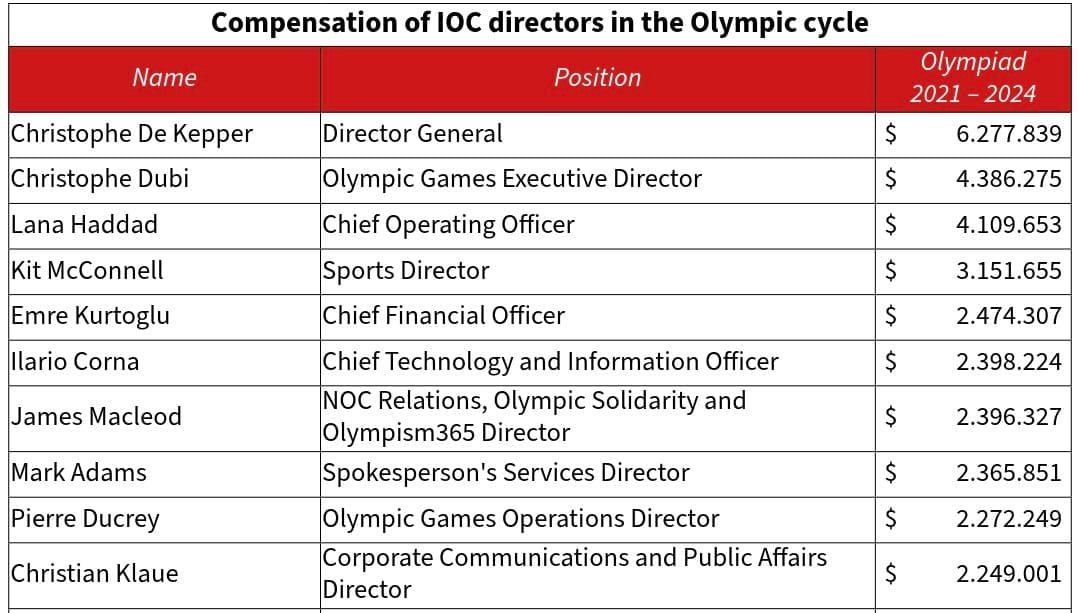
In response to Coventry's misstep, fellow swimmers hit back. Here's one of Coventry's contemporaries, Leisel Jones, an Australian who remains one of the great pioneers of breaststroke pace in the history of her sport:
“[Only] 0.01 per cent [of athletes] make it. You will be in debt for a long time. Nat Cook [an Australian beach volleyball player] said she was nearly $350,000 in debt after winning in Sydney [in 2000].”
And here's Cam McEvoy, Olympic, World champion 50 free, and World record holder as the fastest man ever to swim down one length of an Olympic pool with a clean record: 21.88:
“If every athlete who competes at the Olympics is paid $10k as an appearance fee, and every gold/silver/bronze earns 100k/60k/25k (including individuals on teams) then that would be around $180m - which is only 1.5 per cent of the quadrennial revenue ($12 billion) the IOC generates. For reference, the NBA has a 50 per cent revenue share with the players. You can have prize money and pay all athletes to help those who aren’t the absolute top and still be extremely comfortable with your boatloads of revenue.”
And from Britain, Matt Richards, Olympic 4x200m free champion with the same three mates at the past two Olympics, the quartet the first precise same four in swimming history ever to retain a relay crown in the Olympic pool, with World gold and Olympic silver top his name over 200m free. Here's the Athlete Voice being used as many more need now to use theirs:
Bravo!
What would the kind of change called for by those swimmers bring with it? The need for WADA and Integrity Units to raise their game; the need for regulators to get real about the Olympic Charter, the meaning of Fair Play and the consequences for those who fail to uphold those principles.
While I understand why Hunter Armstrong did what he did, I have far less sympathy with World Aquatics (or any other regulator) if they allow that model to build a bridge between realms and culture tested and untested, anti-doping and doping friendly.
Regulators are already way behind the curve of work needed to plug loopholes and reinforce Fair Play culture and mindset. They also know that adding a clear pro-model of direct payments to athletes at the Olympic Games - as World Athletics has already done and National Olympic Committees galore have done sporadically down the years with financial rewards for medals (Coventry herself was a beneficiary of state financial reward in direct response to her Olympic victories) would reinforce the need to man the dams all the more.
My guess is that athletes would be only too happy for that to happen, as long as Fair Play is evenly applied, and that standards and expectations stretch beyond the athletes to all who play a role in the 'Movement' - all the way up to the top table of governors and a class of folk who all too often seem rather less keen to see their fellow blazers under investigation that they are to see athletes who messed up processed to penalty in as swift a time as legalities allow.
The latter is even the case when the blazer has been barred from holding office in sport at home after an integrity inquiry found against him. Take Antonio Silva, World Aquatics vice-president, European Aquatics president: direction to remove him from office in Portugal handed down by the country's leading authorities overseeing sport and its funding following after a whistleblower raised a red flag, trigger investigation and Silva was judged unfit to hold high office and the Portuguese swim federation was ordered to dismiss him.
 Craig Lord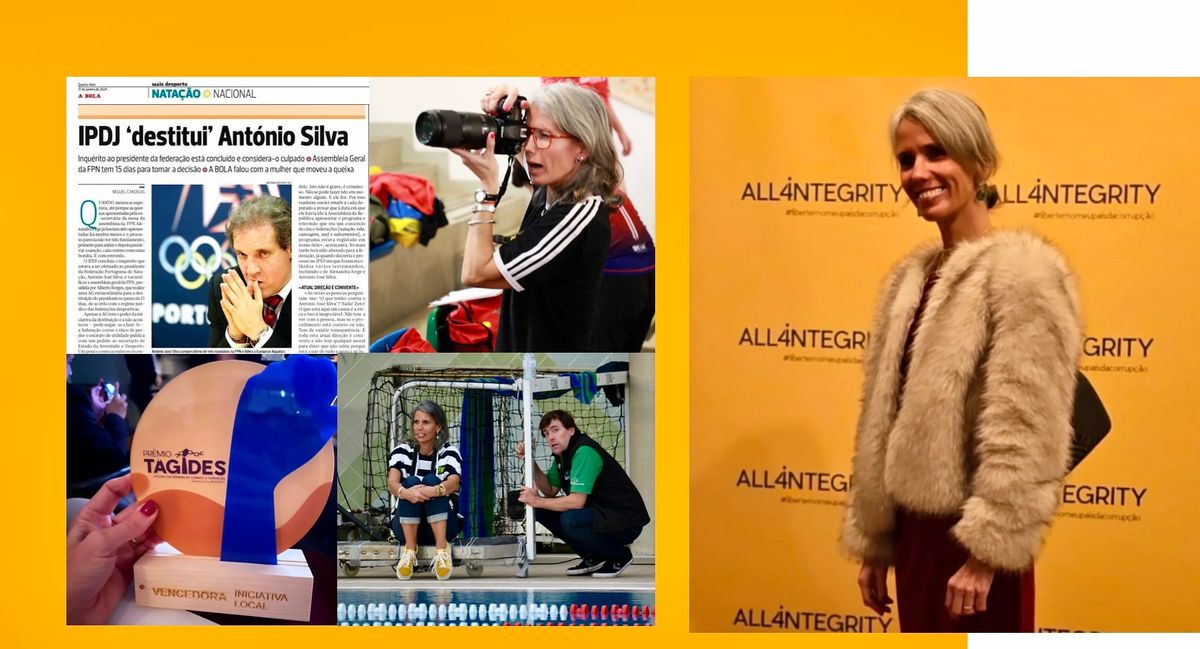
All of that was handed to the Aquatics Integrity Unit. No action has been taken - either to say, officially, 'in the clear, no case to answer' (accountability of integrity unit) or 'sorry, Senhor Silva - you have to go'. There's still time. The case in Portugal is not yet over, according to legal sources who have confirmed to SOS that prosecutors are currently interviewing witnesses to events related to the case against Silva.
That whole story and several others are perceived as part of a picture of 'one rule for them, another for athletes' in elite sport. Athletes want change, but will also realise the change they seek will need more than fees and prize pot in return for peace and harmony with a class of governors who like to use the word 'reform' but struggle with actually taking action when the essential fruit worth plucking is higher up the branch.
Among things athletes will have to consider:
- Athlete contracts that state that all prize money must be handed back by any athlete who breaches the WADA Code
- Provisions for plea-bargaining for athletes, who provide information about the folk in the shadows, who assisted. guided. supplied, persuaded and/or coerced them down the wrong road
- Lifetime bans for first serious offences, not just for athletes, but for coaches, doctors and anyone else involved in shredding the principles of the Olympic charter on fair play. To the lawyers who argue against such hard lines, tell them that doping and manipulation are hugely corrosive forces, and there must be a category of offence, just as there is in life at large, that carries a life sentence. Prevention relies on it.
- Firm rules and red lines on the participation in the Olympic realm of any one who has worked in the promotion of performance enhancement of any kind specified in the WADA Code as an acceptable form of preparation in Sport (not to do so, would make a mockery of spending millions and millions and millions and testing and protocols in clean sport - to allow loopholes into or back to clean sport does no one in clean Sport any favours). As said, I understand why Hunter hunted what he did, but if he is now allowed 'home' and is free to make the Olympic team once more for the USA, then why would every other swimmer out there not embrace the Enhanced invitation to their show, their culture, their mindset, their anathema to clean sport? It's no secret that the list of swimmers who have shown keen interest in Hunter's game is fairly long. If World Aquatics and the IOC want to enhance the problem they have with Enhanced, then leaving the door open and setting up a sign on a bridge saying all welcome, as long as you allow us to send testers in to tick the anti-doping tick box (even as many other rules from our realm are being stretched and broken, shiny suits an example), is certainly the way to enhance Enhanced's performance.
BOYCOTT
The reluctance of the IOC to embrace the modern era and share far more of its real wealth (as opposed to the 'benefits' of "beautiful facilities ... venues... an athletes village" etc) with athletes, is entrenched, the justifications the same today as they were decades ago, their roots firmly in the soil of amateurism and the code and culture that has long seen governors as the VIPs and athletes as the entertainment from which "we" build the house and its business.
The International Swimming League highlighted all of that almost a decade ago, off course, and presented a model for its sport that presented and still presents the far better challenge and goal for Olympic sports than anything the Enhanced project has to offer, money the sole attraction for anyone who couldn't care less about lifestyle products for a longevity industry and the market place and valuation it pursues.
It was December 2018, after FINA had blocked a move for the ISL to host a competition in Italy, that the League turned to Plan B: it called more than 30 of the world’s leading swimmers together in London, and introduced them to their own power through a series of presentations given by experts in a number of fields in or related to professional sport.
One speaker still stands out as the most important when it comes to getting across to athletes the issue raised by Global Athlete: boycott, or, importantly, the threat of boycott and intention to follow through to achieve the desired change and reform.
Rachel Aleks, assistant professor on labour relations at Cornell University in New York, told the swimmers:
“Boycotts are not something anyone wants. You also have to understand that your power is the right to withdraw your services, your labour.”
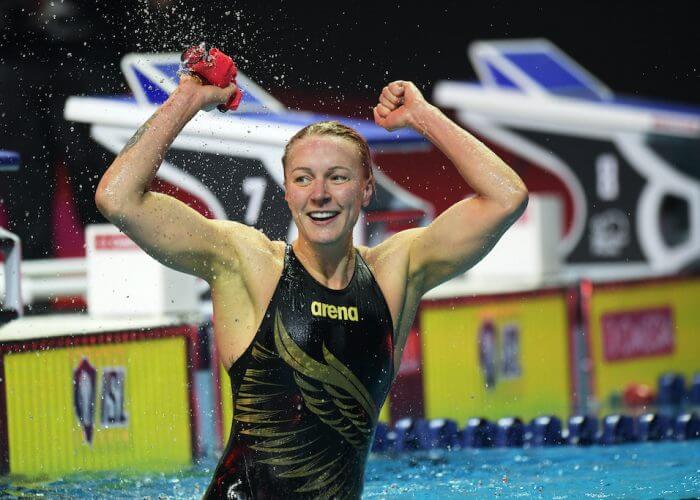
Weeks before, Olympic champions Adam Peaty and Sarah Sjostrom were among swimmers who had learned from their respective domestic federations that FINA had demanded to know what penalty was going to be imposed on the athletes because of their support for the ISL. “The letter was asking, ‘Why are you saying these words about us?’ That just made me more determined to speak up,” said Peaty, adding that “swimming has been stuck in a rut doing the same things for 30 years and more”.
It was time for change, time for something else to live in harmony alongside the Olympic program, something that gave swimmers a home for all years and seasons, not just the one every four years.
The League unfolded as it did, swimmers assisted by the ISL eventually won a class action against FINA, and the ISL and FINA settled their differences, to a large extent. Differences remain, of course, not least of all in the kind of model swimming needs to embrace for growth in between Olympic Heights.
Swimming has for decades been a sport in which retirement of athletes aged between 17 and 20 is commonplace, and the drop out rate of girls aged 12, as highlighted at the World Aquatic Development Conference in Lund a decade ago, is stark. What we learn from such things is a theme we will return to in another FORUM.
In short, for many in swimming, there is simply no prospect of remaining, no chance of putting off school-finishing exams, degree courses or simply moving on in life in other ways designed to cater for the long-term. Their sport, highly subsidised by the Bank of Mum and Dad, not “Olympic solidarity’ nor ‘FINA solidarity’ because they were born in nations that have long taken their swimming seriously, always ever going to be a short-lived experience unless they made the junior and then senior teams for the biggest of international events - and even then, a place in a final would never be good enough to change economic reality and circumstance.
The subsidies and support for development and universality in swimming has not been available for many ‘tier-two’ swimmers, as Grigorishin described them.
I wrote at the time of that London meeting: "He means those third- and fourth-best Americans and Australians among the world’s best 20 who have had nowhere to go to earn money once they miss the big-meet team by 0.5sec or less in any passing season.
"More than 20 years have passed since this author proposed to FINA that the fastest 30 swimmers in the world across all events on the global rankings, regardless of where they came from, should have a golden ticket to the World Championships. The suggestion did not fit the universal model. For FINA et al it was a non-starter and as such many ‘tier-two’ swimmers were confined to the back of the queue when it came to international prospects, let alone any ability to fund their way through the sport.
Grigorishin is aiming to make a market of what FINA and its members have long rejected. He said:
“We have a completely different strategy and format [to the Olympic model]. For us it’s really important to have 300-400 highly competitive swimmers. It’s not just about a few superstars or 40-50 swimmers or even 100 swimmers. It’s about everybody [at the top end of swim speed]. This is a big difference for us because, of course, for the federations, some, shall we say ‘tier-two swimmers’, they’re not so important because if they have no chance to win the Olympics or be a medallist, they are not so useful, they [the federations] don’t care about them. For us they are necessary, they bring real value.”
Whatever went awry with the League, which has been gone for four years but is on the road to a comeback later this year or next, that philosophy above underpinned the style and substance of Grigorishin’s vision for Pro-Swim.
Alongside that is another question we will more fully explore in another FORUM: what kind of home and welcome does swimming provide?
Wayne Goldsmith has urged swimming program organisers to consider the “end-user experience” among the reasons why engagement in competitive Olympic sports is in decline. In comments he made a few years ago, yet still relevant, he said:
“Competitive Swimming is one of those sports experiencing significant declines in the number of kids committing to training and racing. In response, National Swimming Organisations around the globe are looking for new ways to deliver the swimming experience to children and families.
“However, it is fair to say that swimming has in general been slow to react to this crisis with the majority of swimming administrators and coaches continuing to do things “the old-way” and hoping that the participation trends turn around by themselves.
“The key to helping competitive swimming to not only survive – but to thrive – is to look at the “end-user” experience.”
Funding Models Are Shifting
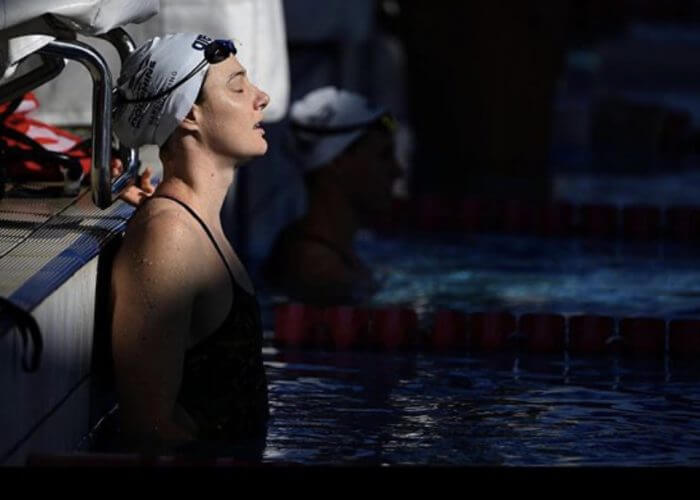
Around the same time, on the cusp of the Covid pandemic, Aussie sprinter Cate Campbell noted the cyclical nature of the subsidised side of swimming, and the need for the sport to place athletes on a sound financial footing. She said:
“No-one has said it yet, but let’s be honest, the writing’s on the wall that funding cuts are going to happen and for a lot of swimmers on the cusp of representing their countries, that might mean they have to give up their dreams. This will also give everyone a little bit of insight into what it’s like to be a swimmer and their personalities and what an average training day looks like, because we kind of exist a little bit in the dark. That’s going to be so important for the sport moving forward because corporate dollars and sponsorship dollars are going to be so scarce in the years to come.”
Grigorishin, a Ukraine power-sector billionaire, had this to say in response to swimmers wondering what would happen in lockdown, the solution a solidarity camp in Budapest:
“Our approach is we consider athletes as our partners so before we made this decision we asked them what they wanted – this is what they told us, so it’s a swimming camp, it’s a competition and it’s a reality show all rolled into one. One of the things we want to do is show people who the swimmers really are. They are not just robots standing on the blocks and swimming for their country so we want to show their personalities.”
So, beyond the fight for financial rights in Olympic sport, where is swimming going and where will it find genuine growth? Not, in my opinion, by constant repetition of the same championship models every single time the show is on, heats, semis, finals, local gala through to Olympic Height.
And I've written many times, I am a big fan and follower of the championship format, with some reservations in the mix, but I'm talking about the moments in between Olympic Heights, and away from the likes of nationals and selection/qualification trials and accredited events required for the championship stream.
In the past decade, The League, improvements required, over-complexities and what we'll call 'cash flow' issues (for simplicity's sake) set aside, had by far the most interesting and promising team-based ideas for selling the sport beyond its niche.
I'm not going to set out a full vision right here and now but here are some suggestions for the direction of travel ... in this series:
 Craig Lord
And ... a few thoughts among many I have own the subject, but not for this file on this day...
SWIM THINKING OUTSIDE THE TANK
- Create 'Seasons' and stick to them. Ask anyone outside swimming what the 'season' looks like and they look back blankly, 'summer, isn't it?' about the closest they get. Swimming has no windows in which some things must happen in the way they happen in a league sport that is far easier to follow. While swimming must build models that speak to its unique nature and some of the traditions of the sport, there's much it can do to create a map in the minds of the wider audience. Think of tennis, or many other sports, and the same activity unfolds in the same place at the same time year after year after year. Not so in swimming - and that map and calendar of sport is one that, as far as the wider audience and the mainstream media goes, is one that does not include swimming.
- League-style events, with international teams, a season window, very simple formats, a duel-style environment and mechanisms that help swimmers build their profiles are the way to go ... as we noted in the last part of this series:
Craig Lord
World Championships - a few 'add spice' thoughts
It was somewhat dispiriting to read the World Aquatics release yesterday. It takes about 2 minutes to come up with all manner of things that ought to be discussed and even explored/trialled. Just a few of a library load of thought:
- Wild cards 1 - should be for any swimmer in the world top 20 by a cut-off date 6 weeks out from the start of the showcase event
- Wild cards 2 - wild car swimmers can opt to race for nations if there is scope for those nations to do so, or for sponsorship teams, giving long-time backers of swimming, such as the kit sponsors who often get a raw deal unless they become a headline sponsor for a very large sum that might be better placed directly with athletes and other buyers and wearer of team kit. Entries would be something like Wild Card - Team Arena; Wild Card - Team Speedo; Wild Card - Team FINIS and so on.
- Relays: reserve two places in all relay events for quartets formed of wild card swimmers from wherever they come from in the world.
- Back to B Finals: get rid of semis, go straight from heats to final, with a B final in between all finals... a win for all concerned, including the media, both broadcast and written, and the window in which swimmers can build their profiles (no one reports on as semi final beyond the actual outcome, a record, a place in a final, or the last stand of the swimmer who 'we can now forget' about)
- Dash skins: all the dash events to be an eight round skins event, with a big round of at least one dash event held on every evening of the nine-day program
- Qualification Season: make it more meaningful and linked to the big event; weave a season thread that makes sense to the casual observer... in money terms, perhaps make every World Aquatics A and B time hold hands with a small reward: $200 to $500, for example. Find sponsors for such a network.
- Clash of Continents: Think of a regular slot on the calendar that would be A Clash Of Continents one event held in each continent in turn, with regional events that lead to the end Clash.
Meanwhile, athletes - raise your voices if you want that pay day: back Cam, Matt, Leisel, many others who disagree with Kirsty Coventry and the IOC status quo and want change.
And ... contact Global Athlete, make your collective strong, list your demands, and do it together in unwavering fashion. Have Global Athlete take your message to the IOC while you work at the job you do so well. As you know in the pool, the one thing that guarantees a loss is to not try at all, to never leave the blocks.
On your marks... Good luck!


