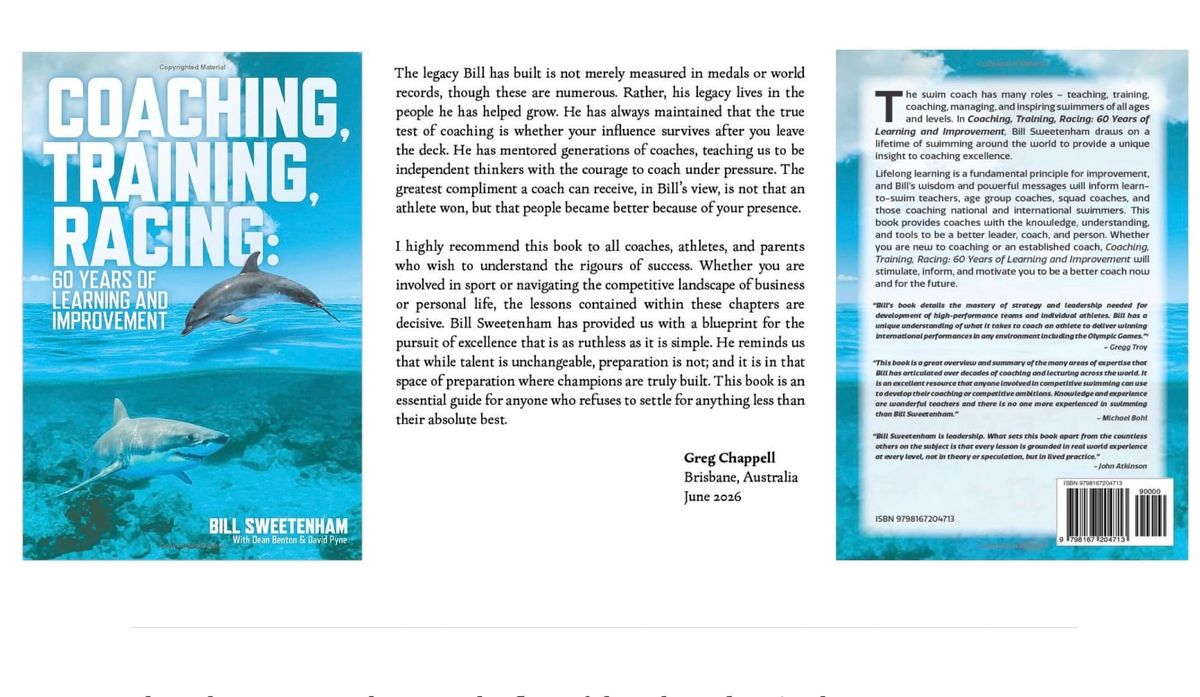
Bill Sweetenham's New Book 'A Blueprint For The Pursuit Of Excellence'
Coaching, Training, Racing - the SOS Swimming Book of the Year, a tour de force from Bill Sweetenham for every coach, athlete and parent seeking deeper understanding of performance sport and the consistent, slow-burn passion and art of striving to bring out the best a human can be

Mid-November approaches, Santa is polishing his sledge on the polar horizon, and many of you are doubtless scribbling down the titles of books that would make a great stocking filler or take pride of place on your swimming shelf.
Add this one:
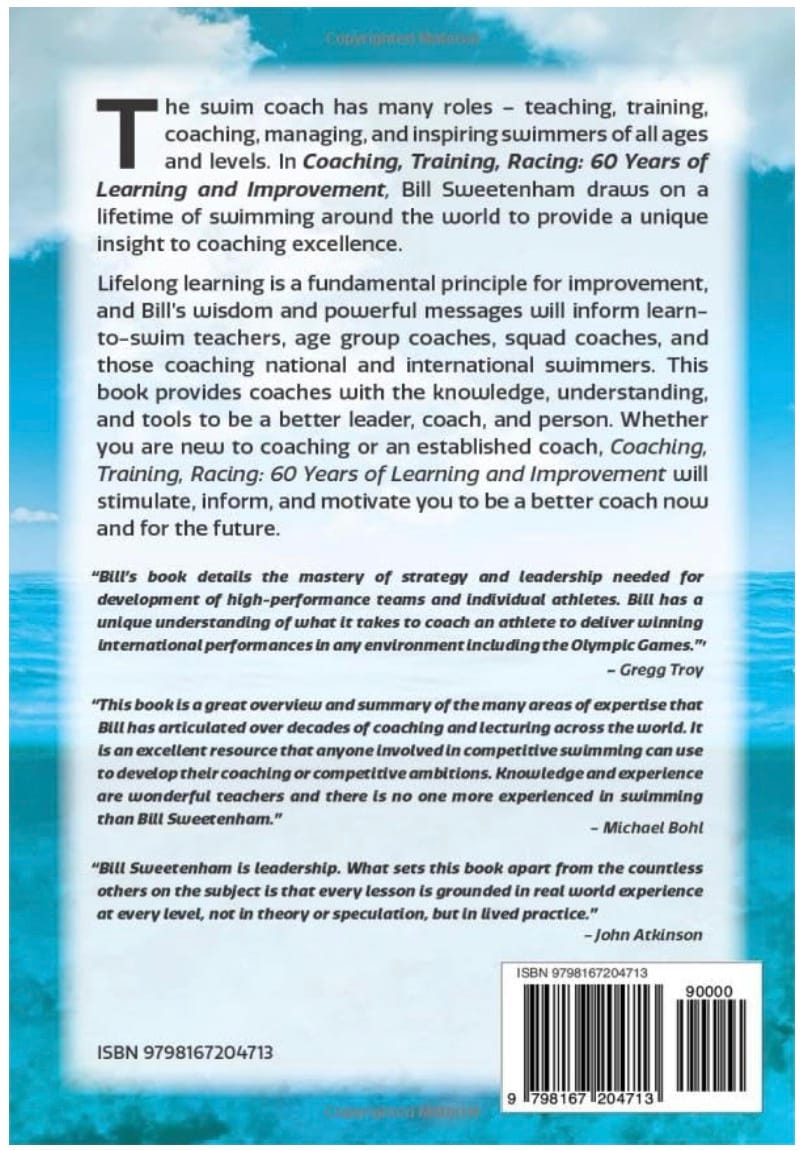
Coaching, Training, Racing - 60 Years of Learning and Improvement
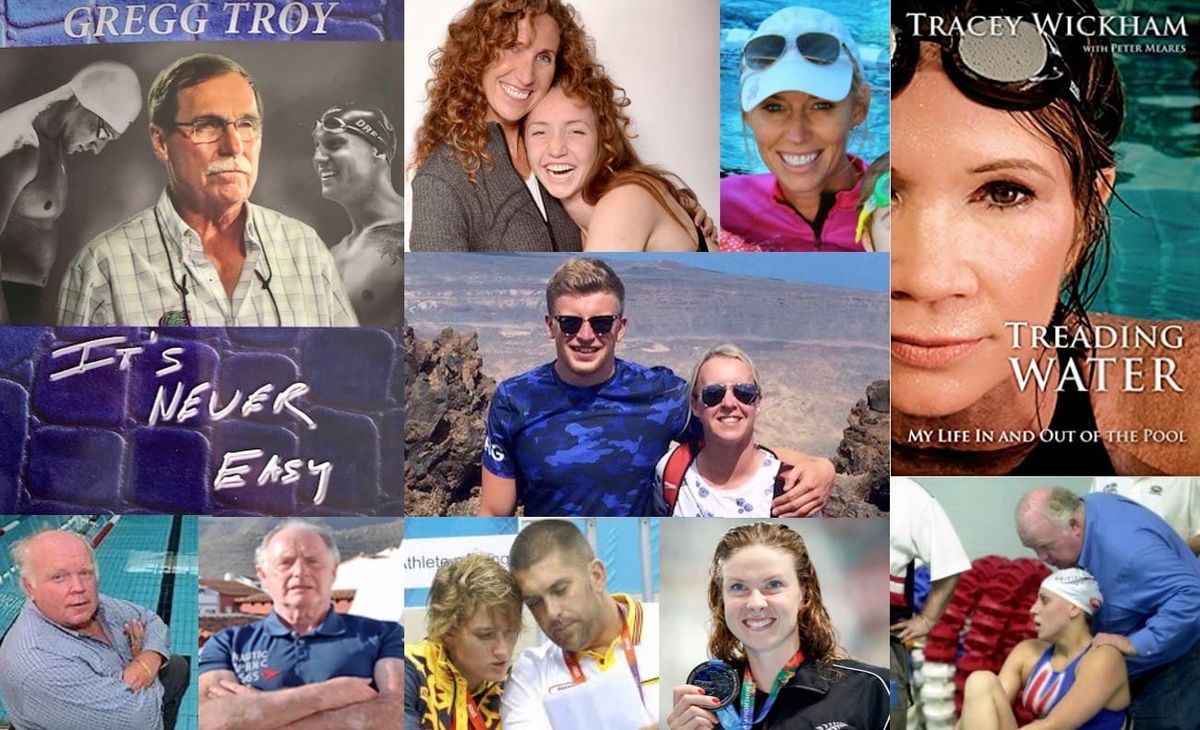
It's a gem of a work from Australian coach, coaches' coach and leadership mentor in performance sport Bill Sweetenham. For those unfamiliar with his work, a few reads here at SOS:
 Craig Lord
 Craig Lord
I had the privilege of reading a review copy, and recommend you read it for yourself. My general thoughts follow, while, down the lane line, SOS will be taking a deeper look at how Sweetenham's guidance has played out in the careers of others, and will continue to be of value for generations to come.
The word guide falls short of the weight of the charts and maps in a performance-sport bible of enduring wisdom, insight forged at the coal face of experience, perennial truths the pillars of a library with a wellspring of timeless advice at its heart.
Sweetenham's book is a must for anyone in search for deeper wisdom about the nature and challenges of performance sport and the pathways, physical and mental, to the best version of you in your role chasing the goal you set - for self and/or those who work with you sharing the same aim of being the best they can be in their role.
Don't take my word for it. A few extracts from fine endorsements grace the foot of this review, while the forward by cricket legend Greg Chappell, the pre-eminent Australian batsman of his time who allied elegant stroke making to fierce concentration, provides the Portal and Narthex to the cathedral within - and is where we start in this review.
Worth noting for those who know little or nothing about cricket: at his retirement, Chappell held the world record for the most catches in Test cricket, part of a career that included 7,110 Test runs in 87 matches at an impressive average of 53.86, including 24 Test centuries. He is famously one of the few batters to score a century in both his first and last Test matches. Chappell captained Australia in 48 Test matches (winning 21), led the side through the challenging World Series Cricket era, and was inducted into the ICC Hall of Fame and the Australian Test Team of the Century. His post-athlete impact includes shaping future generations as a national selector.
And here is an extract from the red carpet Chappell lays out to for the reader of Sweetenham's book:
For those of us in the coaching profession, Bill has redefined what it means to lead. He teaches that leadership is influence that creates capability, allowing ordinary people to achieve extraordinary outcomes. He encourages us to "see with your heart and listen with your eyes," suggesting that a coach’s judgement, developed through thousands of hours of direct engagement, remains an irreplaceable tool that technology can support but never replace. He views the coach and athlete as a performance partnership where the athlete feels what the coach cannot, and the coach sees what the athlete does not.
His principles regarding athlete development are equally profound. He emphasises "skill before speed" and "attitude before outcome," insisting that technical foundations must be robust enough to survive the extreme fatigue of an Olympic final. He advocates for training environments that deliberately engineer adversity, teaching athletes how to maintain technical discipline and tactical awareness when their bodies are demanding relief. He believes that success is "rented, not owned, and the rent is due every day”.
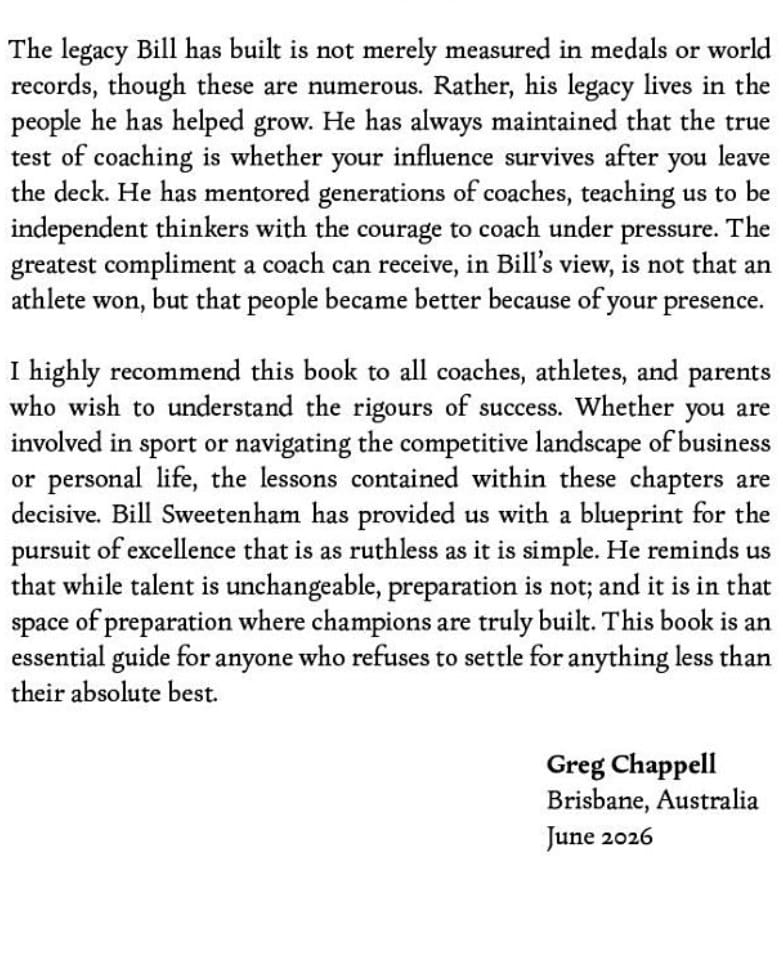
The legacy Bill has built is not merely measured in medals or world records, though these are numerous. Rather, his legacy lives in the people he has helped grow. He has always maintained that the true test of coaching is whether your influence survives after you leave the deck. He has mentored generations of coaches, teaching us to be independent thinkers with the courage to coach under pressure. The greatest compliment a coach can receive, in Bill's view, is not that an athlete won, but that people became better because of your presence.
I highly recommend this book to all coaches, athletes, and parents who wish to understand the rigours of success. Whether you are involved in sport or navigating the competitive landscape of business or personal life, the lessons contained within these chapters are decisive. Bill Sweetenham has provided us with a blueprint for the pursuit of excellence that is as ruthless as it is simple. He reminds us that while talent is unchangeable, preparation is not; and it is in that space of preparation where champions are truly built. This book is an essential guide for anyone who refuses to settle for anything less than their absolute best.
It would be easy to leave it there and, without further ado for those who already want the book, here's ...
WHERE TO BUY THE BOOK (or at the Amazon page geo-pertinent to you):
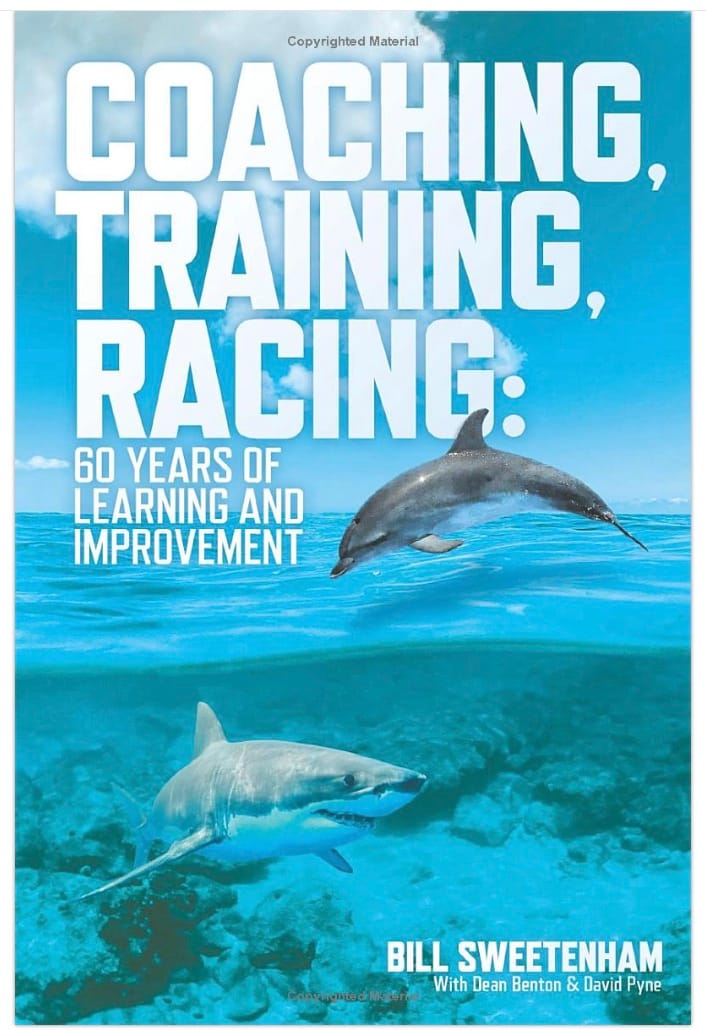
Sweetenham's work has made it to the page with the help of:
- Dean Benton, an athletic performance coach, director and consultant with a record of delivery across a wide range of sports. His career has included senior roles in international rugby, including national teams from at least seven countries.
- David Pyne, a swimming physiologist with 40 years experience in the Australian high-performance swimming community, the athletes, coaches and programs he has helped a Who's Who Olympic coaches (Sweetenham among them) swimmers, support staff and programs, his work spilling across the Paralympic and age-group realms. Dr. Pyne's swimming research has addressed the issues of training prescription and programming, athlete health, competition profiling, and physiological and performance testing, coach education and professional development for shared learning opportunities.
It's not just the wise words that makes Sweetenham's book a fine read and learning curve; the structure, the pace, the flow of thought and topics, the easy access to matters that need the brain to be engaged as you read to appreciate what's being said, meant and taught. And its best digested when that applies to every word: this is neither flick book nor two-minute, short-form video or message-in-a-bottle from an influencer long on opinion, short on actual experience-soaked knowledge on the front line of delivery and accountability.
There's plenty of truth and straightforward, simple, unarguable, real-world truths of the kind some may struggle with because the 'self' stares back at you from every page, in an unnervingly calm manner. Excellent. It's how we get better.
A chapter on Queensland sets us precisely on the right runway in the book, the first four chapters having provided the check-in, the lounge, a few fabulous appetisers and a flute of bubbles for those lucky enough to be in the business class or even further along the aisle of performance sport (and that doesn't mean they must have Olympic gold; it means we've understood there are those and many other moments to celebrate the achievement of the swimmer and coach, the parents, the support staff and others who contribute to a fine outcome measured not just by how far you've got but how far you've come, and what you had to do to get there.
There's a deep sense of leaving no stone unturned so that the achievement is not a moment but a journey truly lived in present tense, all gauges, checks and balances constantly revisited to ensure betterment/safety/wellbeing when such things are far from guaranteed. No denying that there's a destination but that is delivered not by navel-gazing the prize with time and energy wasted. Daily detail and consistency are the bread and butter of great outcomes, which can be public all-time and ultimate glories, or personal triumphs.
So much for the starter. From Chapter 6, we're into the main course. It's a feast, one that challenges and corals preconceived ideas in a pen with a different perspective that urges you, the reader, to travel along the sharp edge of a grinder to get to deeper understanding.
I wallowed in Chapter 7. The 'universal characteristic' of athletic excellence. I want to say 'very nice' but I once had an English professor who told his students that anyone who used 'nice' would be treated to the fate of the lukewarm in the Book of Revelation: spat out.
Given we're dealing in deeper understanding, allow me to swerve from the script for a moment, and explain to those unfamiliar with that spit reference what it means.
The metaphor of "hot," "cold," and "lukewarm" is directly tied to the geography and water supply of ancient Laodicea. Rather than referring to levels of spiritual passion, the imagery compares the church's usefulness to the quality of local water. Here's the context:
- Hot Water (Hierapolis): About six miles north of Laodicea was the city of Hierapolis, famous for its hot mineral springs. People travelled there because the hot water was soothing. Healing was the goal.
- Cold Water (Colossae): About ten miles east was Colossae, known for its cold, pure mountain streams. That cold water was refreshing and great for drinking. Quenching was the goal.
- Lukewarm Water (Laodicea): Laodicea lacked its own natural water source and had to pipe water in via an aqueduct from several miles away. By the time the water arrived, it was tepid, mineral-heavy, and unpleasant. Gagging and spitting it out of the mouth was not a goal, just a poor outcome.
Sweetenham's work speaks to that. It's structured and paced, with sub-headings and concise explanations placed just where you need them, in a way that makes every spoonful a precursor to hunger for the next.
The lessons Sweetenham brought to Britain from Australia in 2000 sing from the page. Some are still very much part of the GBR program, the coach-athlete partnership underpinning success, while others, including aspects of accountability for repeating performance pathways that worked but have, in my opinion been either forgotten (perhaps misunderstood) or set aside in favour of doing anything that can't be said to have its source in a stream of thought from the past.
When we witnessed GBR winning four relay golds in Paris (all the 4x200 - men, women, mixed), the signage back to Sweetenham and some of the coaches and sports scientists he worked with during his time in the UK was swinging from the rafters, via a time of Bill Furniss, Mel Marshall and more.
Team attitudes, all for one, one for all hold hands with Sweetenham's 'protecting team performances' guidance for coaches. The places where we see less of that stand out like a sore thumb.
Chapter 8 tackles Accountability and Responsibility. It leaves no hiding place and conveys the truth every good marriage recognises: 'the easy is hard work' and either you find the time, space and energy to work on it and adapt, whatever the 'it' may be, calmly but constantly, or 'you lose it', so to speak.
It's in that chapter that the young coach will either take the plunge in order to soar - or sink and settle for one foothill or another in the shadow of Olympic heights.
Sweetenham mentions choice. The explanations, framing, contextualisation and simple honesty about what it takes are not hidden in plain sight: they scream from the page, for all who have eyes to see and ears to hear.
The following two chapters, on coaching women and the lessons learned, are stacked with insight that speaks to specific themes but leaves us able to apply the wisdom generally to human circumstance, in its race with experience, far and wide.
"One of the greatest mistakes ... is assuming that experience automatically creates expertise. It does not."
Thank you, Bill Sweetenham. Many realms. The book may be about sporting excellence but it carries wisdom as far as any eye can see and soul can sense in the plain of our understanding.
We see it in a reference to 'knowledge-based experience before experience-based knowledge' and another to 'personal cost' explained in specific context - wonderfully.
After Chapter 10, which spills far beyond the pool deck, in 11 we're confronted with a wave of outstanding questions that this author will explore further when time allows. They're forward-thinking, and coupled to inquisitiveness as an inherent part of what underpins 'pioneering'.
Attitude and character return when Sweetenham gives his take on sports science, how and where and when it's applied. If you ever wanted a book that ticked so many key topics of world-class-performance, this may well be what you've been waiting for, specific and universal application in abundance.
Chapter 12 lights up a network of red threads to all the chapters before it, hooking relevance to theme, example, application and back. I can see young coaches taking snapshots and making giant posters for pool walls long after we're all no more.
And then we return to the birthing pool of talent and skill and 'mastery of movement'. Chapter 13 reminded me of my dad. He taught me to swim, and then he coached me to a place where I fell in love with water, with moving through water, with doing so as efficiently as I could; to know that skill in an element many find alien but would understand it if you told them that it's not unlike being that child who knows what it feels like to go from first ride to hurtling round bends and through woods on a bike, wind whistling past your helmet (assuming one was on at all), a sense of pure freedom and ownership of that and the art and craft of 'better' as your own personal and lifelong 'Citius, Altius, Fortius'. Whatever race you may find yourself in, that one is with yourself.
Sheer joy. The 'fun' and feeling of it all having been worthwhile. The stuff that lasts a lifetime. I felt at home throughout the book, but the source of so much is right there in Chapter 13.
We then move on to 'the pain of discipline is never as large as the pain of disappointment' and other such gems. Chapter 14 is another fabulous read, and thunders like rapids into the handling and managing of 'failure' in Chapter 15.
There's a rhythm to the book, the reader allowed to sit on the shoulder of the composer composing a fine symphony.
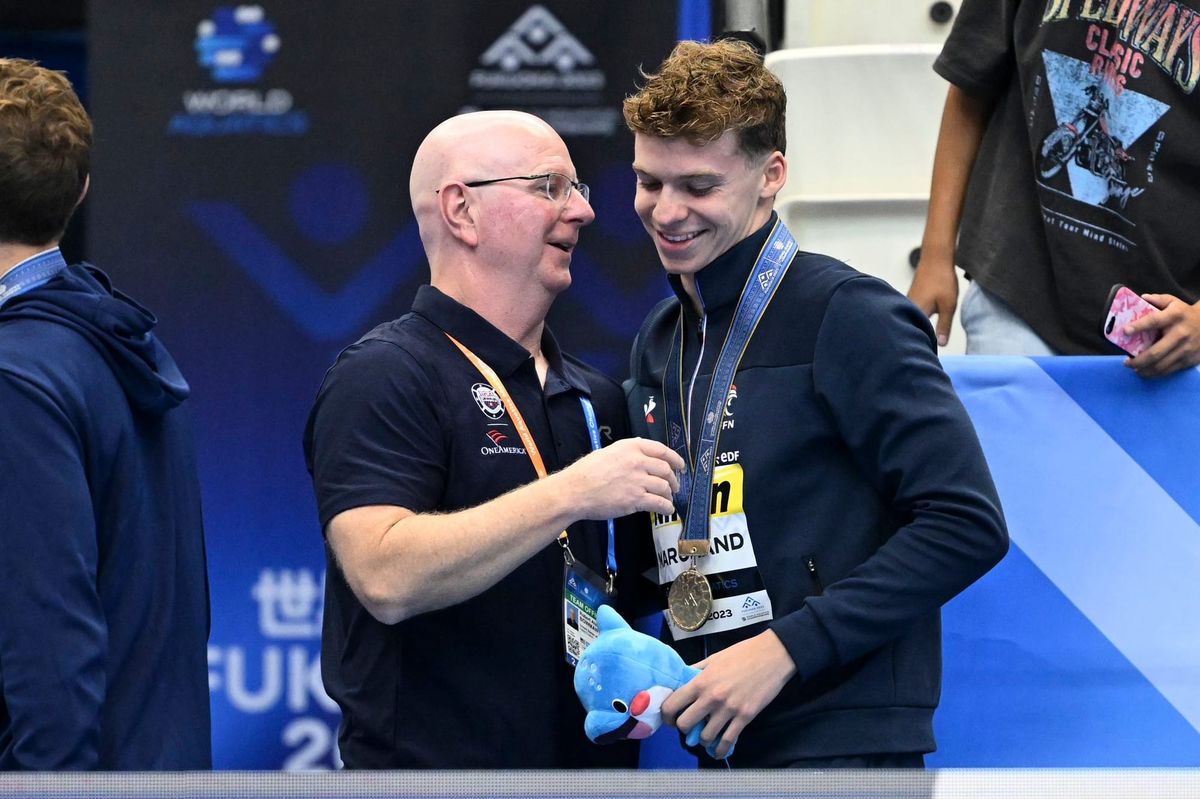
Chapter 16 is a thesis. It deals with the 400m, "one of the purest examinations of swimming excellence". I watched Léon Marchand win the 400 free in Paris in August. He wasn't the fastest swimmer in the race, but he was the winner, and he won it on a wave with two crests: the fear he instils in faster lions in their own den; and the ability to race with absolute confidence and belief his own ability, stretching to the belief that he can win. And when he did, he spoke as if he were still the apprentice in the race. Message sent: 'I'm still learning on this circuit through the woods; just wait 'til you see my new bike!'.
Related:
 Craig Lord
 Craig Lord
Chapter 17 invites us into camp and the champion environment. There's a lot to take in, but there it is, all in one place, signposts clear, none of the hyperbole, exaggeration nor merchandiser-cum-marketer speak all too common today required.
We're bathed in light in a temperate wood on the way to a hilltop of 'easy seriousness', a state kin to the easy speed of which the fast swimmer speaks.
Sweetenham spoke to me a quarter of a century ago on the theme of Chapter 18 when he described which stage of a coaching life he felt he had reached, and where he expected to be going next - wilfully. Did he get there? You'll have to read the book, which might tell you more about where you are and whether that's where you intended to get to or is still on the way to where you still intend to get to.
As I read the Quad cycle in Chapter 19, I saw more glimpses of lessons learned and kept alive, and lessons let slip, from Sweetenham's time in Britain. There were several phrases in the book that were, if not new, to me in the sense of understanding, revivalist, when it comes to being reminded not just that you had a favourite pair of glasses but where you put them, because they had never been lost - just mislaid waiting for the kind of prod some who read Sweetenham's book will surely feel.
Sweetenham mentions "silent speed". Love that. It's meaning is among those posters that will be pasted to pool walls one fine day.
What are 'the Olympics'? A series of incisive, challenging, resilience-reinforcing questions follow, and the spirit of them was right there in the last 25m of spray in every international-championship final in Paris and Glasgow this past summer", "because ... failure is unacceptable". It's a take on Gandalf's 'Thou shall not pass!' to a Balrog who got the better of him only to find he hadn't.
"Hold tight for everyday life," sings Chris Martin in Coldplay's Everyday Life. Chapter 20 tackles the theme in the Excellence Stakes. Then.Chapter 21 is autobiographical, not because the author wrote it like that but because Sweetenham's legacy leaps from the page without him hardly having referred to himself throughout the work.
A back to basics/ source of swimming excellence sum of all parts wraps up Sweetenham's seminal work. Many green shoots will grow from its pages.
Sweetenham had his own children and grandchildren in mind as he prepared to share the lessons of a lifetime, but the good guidance will serve as a treasure-forever for a great many more.
It's the first, early winner in our SOS Awards - as Book of the Year.
Endorsements:
 Craig Lord