When Sports Leaders Are At Loggerheads With The Power Of People & Their Elected Politicians
What's the difference between democratically elected politicians (not Putin) & sports politicians? Like athletes, performance decides the fate of the first. The second group extend term limits (like Putin), change 'sports nationality & scrap 'neutrality' without asking those without vote they govern


European Aquatics - and, indeed its World Aquatics parent organisation – start this month at loggerheads with the continent's political majority and public opinion.
The matter is the thorniest on everyone's minds, at least here in Europe, and here in the European Union, both of those the geographical, administrative and legal home of both those global and continental swimming and aquatics federations: Russia's war of aggression on Ukraine.
Putin's slaughter of Ukrainians, including scores of athletes and others who work in sport, holds hands soaked in blood with his nation's devastation of Ukrainian infrastructure, which has included wilful terrorism through the targeting of power facilities in bleak mid-winter.
Sports leaders like to cite the Olympic Charter to defend the kind of decisions taken by World Aquatics this year, and, European falls in line as September comes round beyond a delay caused by the Paris 2026 European Championships is done and the objections of political leaders wane as attention shifts away from aquatics until the next major swimming (and, yes, its swimming that drives that engine) .
They fail to understand that while there is immense respect and even support for the Olympic Charter, it's a mistake to hold up any 'Bible' as a shield while turning a blind eye to truth and transparency, and speaking weasel words heavy on hypocrisy and a refusal to acknowledge that sport does not take place in a bubble beyond the world, but within it.
Here are three key consequences of Putin's pernicious plunder that make the point no serious politician can afford to ignore, for a reason that sports politicians who never face a democratic vote of members, let alone whole nations, appear not to appreciate nearly as well as they might: their survival depends on their performance, which will be judged by people (AKA, stakeholders), at regular intervals, no changing the rules, Putin-like, by adding four and eight and more years to term limits, while refusing to accept that many stakeholders regard them as unfit for office, let alone another x years on the sports gravy train.
Sources On Putin's Death Toll in Numbers
- THE HUMAN TOLL
- THE COST OF RECONSTRUCTION AND RENEWAL
- Russia's military aggression has cost Ukraine an estimated $588 billion to $1 trillion in total damages and future reconstruction needs.
Financial and Reconstruction Costs
- Reconstruction Needs: According to the UN's Rapid Damage and Needs Assessment (RDNA5), recovery and rebuilding in Ukraine will cost nearly $588 billion over the next decade.
- Total Losses: Ukrainian officials estimate that the total cumulative damage since the initial 2014 aggression has reached close to $1 trillion.
- Daily Economic Toll: The ongoing conflict cost Ukraine an average of $172 million per day in 2025 alone.
Key Impacted Sectors
- Transport Infrastructure: Damage exceeds $96 billion, involving hundreds of destroyed bridges, roads, and rail links.
- Energy Sector: Recovery needs approach $91 billion due to extensive attacks on power grids and generation plants.
- Housing: Destruction of homes and residential buildings amounts to nearly $90 billion in recovery costs.
- Commerce and Industry: Business and industrial losses are estimated at $63 billion.
- Agriculture: Direct damage and recovery needs for the agricultural sector surpass $55 billion.
- Debris and Explosives: Clearing unexploded ordnance and debris is projected at nearly $28 billion.
- COST TO ALL OS US / COSTS TO RUSSIA
- There are lots of sources on such data, facts, figures and, opinion. Here are a couple of examples:
A fine compilation of many sources at Wikipedia:
 Contributors to Wikimedia projects
The Kiel Institute
 Becker, T., Egorov, K., Garcia-Herrero, A., Klein, M., Korhonen, I., Ribakova, E., Risinger, L. Schularick, M.
At which point, if anyone still hasn't got the point, which is anchored at the interface of elected politicians and the security and economic reality, among other forms of struggle in life (as opposed to the fight to stay alive forced on Ukrainians) for their constituents as a direct consequence of Putin's war on Ukraine.
We are not taking about the "things that unite us" in sport discussed in this fine take by Wayne Goldsmith:
 Wayne Goldsmith
Rather, we are talking about the things that divide us in sport, like issues of fair play and rules that must apply to all evenly to be meaningful and fair in themselves (doping, women's rights and so on) and we are talking about matters of athlete welfare and the environment in which athletes work, of ethics, morality, truth, integrity and everything else all the way to basic human decency.
Sports leaders like to think of the realms they govern as autonomous, sometimes in ways that are inappropriate. Yes, as the Olympic Charter states, 'no politics' is a fine principle to have and stick to - but when that message comes from two organisations, such as the International Olympic Committee (IOC) and World Aquatics, that had to strip Putin of their highest honour because they gave him the honour in the first place apparently unable to see what the rest of us could see, it's a much harder sell that any blazer likes to believe.
World Aquatics is not alone, of course: European Aquatics and the hang on to global coat-tails hoping to slip a continental cloak for a global gown in a system that has decidedly rewarded the on-message and ejected those who raise red flags, in camera and in public.
It seems that none of those aquatics leaders watched events at the Winter Olympics and emerged from the experience cured of their tone-deafness:
 Craig Lord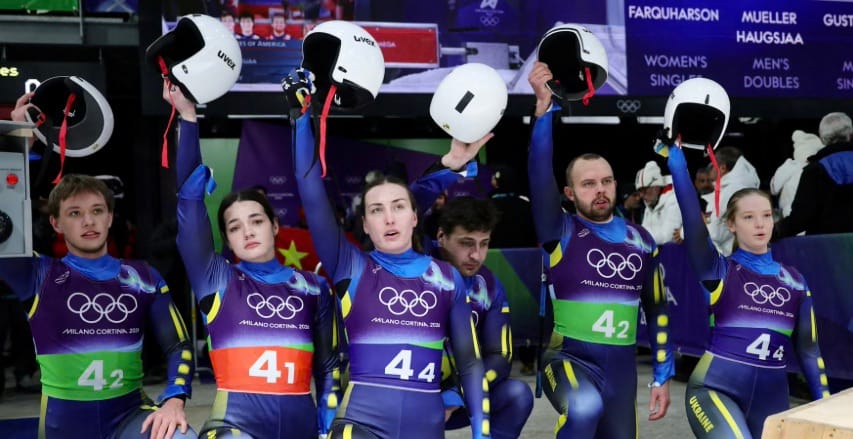
None of those leaders ever face a vote of people to whom they must justify policies galore that have a direct impact on lives and life. And below is a message that every sports politician who may be bristling at this point should listen to if they think their decisions have no consequences for their organisations in the long run.
It comes from Reinier Van Lanschot, Member of the European Parliament for the Dutch centre-left party Volt that he co-founded:
I've heard in sport suggestions that 'no-one cares' (they do) and they include a growing number of politicians turning their gaze towards Olympic sport and asking how they justify to their constituents (among them many who form the bedrock of subsidising the Olympic Movement, namely , the Bank of Mum and dad, or in other words, taxpayers) any form os support for sports leaders who simply do not have their back when the going gets tough.
Here's just a small taste of what they have ignored in our modest SOS coverage alone, and more on why sports leaders err if they think removing 'neutrality' in favour of appeasement (they may not call it that, so they can read 'ignoring political reality) , for subscribers:


