R.I.P. Phil Whitten, A Fearless & Fun Swim Mag Editor Who Had Athlete Welfare At Heart
RIP Phil Whitten, the last man to spend years leading Swimming World at a time when the publication took a fearless approach to governance of the kind that harms athletes and those who stand up for their welfare


We must all go one day when.
So, when Phil Whitten passed away at 82 last Saturday, it was perhaps as good a day as any to hang up his goggles as the man who was the last to lead Swimming World when it was a leading magazine shipped and still cherished to swimming communities around the world: he passed on a day of extraordinary pioneering in the pool, 19-year-old German Johannes Liebmann, on 14:26 over 1500m free in Paris; and over in California, American Kate Douglass taking the pace of 50 free under 23.5 for the first time.
He would have loved that - and, had being in the same room been possible, he could and would have talked for hours about it all, what might be written, what lines might enter the lore of the water; and what else was going on around pool decks awash with politics as the sport went on in the tank. In younger days, he would have called to give me his take on what I'd written - stuff like this:
 Craig Lord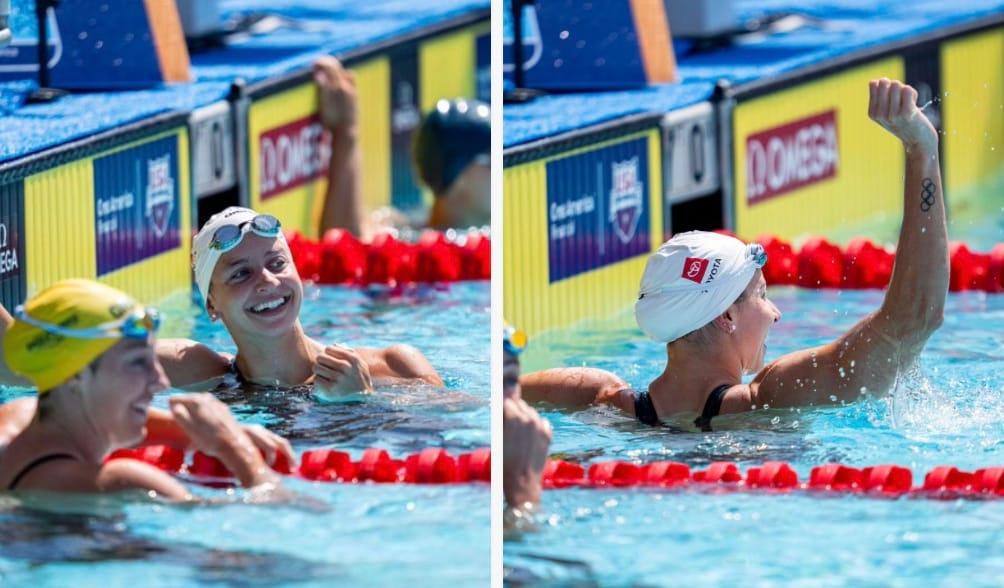
I wrote for and with Phil for a while back in the 1990s and just into the new millennia and would now describe him - setting aside a brief period of hope in 2019-2020 - as the last editor of Swimming World willing to speak truth to power when the need to do so screams from the void of what's not being written.
Phil was editor for something like 17 years (I stand corrected if anyone knows better, but I think that's about right). The good spirit of fair play in Phil is best described through the events that coincided with his tenure as editor, and his determination not to let Swimming World be shipped out without reference to the biggest fraud and scandal the sport in his focus had ever known.
The following, with a few words that speak directly to Phil, is my way of paying tribute to him, because I think he would have preferred that to just a few words about what a nice man he was (which he was, but that would miss the point).
It was late 1990 when revelations in German media confirming that the entire machinery of East Germany's female dominance in the pool 1973-1989 was build on a stare-run secret doping program, in which girls as young as 11 were given anabolic steroids so they could be used as ambassadors in tracksuits" for the communist regime.
When Stern, one of the world’s leading magazines, published state-secret documents in November 1990, proving that a six-times Olympic gold medallist and three of her East German teammates all tested positive for illegal anabolic steroids, Olympic bosses shrugged and looked the other way.
It was the month of German reunification, and there in black and white was the truth we’d all been waiting for alongside what amounted to a signed confession from the head of the East German doping program, Manfred Höppner.
Around the same time, Brigitte Berendonk, a former West German track and field athlete, penned and published the first edition of "Doping: From Research to Fraud", cataloguing the rot at the heart of Olympic sport, effectively controlled at an IOC-accredited laboratory in Saxony.

Berendonk put her important work together with the help of her her husband Werner Franke, a leading oncologist, and contacts in the sports scientific community inside East Germany who, mercifully, as the Berlin Wall fell, saved from the shredders of a regime in panic volumes of Stasi (state police) files describing State Research Plan 14:25 and all its horrors, hypocrisies and criminality,
A decade later, beyond investigation, denials, excuses, gnashing of teeth, betrayals, and more torture for and threats to athletes at the heart of the fraud - victims and survivors of it all on both sides - Hôppner would be handed a criminal conviction.
The journalist - and swimming writer - who best described and recorded the horrid details and testimony of the brave women who spoke truth to former power in those court cases was Karin Helmstaedt, the former Canadian international with German roots and a journalist (later presenter) who brought us regular updates through Nick Thierry's SwimNews operation in Canada.
The material in those reports and the newspaper articles of a couple of other reporters in Germany who put in the hard slog over a lengthy period of time made nit into books and other volumes, some of which were commercial successes and even won awards, without properly crediting the journalists whose work provided the lines then scooped up by researchers working on behalf of the authors and publishers who then put their names on the cover without, in my opinion, due credit to the folk who actually sat with it, listened live and chronicled the true account.
As Berendonk and Franke would reveal in their own work down the years and decades that followed 1990-1992 revelations and confirmations that the International Olympic Committee trend a woeful blind eye to many years before any lame excuse of "statute of limitations" was even possible, we came to read these kind of lines from the Stasi files:
Lothar Kipke (the doctor in charge of rolling out the doping program in swimming, and a recipient of a FINA Pin for services to the sport - cedars later stripped from him after decades of campaigning by this author) even informed his bosses about the possible effects on embryos from anabolic steroid use. Kipke wrote:
"During pregnancy, transplacental virilization of the female fetus may occur."
Which holds hands with this horror from Kipke's partner in what would be declared a crime of "bodily harm of minors", Höppner (quoted form a paper by Franke citing the Stasi papers: "... he acknowledges that a strong increase in sex drive is a side-effect of the steroids given to teenage girls told not to tell their parents about the pills and injections. He then advocates secret abortions at a state clinic (direct quote from the man in the official file):
“Should a pregnancy occur while anabolic steroids are being taken then it is recommended in all cases that an abortion is carried out. Children born to athletes who had taken steroids are to be delivered in a Stasi clinic so that a decision could be taken as to what to do in the event of complications.”
Those kind of revelations were making their way to the world when, in 1992, during Phil's first year as Editor at SW, it was becoming clear that the relief felt at Perth 1991 World Swimming Championships over the end of the GDR era had been overtaken by a sense that China was becoming GDR Mark II.
As ever, it took coaches, athletes, media, parents and others to raise the red flag, the silence from those in positions of power and influence deafening. USA Swimming, many other domestic federations with affected swimmers around the world, FINA and all its continental affiliates, the IOC, you name it: they sat on their hands, as if waiting for the storm to pass while knowing that this was (and remains) a storm that will never pass until a generation of governors with a spine comes along to add an official force to the wind required to carry the harm away and herald a time of healing and recognition.
Phil was among those of us reporting the masculine physiques of Chinese teenage girls who would spring world-class times, even records, into the sport, and then, in some cases, disappear, to be replaced by others. Phil carried out a statistical analysis - not unlike the one I carried out in Paris, when Liebmann's 14:26 woke up the next day with a 23.19 as the women's 50 free World record (that link above).
Phil concluded his analysis with a ridiculous number: he said there was a one-in-several-trillion chance that the Chinese performances were legitimate.
We knew it. It was obvious. Events bore it out. And yet, still do the results of the 1970s and 80s, still do the results of the 1990s stand as the record of the sport of swimming, a sport governed by spineless blazers vomiting out superlatives for how great the realm they govern is, handing their top prizes to a political class of rogue and abuser (the history of those prizes reads like an indictment), while turning a blind eye to athlete welfare.
Phil was part of a small information-sharing group of like-minded journalists: me, Wayne Smith and Nicole Jeffrey, all News International journalists, another Australian, Jacquelin Magnay, Sylvie Josse and her colleagues at l’Equipe, among other reporters around the world, and all with the work of Karin Helmstaedt and her German colleagues and sources, a constant companion, and after Europe and Canada (via SwimNews) mainstream media caught the vibe, the U.S. mainstream media finally caught up, not least of all because Phil Whitten had pointed the way.
It did not end at the GDR and China, of course, and when in 1994 I first noted the significant, sudden, and relatively late-career progression of Ireland's Michelle Smith, Phil was on the phone: what's going on? The trail and track led to a 1995 season in which the swimmer stepped up to 'getting closer' to causing damage in global waters.
The rankings work of Nick Thierry at SwimNews was critical, allowing us all who covered the sport not only to see where Smith had come from and where she was going but just how unusual that was. And it was.
Atlanta 1996 Olympic season came and went: legends like Krisztina Egerszegi, Janet Evans, newcomers like Allison Wagner - they were all kicked to the curb by the Irish swimmer celebrating three golds (400 free, 200 and 400IM) and a bronze (200 'fly, there was no getting past the Dolphin skills of Susie O'Neill and Petria Thomas).
As the Games ended, I wrote in The Times about why we should all be skeptical about Smith's performances, based on off-the-chart stats and other aspects of her story, including the doping ban handed to her partner, coach and former field athlete for The Netherlands.
Phil wrote his own take on it in Swimming World under the headline “Why Is Everybody Saying All Those Nasty Things About a Nice Irish Girl Like Michelle Smith?” Smith and Erik de Bruin threatened to sue - and they did that several times. It came to nothing.
All the stats and info and reports and talk in the sport of swimming - which brought criticism from politicians, sports governors and other folk with an official stamp of one kind or another sewn on their blazers with pride - was read and digested by some of the finest anti-doping minds in the world in the days before WADA was born.
One of them was Dr. Malcolm "Taffy" Cameron, a world-leading pathologist, specialising in criminal pathology. He also happened to be chairman of Beckenham SC in England, and a member of the FINA Medical Commission.
He was the man who sent testers to meet the Chinese team off the plane in Hiroshima when they arrived for the Asian Games in 1994 weeks after China's women had dominated at the 1994 World Swimming Championships in Rome. The result of Taffy's ability to think ahead: 11 positives, 7 of them among swimmers.
In January 1998, when Smith had decided to bypass the World Championships in Perth, Taffy thought it was a good moment to send a testing team to check on the Irish swimmer and make sure all was well.
It wasn't - and that test would lead to a case of manipulation, there having been a whiskey concentration in the urine strong enough to have killed a human had the alcohol been imbibed in quantities that would have confirmed any drinking. The story of the case was broken in The Times by this author, and it would all end up in at the Court of Arbitration hearing, at which the swimmers lawyer forgot for a moment that he'd agreed to have a public hearing - the first in CAS history.
As Irish media would later report: "During Michelle Smith's CAS appeal hearing, defense lawyer Gerard Lennon inadvertently confirmed the presence of androstenedione by telling a FINA lawyer, "You said you wouldn't mention the andro," despite it not yet being introduced. This blunder, highlighted by journalist Craig Lord, destroyed the defence's argument by revealing knowledge of a substance."
Manipulation was the charge pursued and the case won, however, because that evidence was rock solid.
During those years in the 1990s, Phil reported our work, wrote and researched his own and editorialised it all in print, and, later, when the digital era kicked in, on SwimInfo, for several years almost single-handed, giving what remains a legacy for Swimming World's website: its status as pioneer and trend-setter of online niche coverage of swimming. The difference between then and now is obvious: in Phil's day, the swimming got covered - but alongside it, there was always a fearless approach to and exposure of bad governance, wrongdoing, the treachery and malaise of governors. And he did that where and whenever he saw it rear its ugly head.
It was for all the reasons above and more, that we'll miss Phil very much indeed, though we've missed his energy in Swimming World's coverage for quite some years now. My own year as editor at Swimming World in 2019-2020 trying to help turn a rusty vessel into an ocean-going liner reinforced a sense of a spirit and fearlessness lost in pursuit of better relations with people who don't deserve them. The kind of folk Phil would have seen coming a mile off.
On occasion down the years, we shared rooms, as well as honours, such as the Al Schoenfield Media Award at ISHOF, and the American Swimming Coaches Association Media Award, given by people who appreciates the battles undertaken - some won, some still ongoing - in pursuit of fair play for athletes and clean sports.
Some of that work bonds the likes of Nick Thierry, Phil Whitten and others who were not afraid to speak truth to power, and never placed commercial interest ahead of the kind of journalism that ultimately serves athletes better than any sycophantic, partisan, and, more-often seen these days, unquestioning and cheer-leading coverage ever could. The day of the influencer is a curse of a specific kind.
Humble, Witty, Fun & Fearless
Dr. Whitten attended Harvard, held an interdisciplinary Ph.D. and later taught at Harvard and Bentley College, receiving outstanding teaching awards from both institutions. I never heard him brag about any of that. He was happy to mention his campaigning for the betterment of athlete welfare, because that's where his arrow could land in the interests of others.
He could and would speak about swimming for hours but there was always a point where he drew the line and wanted to know 'how's life - you know, the rest of it', with a smile, eyes shining, full presence engaged.
At which point, I take the liberty of referring you to a tribute written by Gerry Rodrigues, a close friend of Phil's and a fellow swimmer and fellow traveller in Swimming World's editorial journey. Gerry's lovely tribute mentions the saint in Phil's life, his wonderful wife, Donna, to whom my heart goes out this day.
Here are Gerry's words, and a read full of the spray and the waves of life, and a life well led.
He ends with this:
RIP Phil. You will be much missed, as will the fun you saw in every twist in a tale. I will treasure for the rest of my days your support for my work and our work, and the times we spent at awards dinners in the USA in the company of some of the legends of the sport, as well as the coaches (legends among them, too) and others who were fellow battlers for clean and decent sport, including an ASCA led by John Leonard. We all sat there in the presence of some of those governors who needed a hard back to their chair to avoid the dangers of being spineless.
Sincere condolences to Donna and the wider family.

