Swimming Mourns Ian Turner, Mentor To Paul Palmer & Guide On Britain's Long & Winding Road To 4x200 Glory
"Ian Turner an absolute master of coaching from the 1980 ; 1990 and 2000’s. Ian tread where few others dared and took down barriers that stood in the way of many British and English athletes and national staff opening up new horizons for so many who dared to be better than the system permitted."

Ian Turner, the British swimming coach who mentored Paul Palmer to Olympic and World Championship podiums in the 1990s and played a pivotal role laying the runway to Britain's 4x200m takeoff, has passed away.
Swimming mourns a man much admired by peers at home and abroad, not to mention the athletes he worked with, the countless young lives he enriched and the many who shared his journey.
State of Swimming extends sincere condolences to Ian's family and the community of the many he worked with in the countries his life took him to, including Singapore and New Zealand. He will be much missed.
The first comes from Australian Bill Sweetenham, the mentor's mentor and a man led a revolution as Britain's Performance Director with Turner and a generation of coaches that helped set a course for brighter, stronger days in the Team Great Britain pool, the other from his colleagues and peers at the British Swimming Coaches Association, with more to come.
Sweetenham said:
"Ian Turner an absolute master of coaching from the 1980 ; 1990 and 2000’s.
"Ian tread where few others dared and took down barriers that stood in the way of many British and English athletes and national staff opening up new horizons for so many who dared to be better than the system permitted.
"Ian gave everything in order to be great at something - lucky for many that his driven passion was performance swimming.
"Ian had no limits or boundaries whenever he was challenged by the ever-moving goal posts of global and British standards. Ian saw the positive possibilities when many saw a challenge too far or an obstacle too difficult along with restrictive boundaries that couldn’t be busted and beaten.
"Ian Turner left a legacy of trust and respect in England, Singapore and New Zealand, where his career stood tall and charismatic at the same level.
"Rest well my very good friend. We enjoyed a truly great friendship and unparalleled journey in life and sport.
"Get the warmups completed and I will meet you for the main sets. Your very good friend Bill."
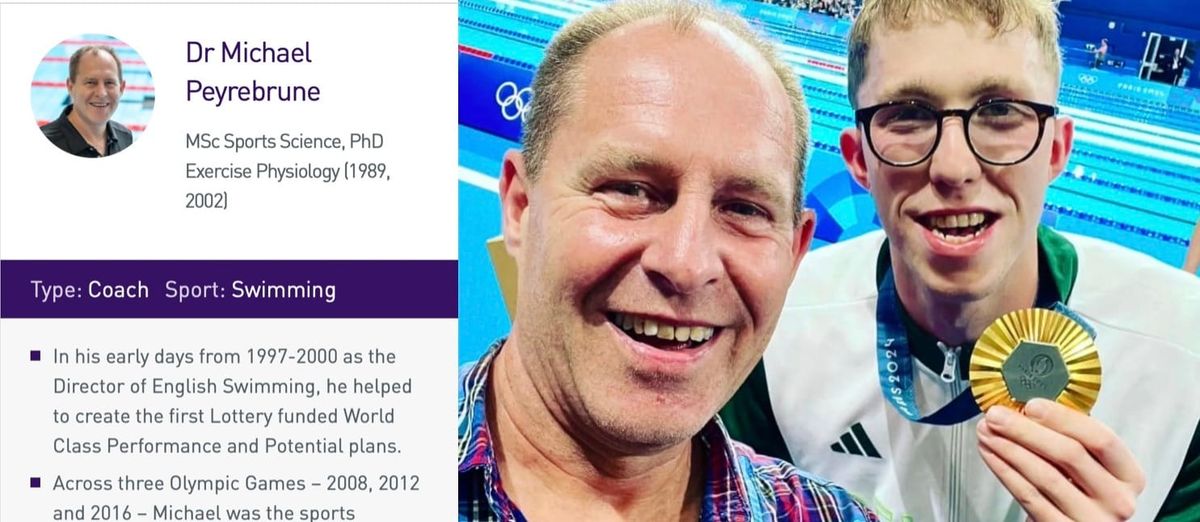
- See extract from an interview with coach, sport scientist and BSCA stalwart Mike Peyrebrune.
The BSCA
The BSCA are extremely sad to learn of the passing overnight of former GB National Head Coach Ian Turner.
He served as British Swimming's Head Coach from 1999–2008 and later held key roles in New Zealand and Singapore before supporting grassroots swimming through the Pentaqua Swim Academy.
Ian was a school teacher for 23 years prior to becoming a professional swimming coach. Whilst teaching and coaching at Lincoln Pentaqua swim club, Turner placed 4 local youngsters on GB Olympic Games Teams (1988/1992/1996), with Paul Palmer winning silver in the 400m freestyle at the Atlanta Games. These 4 swimmers also won medals at World & European Championships.
After the 1996 Olympic Games he moved to Bath University to develop the first High Performance Centre in Great Britain.
During his coaching career, Turner has placed 25 swimmers on 7 Olympic Games teams.
In addition, swimmers under his leadership won 127 medals at Olympic, World, European and Commonwealths. After leaving the UK in 2008, Turner joined the North Shore Club in Auckland before moving to Singapore to become Technical Director.
Our condolences go to his family & friends.
A fuller obituary, with plaudits a d tributes is here:
 Craig Lord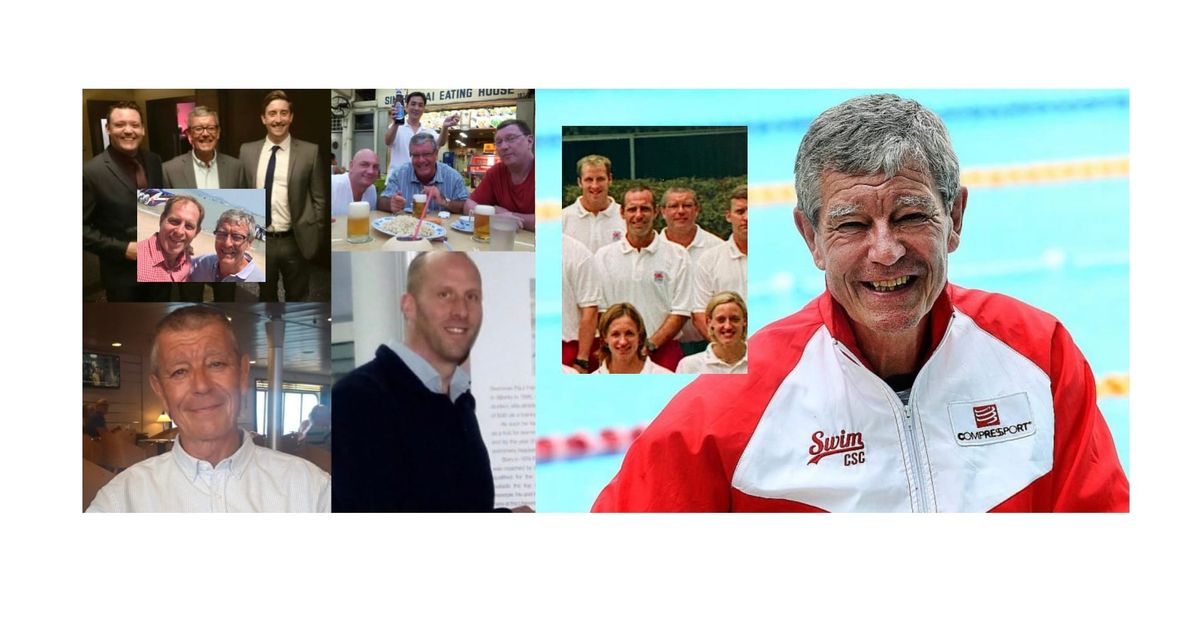
Rest in peace, Ian Turner.
Meanwhile, here is an extract that provides a fleeting glimpse of the work, passion and spirit of Ian Turner:
In the thread of Britain's pursuit of 4x200m success, we arrive at the Athens 2004 Olympic Games. Here’s what unfolded:
David O’Brien, guided by coach Chris Martin, was asked to do a swim-off/time trial and went under 1:49. Good but not good enough to make the heats line-up on paper. Coach Ian Turner, mentor to Paul Palmer and a man who had worked long-term on Britain’s 4x200m project, then told Ross Davenport and David Carry, one the squad of boys-to-men who cut their world-class teeth at Britain’s offshore centre for the male program - the Southport School in Queensland - to swim the heats with easy speed. They did just what they had been asked: Ross, 1:49.24, David, 1:49.28, the team through to the final by a comfortable margin in fourth place, top hitter Simon Burnett on 1:50, powder kept dry.
Which is when coach Martin made the case for O’Brien: his swimmer’s 1:48-plus time trial was better than three of the heats swimmers. Argument ensued, with Turner noting that he had instructed the heats quartet to ‘swim easy’ and that he believed Davenport and Carry had a whole new gear to come. For whatever reason, Martin’s claim for his charge prevailed - and Carry was out, O’Brien in, his time trial effort faster than his swim in the Olympic final. And this is where bronze was won and lost:
Gold, USA; Silver, AUS Bronze, ITA
- ITA: Emiliano Brembilla (1:48.16); Mass Rosolino (1:46.24); Simone Cercato (1:49.85); Filippo Magnini (1:47.58) 7:11.83
- GBR (4th): Simon Burnett (1:47.90); Gavin Meadows (1:48.46); David O'Brien (1:49.05); Ross Davenport (1:47.19) 7:12.60
Turner knew that Davenport’s two-second drop from heat to final was of the order of progress on the clock he had expected to see from Carry. Even a 1:48.2 would have placed the Brits on the 4x200m podium for the first time since 1984. On three legs, Italy swam slower than their British opponents, but Massimiliano Rosolino's 1:46.24 sealed the deal - and the decision on Britain’s fourth man has long been a part of the evolution of the Great Britain men’s 4x200m during the past three decades.
That story forms a part of this feature on Great Britain’s success at Tokyo2020ne:
 Craig Lord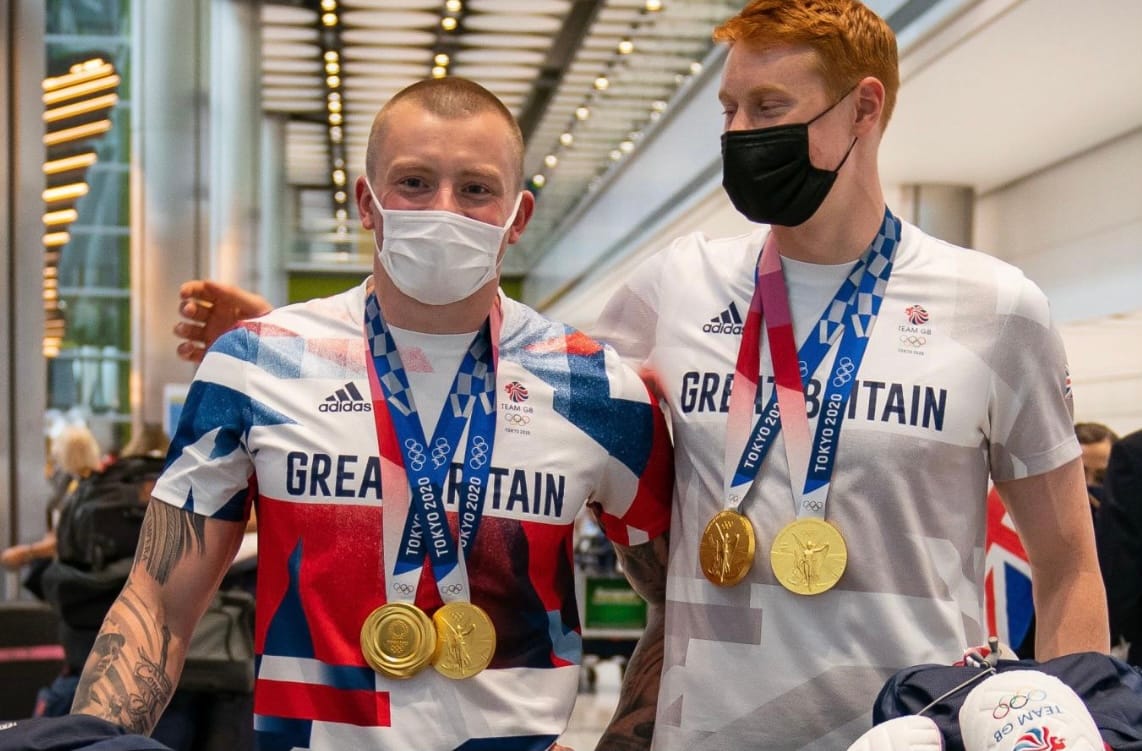
The follow-up including this historic moment at Paris 2024, where Tom Dean, James Guy, Matt Richards and Duncan Scott became the first precise-same swimming relay quartet in Olympic history to retain a title at the Games, all the way back to the first chance of it happening, in 1900:
 Craig Lord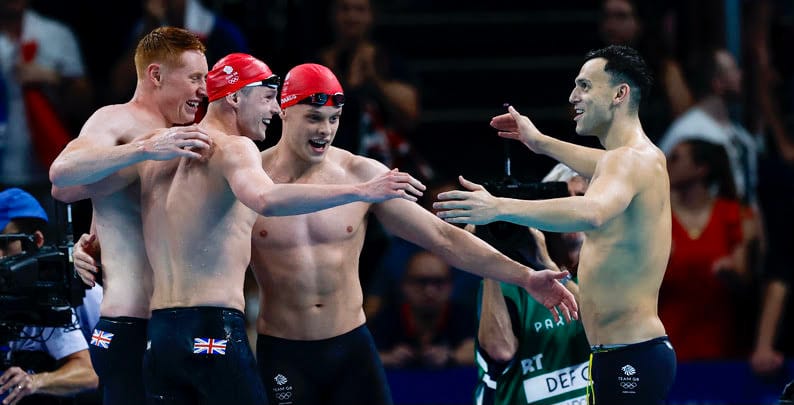
If lessons were learned that day in Athens more than 21 years ago, the price paid belonged to all with decision-making responsibilities. Within a year, Carry had proved himself with 1:47s in solo racing and would go on to help Britain win silver medals in the 4x200m at World and European levels, while, in Scottish colours, celebrating Commonwealth 400m free and 400m medley titles in 2006, a silver in the 4x200m at the same Games and then follow up silver and bronze in the 4x200 and 400 free, respectively, at the 2010 Games.
In Olympic waters, Carry would lead Britain in the Beijing 2008 4x200 final, his 1:46.78 from the blocks a measure of progress hard to define because of the arrival of the first non-textile (50%) bodysuits in history. Comparisons with textile times confirmed truly significant drops in the mix in all events but gains on the clock were not as dramatic in all swimmers. The shiny suits, as I called them (because when wet, the tight, compression made the surface of the polyurethane look like a shiny balloon; and, indeed, the suits would pop like a balloon if snagged by a fingernail), granted more advantage to some athletes than others, depending on physical build, angles of buoyancy and related factors.
Roll back the years and take a look at the Beijing line-ups and if there was a team that stood out on the measure of weighing in/physical size, it was Britain, the lightest of the six teams in the finals that entered the fray with a shot at the podium. They finished sixth within a second of bronze, the Michael-Phelps-led USA champions ahead of Russia and Australia.
The combined weight of David Carry (1:46.78), Andrew Hunter (1:46.73), Robbie Renwick (1:46.16) and Ross Davenport (1:46.25) 7:05.92 (British record) came in at 50kg below the average of the five teams ahead of them, the USA and Russia, the top 2 in the swim and on the scales, at over 350kg, or an average of 15kg heavier per man than the Brits. The suits played a part in that result. Precisely how it changed the dynamic from what might have been is guess work, but worth noting the fact that size/weight plays a part in the mix of fitness and skills in the art of racing in their element: the British foursome that hold the World textile best time and own the past two Olympic titles weigh around 10kg lighter than the U.S. winning quartet of 2008, and 10kg per man heavier than the Brit quartet of 2008 on whose shoulders they stand.
Peyrebrune’s take as sports scientist and coach on the beat and with the team at the Osaka pre-Games camp in 2008, believes that the suits did shift the dynamic of races in terms of how things might have turned out differently if all had the men had swum in textile jammers, for example:
“In the years between Athens and Beijing, we had Simon Barnett, who did a great job, while Robbie Renwick and Andy Hunter were added to the team, along with Ross and David. They were a really good cohort and spent time together in preparation, going to California for training camps and competitions and then in Australia, where the guys were training against each other. It was a fantastic group. Now, the sadness is that when we went to Beijing, none of our guys really benefited much at all from the suit, whereas the big, muscly big muscly Russians, and the Italians, with Magnini, and other sprinters on several squads who could extend to a 200m much better than they could without the suits.”
Britain had a great Games in 2008, including double gold for Rebecca Adlington over 400 and 800m free and Joanne Jackson, with bronze in the 400m free, both of house results involving input from Peyrebrune in his work with coaches Bill Furniss (Adlington) and David McNulty (Jackson). Mike recalls:
“Those Games were a great experience and it was terrific to have the Becky and Jo stories, but just a little bit frustrating that the men's 4x200 didn’t get there, and weren't far off [the podium] in the end. But that gave the impetus for the next phase on the way to the breakthrough we saw in 2016 and then the results that followed in Tokyo and Paris and a lot of events in between.”
How The Fire In The Furniss Years Was Stoked In The Balance Between Sweetenham & Turner
At a time when Sweetenham was handing out lessons some would find too hard (as he predicted in late 2000 as a man with a record and reputation for teaching resilience and taking on commitments and habits that many would consider to be “tough”, even “hardline” as confidence-building, no-stone-unturned tools in preparation for big-occasion challenges, Turner, a former schoolteacher, rightly took credit for building the foundations of progress and the essential belief that every passing near miss and podium beyond Olympic waters strengthened along the way. Says Peyrebrune:
“Ian had a great manner. He was professional, and you didn't mess with him, but it was done in a way that told you ‘I'm not going to force it down your neck every day of every week but I expect bloody good performances, I expect you to be punctual, I expect to go about your business in a professional manner [etc]’, while still having an easy way with people. That sort of fed into the transition from Bill (Sweetenham] to Bill (Furniss).”
In a sense, Furniss’ leadership benefitted from both Sweetenham and Turner, the Australian having “dragged British swimming up by the bootstraps”, as Peyrebrune puts it, the mentor to Paul Palmer having shown highlighted the line at which the Australian’s “90% brilliant work” was drawn, beyond which we find Turner’s critical 10% of showing the swimmer how to get to a better place in “a more manageable and bite-sized way”.
The latter had learned from the former and, as “a very astute observer of what worked well and what not so well”, Mike notes.
That interview in full...
Craig Lord
... which follows Part 1:
Craig Lord