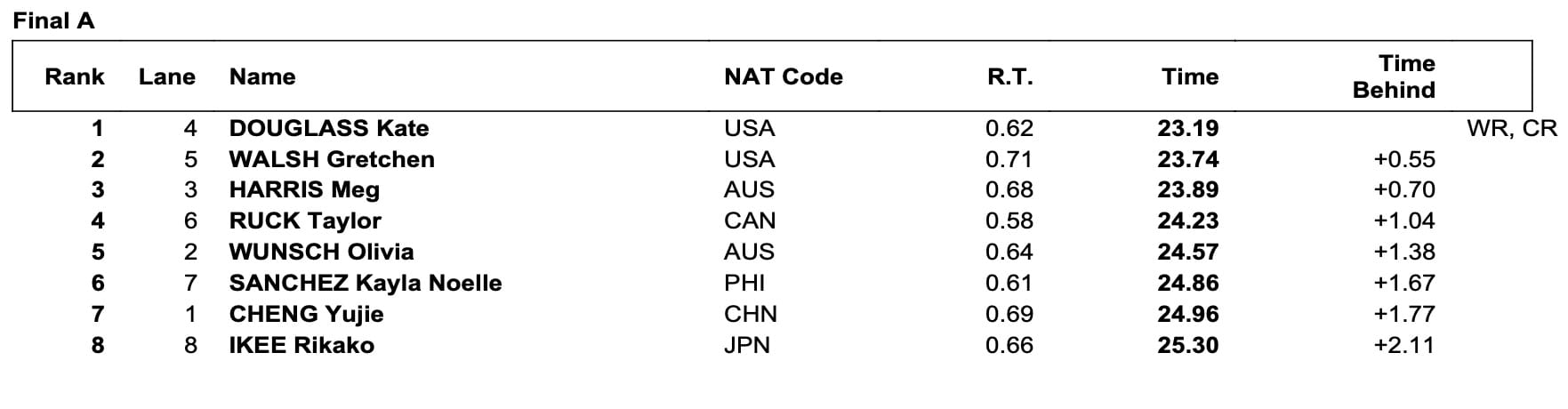
A Gust In Lane 4? Kate Douglass Has Her Bǒras Bounce: 23.19 50 Free WR
Douglass's swim is roughly 30 times more statistically unusual than Johannes Liebmann's 14:26 WR in the 1500m free in Paris, relative to what each event's own history says a "big" record-breaking swim looks like


Impossible to find the right superlative or descriptor, really. Having described Kate Douglass' 23.49 World record in heats of the 50m free as akin to an aquatics bomb being dropped, where to go with a 23.19?
🚀🚀🚀🚀🚀🚀🚀🚀🚀
— 競泳NEWS (@swimcoverage) August 16, 2026
🌏NEW WORLD RECORD!!!!!!!!!!!!!!!!!!!!!!!!!!!!
🇺🇸KATE DOUGLASS
50FR 23.19 WR!!!!!!!!!!!!!!!!!!!!!!!!!!!!!!!!!!!!!!!!!!!!!!!!!!!!!!!!
🔥🔥 A MASSIVE WORLD RECORD 🔥🔥
😳😳😳😳😳😳😳😳😳😳😳😳😳😳😳😳 pic.twitter.com/9itynZF3UP
Where to Begin...
Let's start with Bǒras and Sarah Sjöström's 24.43 shockwave on a gusty day outdoors in Sweden when the sprint ace downed the World 50m butterfly in 2014... the standard stands tall yet, though Gretchen Walsh, Douglass' teammate, has got closer of late, but not cracked the dash as yet, despite making some huge gains in the 100m event. Park Bǒras for a moment... we return there in the stats analysis below.
Point 2. Here is a reminder of the dawn of 50m free among men in 1976, and what happened up to 1980, Jonty Skinner's first-liner a split time to the 100.
23.86 Jonty Skinner South Africa 14 August 1976
23.74 Joe Bottom United States 3 July 1977
323.72 Ron Manganiello United States 29 July 1978
23.70 Klaus Steinbach West Germany 23 July 1979
23.66 Chris Cavanaugh United States 2 February 1980
23.12 h Chris Cavanaugh United States 10 April 1980
Douglass, coached by Todd De Sorbo and team on the pro side at Virginia, is travelling a whisker shy of Chris Cavanaugh in 1980. The historic comparisons of women and men are interesting and mostly fun. And mostly they fall in line with current women's standards being about 50-60 years behind the curve of time when men's top speed was what women's is today.
The more serious point: the women's 50m free within itself and in its own historic timeframe. Douglass's swim is roughly 30 times more statistically unusual than Johannes Liebmann's 14:26 World record in Paris over 1500m free yesterday:
 Craig Lord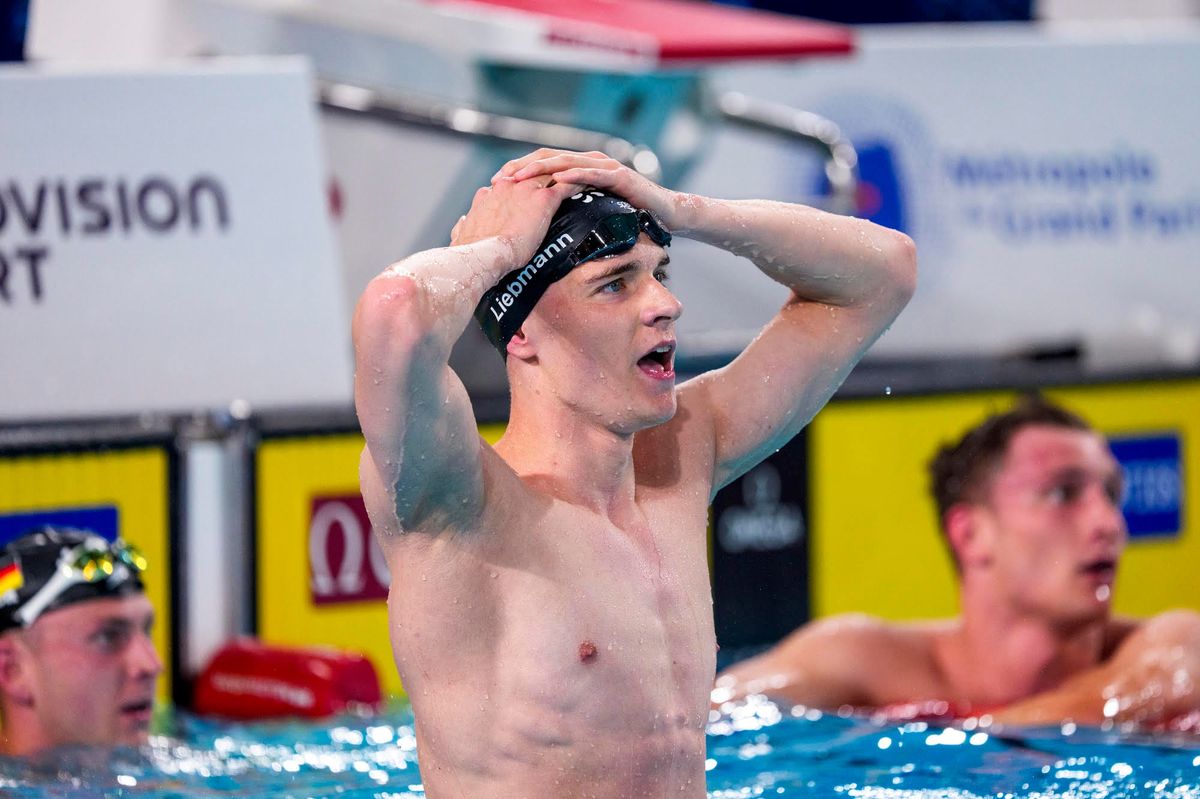
Read on for free by registering with us ... further explanation, analysis and comparison with Liebmann and Sjostrom:


