Time For Fight Not Flight If You Want A Swimmers' Pay Day
To the left, a bulked up $250,000 for a pyrrhic victory at a bonfire of vanities that turned into a damp squib; to the right, a tennis player out injured in First round at the French Open where that starter match carries a €87,000 pay day. What's the real swimmer to do? Stand up and be counted ...


The swim of the meet at the AP Race London International was in no doubt when Anna Moesch stopped the clock in 51.94 for the second-fastest women's 100m freestyle swim of all time:
 Craig Lord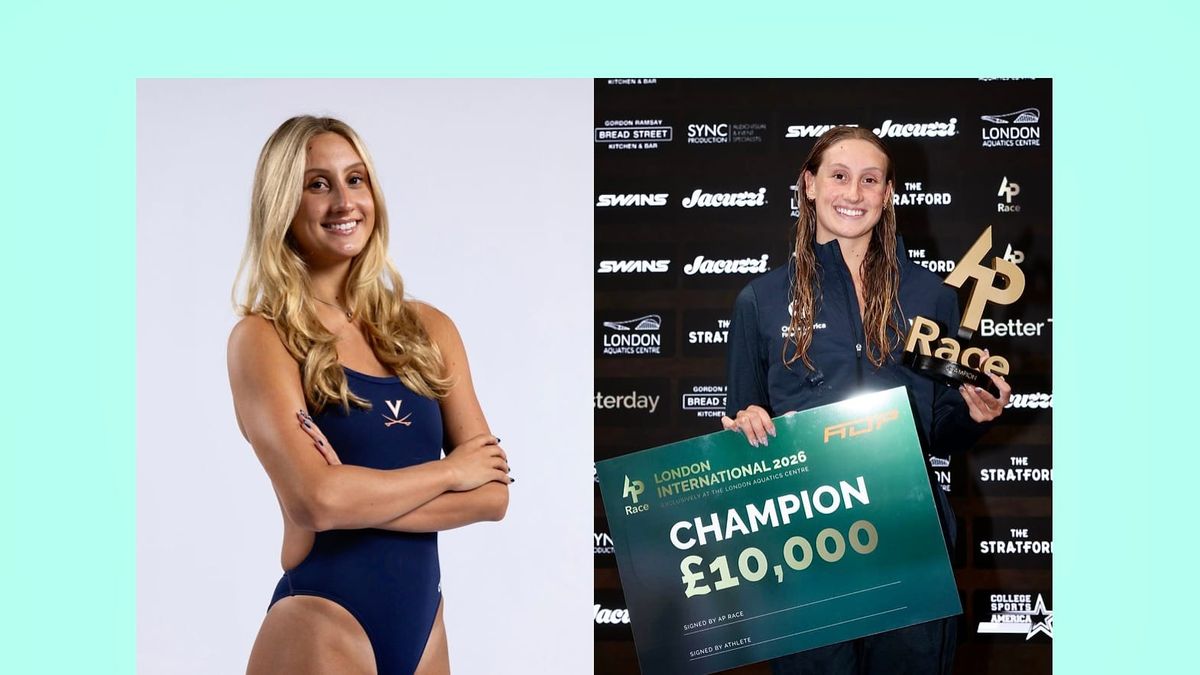
Here are the top 10 performances at the meet, basically covering almost all efforts ranging from 900 points upwards:
1 Annaliesa Moesch 51.94 - 100m free
2 Angharad Evans 1:05.13 - 100m breast
3 Johannes Liebmann 14:45.56 - 1500m free
4 Oliver Klemet 3:44.01 - 400 free
5 Ryan Erisman 3:44.03 - 400 free
6 Florian Wellbrock 14:50.58 - 1500m free
7 Lauren Cox 27.54 - 50m back
8 Filip Nowacki 2:08.85 - 200m breast
9 Oliver Dawson 2:08.93 - 200m breast
10 Adam Peaty 26.79 - 50m breast
There were plenty of other fast swims and many tight tussles, too, at an event that included junior and fun/inspiration events - and was, doubtless, best seen live in-venue in the way the original London International - sponsored by Coca Cola in the late 1960s and early 1970s - was.
Inspiration is keener when you with less it directly and then get to see the high achievers right there in front of you, engaging, talking, signing autograph books and shirts, the sights, the sounds, the smell, the touch, the look and feel and essence of the day enshrine in memory to be treasured forever. Many decades on, I can remember a day in 1971 at London's Crystal Palace like it was yesterday. I wrote about it here:
Craig Lord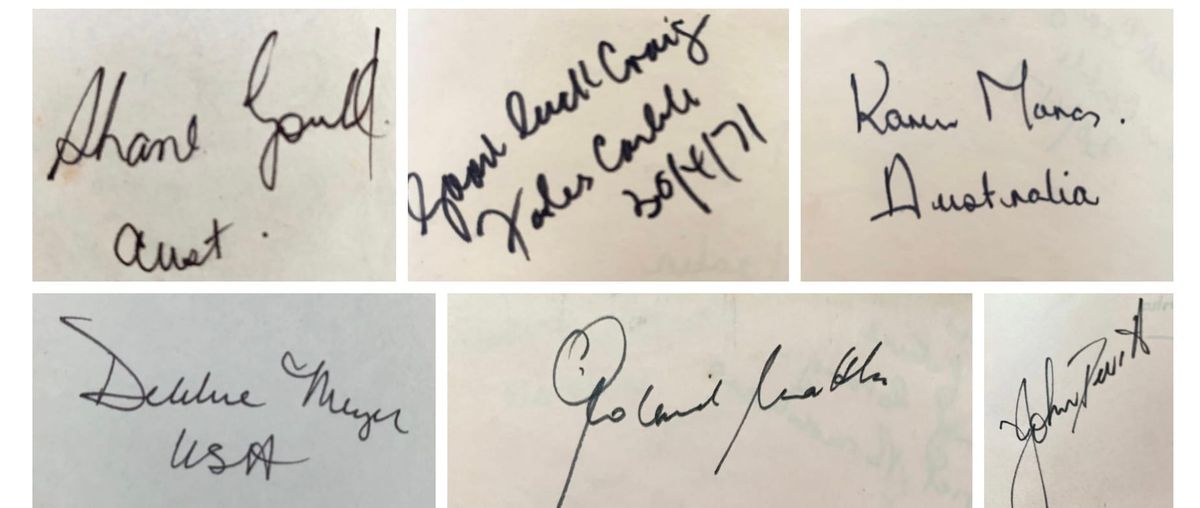
There was no digital era, no internet, no social media back then, of course, but the press bench was full, camera crews and international broadcasters in town to see Shane Gould match Dawn Fraser's 100m free World record, to see Karen Moras break Debbie Meyer's last World record, over 400m free, to witness the roll of Roland Matthes, the Rolls Royce of backstroke on his way to becoming the first winner of back-to-back double backstroke crowns at his second Olympics, a visiting Canada team with Donna-Marie Gurr, Angela Coughlan and Byron McDonald; Gould and Moras' mates John Devitt and Debra Cain; Meyer's mates Ross Wales American-team siblings Lynn and Rick Collela. There were many more, and thanks to each one of them who stopped in front of a scrum of kids and signed our books. The ripple is real.
It was an era when swimming both engaged with and was reported on far and wide in mainstream media, national and international.
Sadly, no more. Search online for Anna's 51.94. Niche only, despite the all-time No2 time, despite the thrill of a growing event that does a fine job of weaving the story of what is and what may come next, despite the 10k prize for the best swim. The smorgasbord of 'direct' social-media and online access, live streams and results has tricked a generation into thinking that will be enough to reach the wider audience where growth resides. It won't.
Discount the niche, no matter what the digital counts and its algorithm may tell you; it's always lovely to have a chat with the 'family' but the point of growth is to tell folk beyond your garden gate 'come in, the water's lovely'.
The result is very similar if you run the same search for a wave of recent national championships and internationals such as the Stockholm Open of last month, and other summer-season qualifiers such as the Mare Nostrum Tour we're in the midst of this week: practically nothing, the likes of Johannes Liebmann's 800m free European record getting a smattering of coverage in Germany, a mention in the odd round-up column, the same for a few other outstanding swims in their own national media, the vast majority of all other action (and, as usual at this time of year, there is a lot of it) gets no mention whatsoever - anywhere.
I discuss that and related issues in our latest SOS FORUM series focussed on where swimming might find elusive growth, including the need for guardians to do far more to help build a genuine economy for the sport.
Part 3 and 4 both raise the issue of swimming's significant loss off mainstream media coverage at almost all points, now, in between Olympic Heights, even World long-course championships barely attracting the much more extensive coverage the sport we saw in a long period up to the start of a decline that has accelerated in the past decade, economic stresses on media brought about in part by the changing landscape in the sector leading to more focus on the sports that have big economies, wage-paying structures for professional athletes (and others), sponsors, partners and investors at the interface between the sports and the wider world of lifestyle and deep connection to long-established seasons, traditions and followings of a kind that pre-date the digital era by decades.
Here's an example of one of the key aspects of Part 4 in our series, storytelling and why swimming's relationship with mainstream media - perhaps worse now than at any time during my years as swimming writer for The Times since the late 1980s - matters:
Craig Lord
And Part 3:
Craig Lord
On the issue of mainstream media, here's some context from the UK and Europe this morning:
Turn on the UK's premier morning-prime-time radio news program, BBC Radio 4's Today, widely regarded as the most influential news and current affairs broadcast in the UK, a program that serves as a primary agenda-setter for British politics, business, and media. In short, decision makers, investors, markets, other media and more tune in to get their steer for the day. There's a regular sport slot, and swimming gets very occasional mentions, but far fewer than many other sports, including the big Pro hitters at the top end, women's football (coverage of which now knocks all swimming into a cocked hat) a growing media magnet (some of it distinctly tick-box led), and at the bottom end of the scale, we find the top of the Olympic-sports ranks, track and field.
Tennis is up there with the sports that get year-round coverage, each passing season, grand slam and feeder event in its place on the calendar and followed faithfully by a very large, regular and constant caravan of international mainstream media.
The caravan follows not just a sport, but a sport that is expected, awaited, predictable on the calendar, tickets, including membership packages, season tickets and the like, bookable long (sometimes years) in advance.
Here's what that looked like this morning compared to the World top 3 rankings of the likes of Moesch, Evans, Liebmann, Klemet and Co. All, important to note, will have to replicate at least that standard and at least that ranking in a singular fleeting moment run their lives in Los Angeles in 2028 to get anywhere remotely close to the kind of sports experience of 30-year-old UK tennis player Cameron Norrie, who retired injured from his first-round match at the French Open yesterday.
That piece of news generated dozens upon dozens of articles, explainers, commentary and analysis to sit alongside the official broadcasts being beamed around the world. Here's one of several takes on the BBC website since Norrie's exit, explanation and understandable frustration:
 Jonathan Jurejko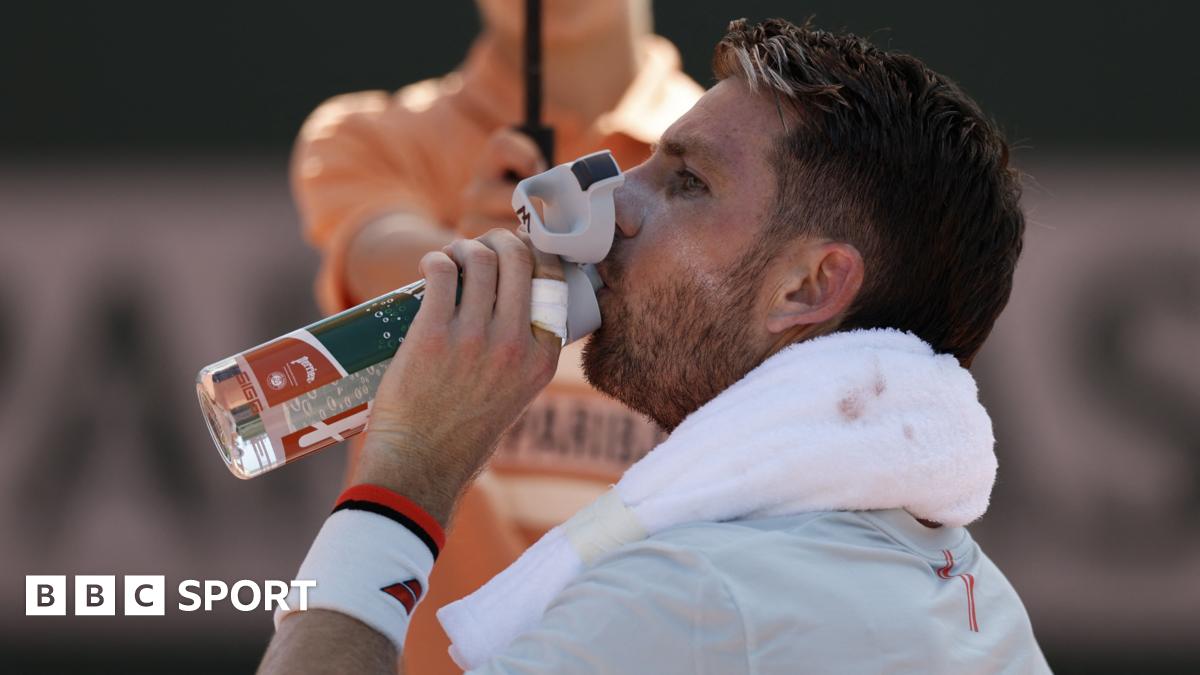
Multiply that count of one article, its length and breath, until you're running at least two noughts at the back of the sum, and you get an idea of how much coverage Norrie's first round exit has had since he said: "It takes a big mental effort to play matches like this when you're not fully fit."
Not fully fit - but easily able to pay his bills. First round players at the Open receive €87,000. This is an imperfect summary of what springs to mind, but I make the point anyway:
That first-round fee is a sum most Olympic finalists, including medallists, in swimming can only have ever dreamt of throughout history and continue to be in a place where they can only dream of earning a decent living wage for their professional commitment in a highly subsidised sport that is yet to build a professional wage-based economy for the folk who generate the income. It's a sport in which governors dedicate a large share of revenues to solidarity in the shape of development centres and related activities, prize money that is thinly spread, and HQ moves, real-estate twists and turns and other costly ventures, while most swimmers in the leading 20-30 swimming nations of the world alone rely almost entirely on the bank of mum and dad, and, should they get to the edge of the aquatic equivalent of Norrie's rank and status in tennis, may benefit from funding models are often provided by taxpayers who, like most athletes and other actual stakeholders, have no say in the decision-making process that determines the environment in which they work. Examples of experience include South African teams of swimmers whose families must pay big sums for the privilege of taking up the Olympic selection they have earned; or, as is the case in New Zealand this year, the families of swimmers selected for an international in Australia must pay for their team kit and contribute to costs in order to take up the 'honour of selection'.
Meanwhile, here's Cameron Norrie's ATP profile at a glance:
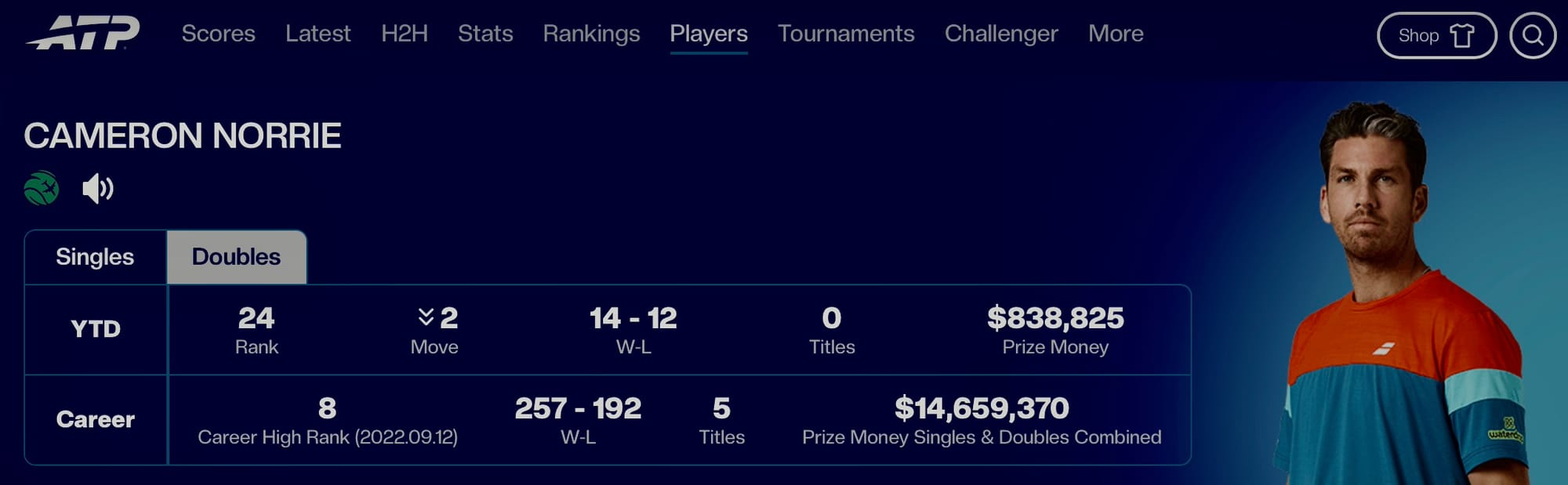
Since his career earnings topped the $1m age 23 in 2019, the account has stacked up nicely, his career earnings total flowing as follows:
- 2019 - $1,767,551; 2020 - $2,688,134; 2021 - $5,022,119; 2022 - $7,950,477; 2023 - $10,178,607; 2024 - $11,523,739; 2025 - $13,538,950; ... and with what he's earned so far in 2026, $14,135,517. In full.
Wonderful - and horribly painful for swimmers and all those who guide them from youth to national teams and into finals at international level, the scales as far apart as possible when the weight of work and dedication and discipline send one scale crashing to the deck, the compensation scale high in the air, even the weight of a gold medal like a feather when compared to Norrie's nest-egg of a net worth.
At which point, there will be those who say 'see, that's precisely why some swimmers have chosen to hop off to the Enhanced Games and earn 'what they deserve'. I really wouldn't like to say what I think people who embrace doping despite the horrid history of harm in swimming that screams "we've seen it all before, including the daily medical supervision that made the whole thing fall somewhere between 'safe' and 'worth the risk', at least for the state actors and puppet-masters, some of whom would later be convicted of bodily harm, fined and handed suspended jail terms."
I'm going to give the clown show as little energy as possible - so here's my short take: mainstream media coverage was largely 'negative', or, as I see it 'negative in a positive way', meaning, a great deal of it was highly critical of the whole concept.
Among the many ignorant, ill-informed comments on Social Media was this one from a doctor in San Diego who's into 'connecting metabolic, mental, & cardiac health' and had this to say: "I'm seeing negative press about the enhanced games due to only 1 world record being broken and un enhanced athletes beating the enhanced athletes. For me this totally misses the point. It's not about the best performers in the world. It's about athletes retired for 10 years, coming back and getting their personal best. It's about how that relates to the average individual wanting to perform their best. Plus, the absence of the truly best of the best will limit the ability to achieve world records. But that's not the point. The point is for me is what it can mean for human health more broadly."
I responded:
"No world record was broken (no eligibility, several grounds, not just doping) + 1 swimmer retired for a long period … most v recently retired. ‘Negative’ response not because WRs were not ‘ broken ‘… but because EG made records they are not eligible for central to their peacockery."
Or perhaps the coaching was off? Who knows. Or more to the point, who cares.
Among the few who do is Shane Ryan, a former American member of the Ireland team retired from the elite land and now chasing enhancement. He compared the Enhanced Games to the recent China Open, saying: "It's the same thing as when the US swimmers went over to China to that meet where there was a money grab. That's the same thing. Exact same thing... We're being open about it."
I responded:
"Of course it’s not … sure, they both promote charm offensives that seek to sweep truth under carpet but racing doped swimmers and playing a role in the promotion of doping as a ‘sports’ option is not ‘the same thing’ as an ill-judged Wada decision. + 2 wrongs don’t make a right."
And here's Libby and Georgie Trickett on the subject at the Sportish Podcast, well worth a listen - An Emergency Enhanced Games Debrief
"Nothing grabbed me; I wasn't particularly interested in it, because it wasn't sport. There was nothing on the line except a bit of prize money. We don't know who these people are, we're not really interested in them." - Georgie Trickett
She and Libby make the point that the expected crowds simply didn't turn up. "It was dead!" says Georgie. And then listen to what Libby has to say via the link above.
The sense of 'damp squib' was all too real for the unreal unfolding in the pool.
Of course, we all get the need to earn a decent wage, but as every swimmer in the world knows, because they have parents, siblings, other family members and friends who go to work every day in return for a wage, most of us have to do rather more in life to earn a crust than preparing for a 50m dash pumped with drugs, a body suit to buoy us and our egos to a time on a clock the wider world neither understands nor could care less about.
Do I think Cam McEvoy is underpaid for his 20.88 and all that went into it? Yes, no question. Do I think any of the swims seen at EG were worth the big-spend, small change of tech bros and co's? No.
So, by all means tell Kirsty Coventry that she's living in her own past when she tells Sport Nation NZ:
“I don’t believe in paying athletes. I come from a small country, I came from a sport that doesn’t necessarily pay athletes very well, and I still don’t think we should be paying athletes at the Olympic Games. Now I do think we should find more ways to directly impact athletes ... to find ways to directly help them on their journey to becoming Olympians, while they are Olympians, and as they are finding ways into their new career transition.”
Her's ended up with a very well paid job as president of the International Olympic Committee after some while towing the sports politics line at the heart of an organisation that has a constitution that insists politics is kept at bay, at least for athletes, most of whom will have a far more challenging 'transition' into the rest of life far from the comfortable subsidised journeys of IOC board members, some of whom are independently wealthy and would struggle to understand what it takes for a swimmer to get anywhere near an Olympic gold medal.
I'm not suggesting the Olympics would benefit by giving pumped-up prize points in enhanced dimensions for every gold, but World Athletics is on a much better curve of reasonable compensation for Olympic athletes than World Aquatics as things stand. Swim bosses have given the matter some thought, but too much, including a foundation 'pension' fund, is linked to obligations that simply don't add up for the vast majority.
More Swimbledon, Duel and League, less Swim World Cup and endless championship formats required in between the championships that matter most and would benefit from replacing the constant mirror with a parallel stream that shines and flows in its own right and context. One of the thrills of college racing in the U.S. is that it's about team, it largely unfolds in an irrelevant measure of a pool that tells us far less about prospects in a 50m long-course pool than many a forecast would have us believe. It's different, the pressure is fun and not directly related to the goal that need not stare the swimmer in the face with every passing race.
Meanwhile, I say this to swimmers: By all means break your silence and tell Kirsty what you think - and press World Aquatics to build that wage economy; pray do get back to the idea that you need to build a strong athlete representative voice with organisations such as Global Athlete to force he change that will not come without your input and determination (you know how results in the pool are achieved - its no different in life and governance); please do speak to your home-nation politicians about better facilities, conditions and the importance of supporting swimming as a life skill, safety to physical and mental health - of individuals and communities, like Duncan Scott and others at Scottish Swimming have (as one example among many fine contributions the sport makes beyond its spill, the standard work of vast numbers of swim clubs and coaches around the world often engaged in similar positive contributions).
But don't ask us to see signings for a cited 'longevity/vitality' research project in which very wealthy investors (some of who have some extreme ideas about the future of humanity, and others among whom have some serious questions to answer about their business models) are paying $250,000 a pop for shiny suited and/or doped efforts that fall shy of any outstanding, natural human achievement, regardless of where the clock stops.
The enhanced circus gave its guinea pigs more prize money, but no progress, no soul, no meaning, no line nor lore for the book of sport and its fair play principles.
We know some people cheat and some push the line of limits put in place for sound reasons - and we know, too, that many of them are not winners, m just folk hoping the assistance will get them closer to those blessed with the extraordinary qualities, physical and mental, required to compete - and win - at the highest levels of their game.
In that sense, among others, the EG teaches us nothing. The role of fair play, ethics, integrity, a culture of 'do no harm' on the sidelines of the EG as constant lessons and reminders of the better way. The Competent Causation Principle is one in which philosophers of cognitive science "emphasise that true human achievement must stem from the individual's raw talent and sustained effort, demonstrating a clear, direct causal link between the person's internal drive and the outcome".
And all of that is more energy than any clown show deserves.
Swimmers should remind themselves of London 2019, a meeting with the League at the outset of what promised so much, delivered to a degree and remains highly relevant to the building blocks required for there to be a swimmers' pay day one fine and much better day.
The link below takes you to what unfolded in London in a different direction and in a place where inspiration will ripple out to the next wave and the next in a way that the self-interested, peak-less peacockery and damp squib of Las Vegas ever could, Cody Miller's frail and highly questionable '... but it's the future' something we should all hope will never come to pass.
And a feeling glimpse of why the event is much more than a swim meet - from Kevin Pickard:


