Lance Larson – Sub-Minute 'Fly Pioneer Who Triggered The Birth Of The Timepad
Into our SOS Hall of Fame goes Lance Larson, as we add the profiles of the pioneers, the American's role including a pioneering 59.0 100 'fly sub-minute debut, the Olympic judgement of the naked eye & a role in butterfly's breakout from its breaststroke cocoon - a rich thread of swim history ...


Lance Larson turned 80 on July 3, 2020 - in the same week in which he was also able to celebrate the 60th anniversary of the moment he became the first swimmer to race inside the minute over 100m butterfly.
The American, better known for the first place at the Olympic Games that resulted in the faster swimmer being handed the silver medal over 100m freestyle in the days when the naked eye counted for more than the clock, clocked 59.0sec over 100m butterfly on June 26, 1960.
With that swim, Larson had done for butterfly what fellow American Johnny Weissmuller had done on freestyle in July 1922: he shattered the existing speed standard with an effort that swept pioneering pace well inside the minute.
On June 29, 1958, Japan’s Takashi Ishimoto had axed 0.9sec off his own global standard to leave the ‘fly mark at 1:00.1. It would only be a matter of time before the barrier would fall. Come the hour, Larson left no doubt, with a following wind, his 59.0sec now 60 years old as the pioneer turns 80 today (from our 2020 archive).
Larson's also held the world best in the 200m medley, his 2:24.7 clocked on July 11, 1959, in Santa Clara. World records in the event only counted from 1954 onwards, when a minimum time of 2:13.0 was set. The first official global long-course standard was the 2:12.4 swum in Lincoln, USA, by Greg Buckingham on August 21, 1966.
Lance Larson was born on July 3, 1940 at Monterey Park, California. He grew to be 6 ft 1 in (1.85 m), weighed in at 174 lb (79 kg), excelled on butterfly, freestyle and medley and raced for the Los Angeles Athletic Club and, in college, the University of Southern California.
Larson attended El Monte High School. He set CIFSS (California Interscholastic Federation-Southern Section) records of 55.5 and 54.6 over 100 yards butterfly in 1957 and 1958, the latter the same year he took the 100-yard freestyle standard down to 50.9. Larson later became the first high school swimmer to break 50sec over 100-yard freestyle but his pioneering sub-minute 100m butterfly is more widely known.
Racing for USC Trojans at NCAAs, he won free, ‘fly and medley titles and claimed Amateur Athletic Union (AAU) national crowns in all three disciplines, too. Rome 1960 was a crowning moment that might have been all the more spectacular had it not been the last Games before timing would count for more than the naked eye and one of the last before the introduction of a race program more akin to that we know today.
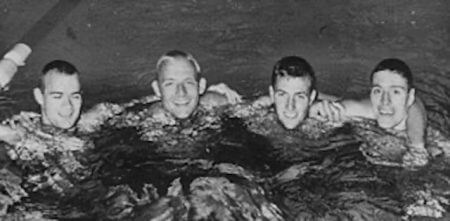
At the 1960 Olympic Games in Rome, he claimed gold in the 4x100m medley and a controversial silver as the fastest man home in the 100m freestyle.
Larson later married Betty Lee Puttler (1940–2007) of Newport Beach, California and the couple had four sons, Lance Jr., Greg, Gary & Randy. Lance Lanrson senior remarried in the late 1990s, and has two adopted daughters.
Retired since 2014, he lived in Southern California’s mountain community after a career operating a dentistry practice in Orange, California from 1979 onwards.
Lance passed away in Orange, California on January 19, 2024 following complications from pneumonia, at the age of 83.
At the time of his death, he was survived by his wife Sherri, four sons: Lance Jr., Greg, Gary and Randy; two daughters: Jairica Fosburg and Danica Juliano; three stepdaughters: Erica Leon, Jessica Sherwood, and Monica Jara; and 10 grandchildren.
Lance Larson The Unlucky Swimmer Granted Silver As The Fastest Man Home
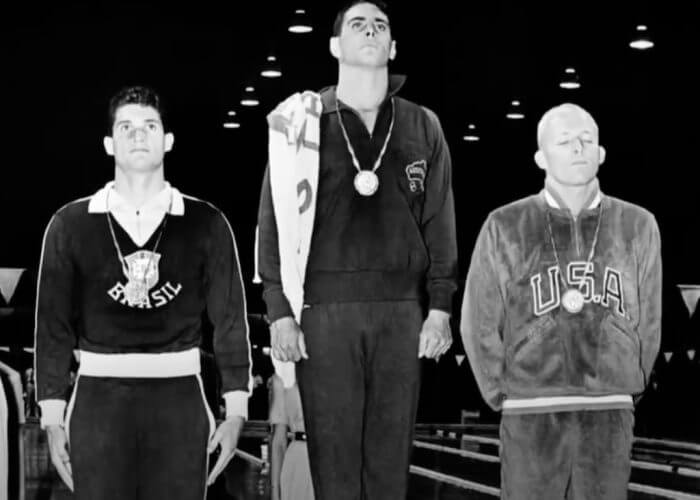
Lance Larson may well be regarded as one of the unluckiest swimming champions in history. Consider this unfortunate circumstances:
- his 55.1sec timing over 100m freestyle clocked in the Rome 1960 Olympic final was declared an Olympic record a year after he swam the time only to find himself handed the silver medal behind Australia’s John Devitt
- he was the dominant 100m butterfly swimmer of the summer of 1960, taking the global mark down to 58.7 on July 24 a month before the last Olympic Games not to feature the 100m butterfly (a ‘pure’ sprinter, he was fourth at U.S. trials over 200m butterfly)
- he was part of a USA 4x100m freestyle quartet in summer 1960 that would surely have shattered the world record for Olympic gold had the 4x100m freestyle been added to the program in 1960 not 1964 (Larson and Farrell held the world record with Ed Follett and Joe Alkire at the time of the Rome Olympic Games)
He might have come away from Rome with four golds if the sands of time had shifted in his favour but they did not and the gold he claimed in the 4x100m medley with Frank McKinney, Paul Hait and Jeff Farrell represented his only visit to the loftiest place on the podium. His bonus with team-mates was a world record of 4:05.4, inside the 4:08.2 clocked by his prelim teammates Bob Bennett, Hait, David Gillanders and Steve Clark, who would shatter the 100m free World record a year later on 54.4 in Los Angeles.
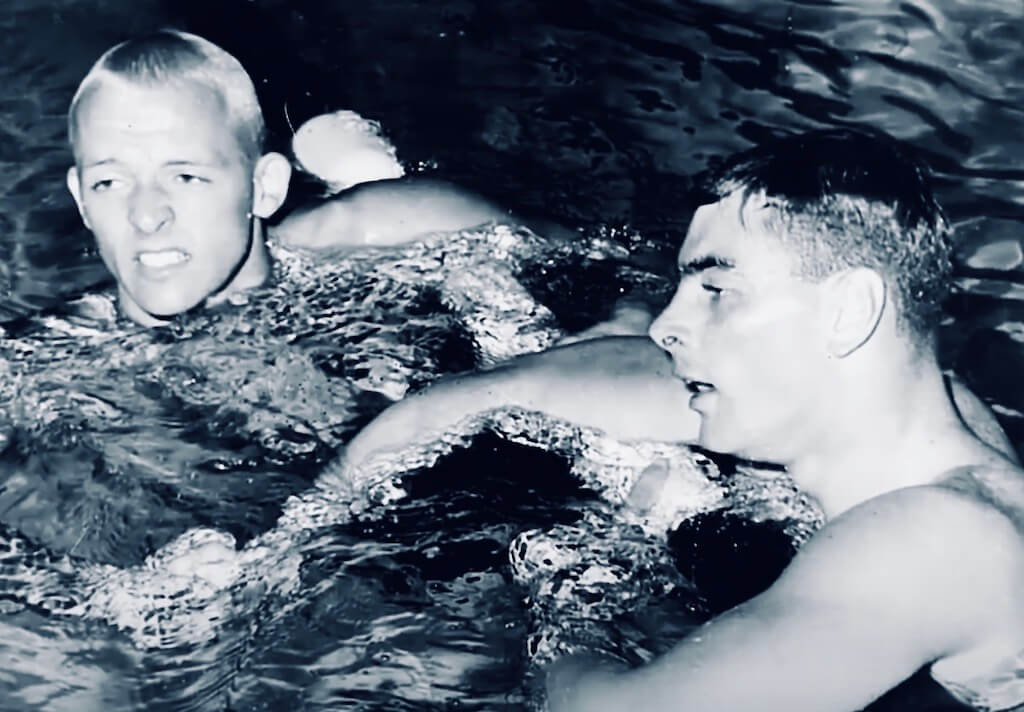
Devitt had set the global standard at 54.6 on January 28, 1957 – and that’s where the mark stayed all the way to the Olympic final in Rome. In December 1956, after deciding that only long-course swims would count for World records, FINA declared the 55.4 in which Australian Jon Henricks had claimed 1956 Olympic gold in Melbourne the first global 100m free standard of the new era.
When Devitt became the first below 55sec long-course on January 28, 1957 in Brisbane – breaking the World record of 54.8 by Dick Cleveland, of the USA, in a short-course pool – FINA had a rethink, scored Henricks out of the list and made Devitt’s time the first pioneering effort of the long-course era.
By Rome 1960, Devitt remained a golden shot – but with his 55.0 American record from trials, Larson was a clear threat.
John Devitt passed away on August 17, 2023 – here is the obituary I wrote at the time:
 Craig Lord
In the rest of this file:
- Butterfly's Breakout From Its Breaststroke Cocoon & The Stroke's Birth & Evolution In The Era Of Lance Larson


