On This Day In History - When Hveger, Verdeur & Salnikov Pushed The Pace
Timeline - The SOS Daily Trawl of official World long-course records (plus all pre 1954 standards, all pools and metrics) set this day throughout history.


On this day in history… World records were set by Ragnhild Hveger, Joe Verdeur and Vladimir Salnikov.
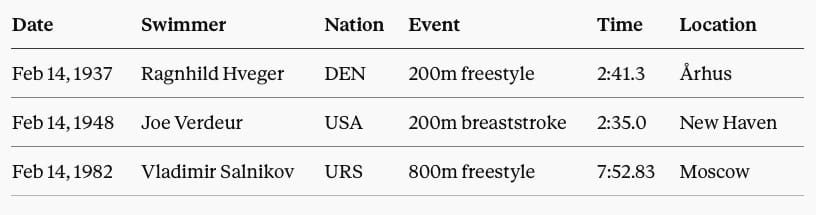
Most of Ragnhild Hveger’s 44 World records were set over 200 to 800 freestyle but on this day in 1937 at home in Århus, the Danish pioneer wiped 3.2sec off the global 200m backstroke standard that had stood to Nida Senff, the 1936 Olympic 100m back champion for the Netherlands, for 12 days.
Hveger’s tally of 44 standards included 15 in events that remain official to this day, her 200m backstroke marek the only one that was not set on freestyle. It was swum in a 25m pool in 1937 before rule changes made 50m pools the only measure that counted for what we now know as the ultimate, long-course, World records of the sport. Hveger’s count of global marks places her among the most prolific standards-setters in the sport.
 Craig Lord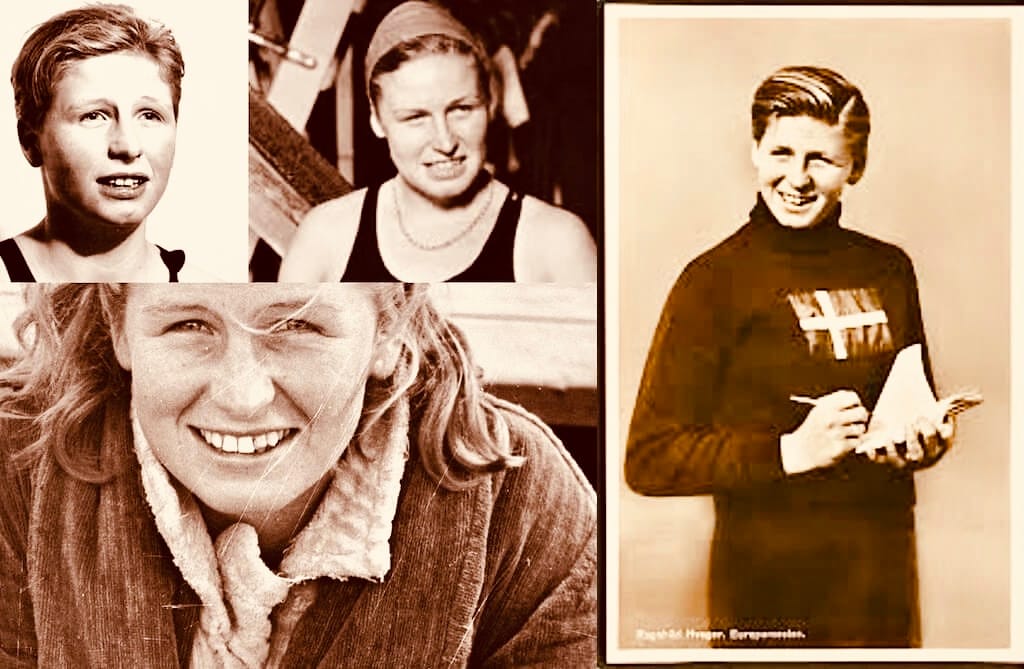
Other commitments prevent the posting of other profiles of World-record breakers this weekend - additions will follow in the week ahead. For now, a couple of small notes on Verdeur and Salnikov:
Joe Verdeur broke the World 'breaststroke' record 12 times between 1945 and 1950, at a time when using butterfly arms was allowed. He set the official 200 standard seven times, more than any other swimmer in history ever has, though he was swimming a totally different stroke to the breaststroke we’ve known since the 1950s.
At the 1948 Olympics, the 200m final produced a USA clean-sweep: even though John Davies (AUS) was timed at 2:43.7 and Robert Sohl (USA) at 2:43.9 behind champion Verdeur (2:39.3, OR) and the other American in the race, Keith Carter. The times stood, but bronze was awarded to Sohl by the naked eye of the finish judge. Such was life for athletes before electronic timing.
The race saw seven men use a butterfly arm action. The one man in the final won by Verdeur who used traditional breaststroke, Bjorn Bonte, of the Netherlands, paid the price of a sport that had yet to batten down the hatches on what the stroke would become: he was last.
It would not be the last Olympics without butterfly: the first Games that saw the new stroke in Olympic waters was Melbourne 1956, by which time, no dolphin/butterfly action was allowed in breaststroke - and the four-stroke ‘medley’ was born, through it would not appears in the Olympics until Tokyo 1964.
Meanwhile, in Verdeur's 'legends' profile, we'll explain the several reasons why the 200m breaststroke world-record list is not a simple record of progression on the clock, with the official standards getting faster, then slower, then faster, then slower than the previous mark too many time s to make sense to the casual observer...
Vladimir Salnikov was known as "the Monster of the Waves": when he claimed the first of his Olympic 1500m freestyle titles, at Moscow 1980, he was the first man ever to race inside 15 minutes. Between 1979 and 1986, he set 13 World records over 400 (6, which remains the most ever in the event by a man), 800 (4) and 1500m (3).
On this day, he clocked the second of his 800m standards, after having become the first man ever to race inside 8 minutes with a 7:56.49 as a split in a 1500m race at the URS Vs GDR duel in Minsk on March 23, 1979. That performance marked the first of his 13 global marks.
No records on February 13, this year falling on a Friday ... take care! :)
February 12
When Bill Smith Added The 200 WR To His Pantheon
On this day, February 12, in 1944, Bill Smith, who already set global standards at all distance from 400 yards and metres up to the mile, set a 200 standard four years out from double gold at London 1948:

 Craig Lord