On This Day In History - When USA Mates Gaines & Sterkel Set The Global Pace
Timeline - The SOS Daily Trawl of official World long-course records (plus all pre 1954 standards, all pools and metrics) set this day throughout history.


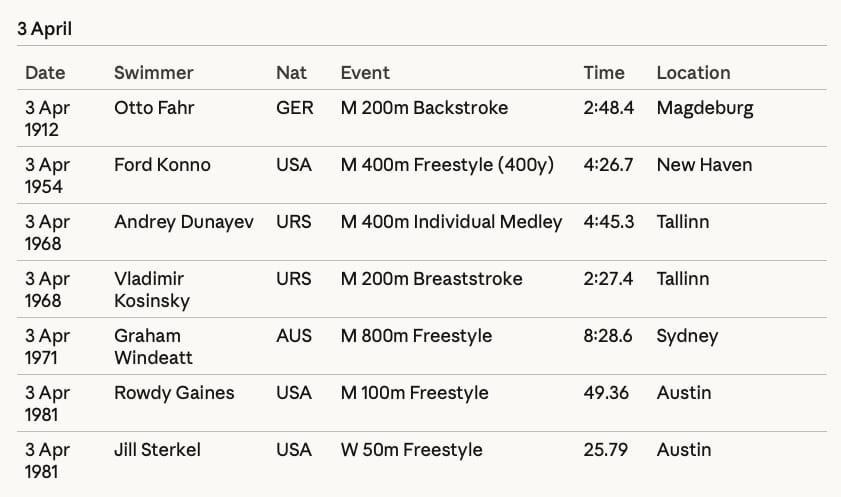
The following World records* were set on this day, April 3, in history:
All those pioneers enter the SOS Hall of Fame today, as we build our pantheon of legends, adding as many profiles as possible - and as close to a record-breaking day for each athlete - as we make our way through 2026.
Rowdy Gaines set his sole 100m free standard in 1981, three years before Olympic gold in the event at a home Games in Los Angeles.
He was the third holder of the standard in the sub-50-second era, after a 49.99 for Montreal Olympic gold made American Jim Montgomery the first to break the barrier, on 25 July 1976, and what followed hot on its heels: a 49.44 from Jonty Skinner, barred from competing at the Olympics because of his nation's apartheid regime in South Africa, on 14 August 1976 at the AAU Championships in Philadelphia.
Gaines, who raced for Auburn, clocked 49.36 in a time trial on 3 April 1981 at the Longhorn Invitational in Austin, Texas. That would be the time to beat until a 49.24 from Matt Biondi on 6 August 1985 in heats at USA Summer Nationals in Mission Viejo, California, three years out from his own 100 free Olympic gold for the USA, at Seoul 1988.
Sterkel, who swam for the Texas Longhorns, clocked her 50m free World record at her alma-mater's meet five years before the dash was first swum at he Madrid 1986 World Championships ahead of the.event's introduction to the Olympic program in 1988.
(an earlier version of this note on April 3 connected the two USA sprinters at the Longhorns meet where they both set their records on the same day, and has been clarified: Gaines raced for Auburn - thanks to the sharp-eyed reader who asked the question)
More on Jill Sterkel and what her Montreal Olympics 1976 victory with USA teammates unlocked...
 Craig Lord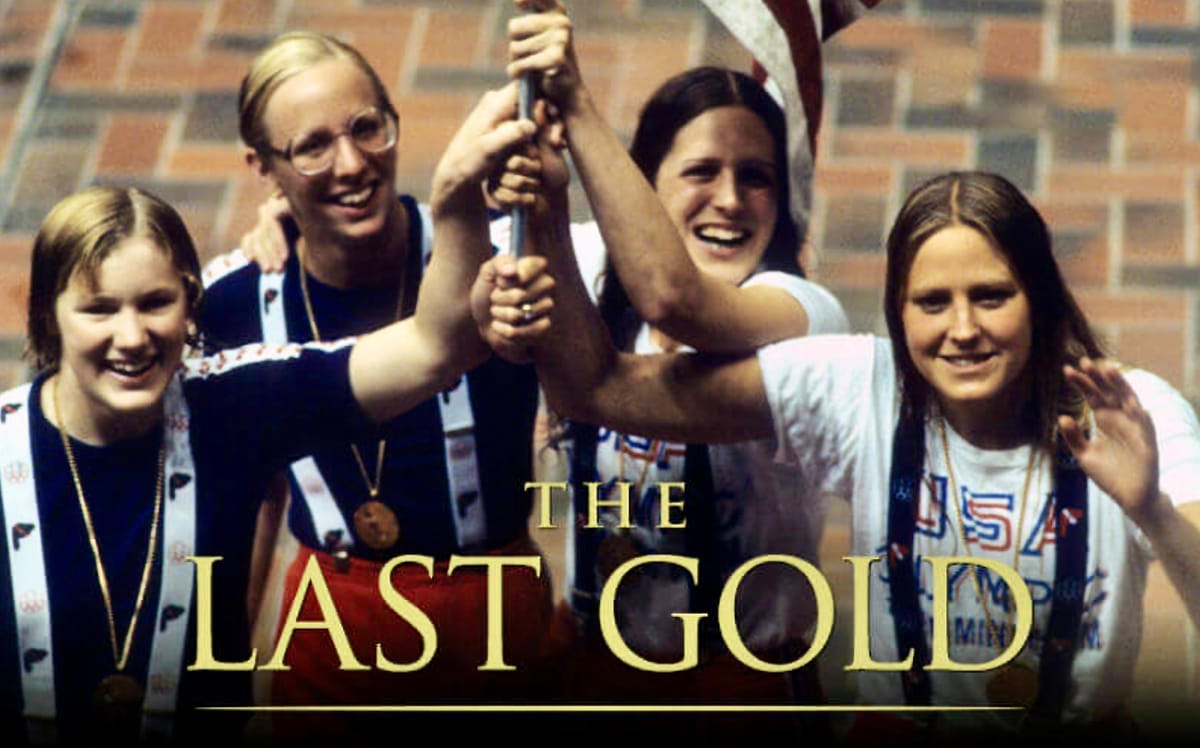
 Craig Lord
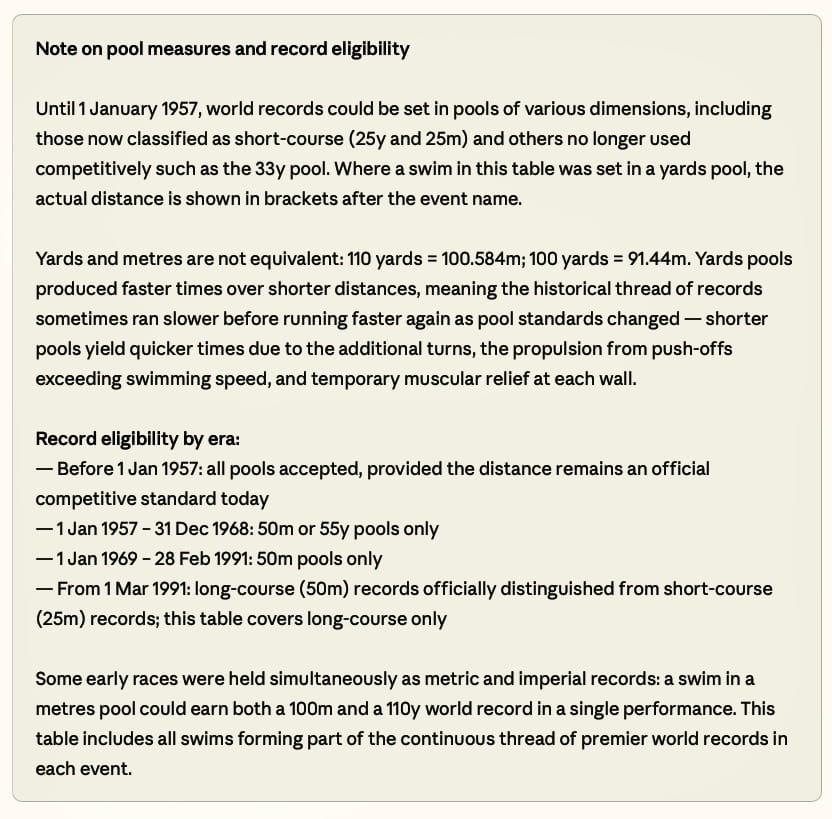
- * - the measure of World records in this current exercise:
April 2
The Swim Evolution That Links Leo Spence & Joe Verdeur Either Side Of War
On this day, April 2, in history, the following swimmers set world records:
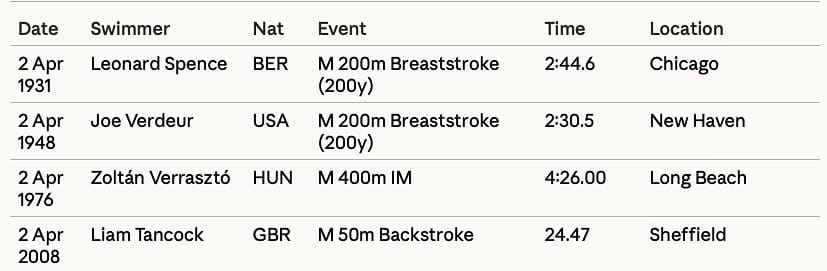
1931 and 1948: the world 200m breaststroke records set on this date all those years ago - and the stories of Leonard Spence (see profile below) and Joe Verdeur spanning the evolution of breaststroke before a split with butterfly from a time to before WWII to a time after it:
 Craig Lord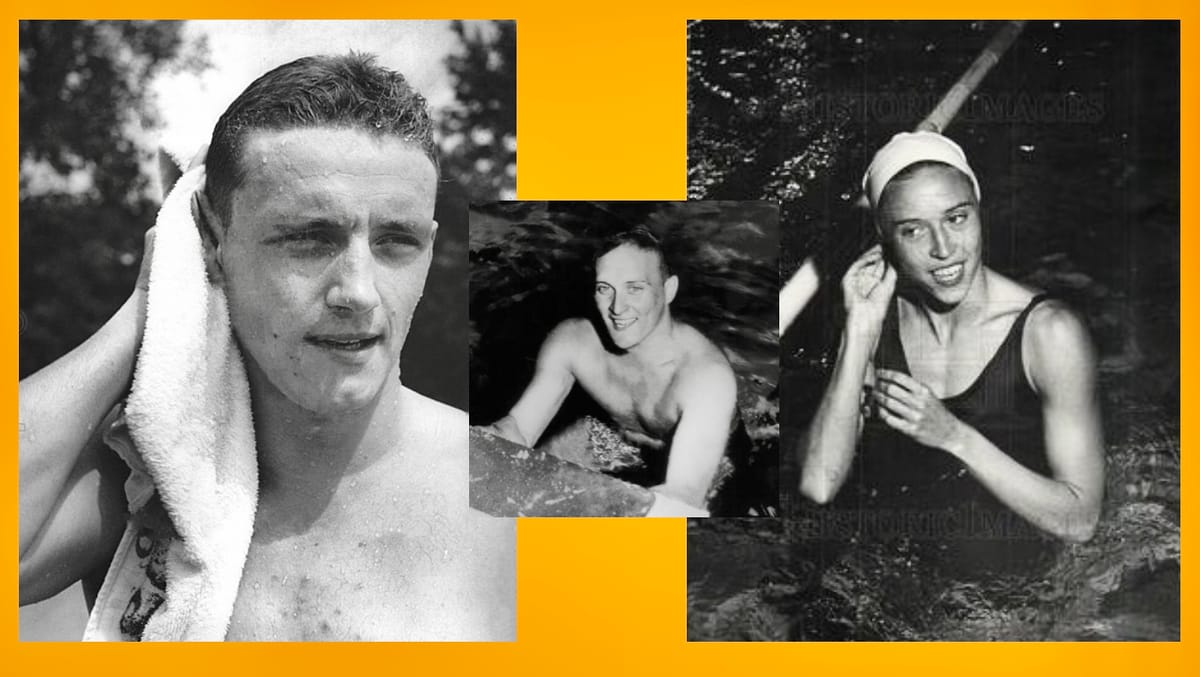
Similarly, the other two standards set on April 2 in history, have connections, in that Zoltán Verrasztó, was, like Liam Tancock, primarily known as a backstroke swimmer. Indeed, Verrasztó was reigning World 200m backstroke champion (1975) at the time he set the 400m medley record in 1976.
The Hungarian, who turned 70 on the 15th last month, won silver in the 200m back and bronze in the 400IM at the Moscow 1980 Olympics. His pantheon also includes the 1977 European 200m backstroke title.
He later coached his children, Evelyn Verrasztó and Dávid Verrasztó to world-class Olympic status.
Each claimed European titles during their careers, while David built a unique range of 400IM honours: two silver at Wold long-course level (2015, 2017), three bronzes at World short-course level (2012, 2014, 2016); three golds (2014, 2016, 2018) and three silvers (2010, 2012, 2022) at European long-course championships; ands three golds (2010, 2013, 2015) and three silvers (2009, 2011, 2012) at the European short-course championships.
More profiles to come as we build our SOS Hall of Fame
April 1
When Summer McIntosh Heard The Crowd Roar For The First Time - & Leonard Put The Brothers Spence On The Swimming Map
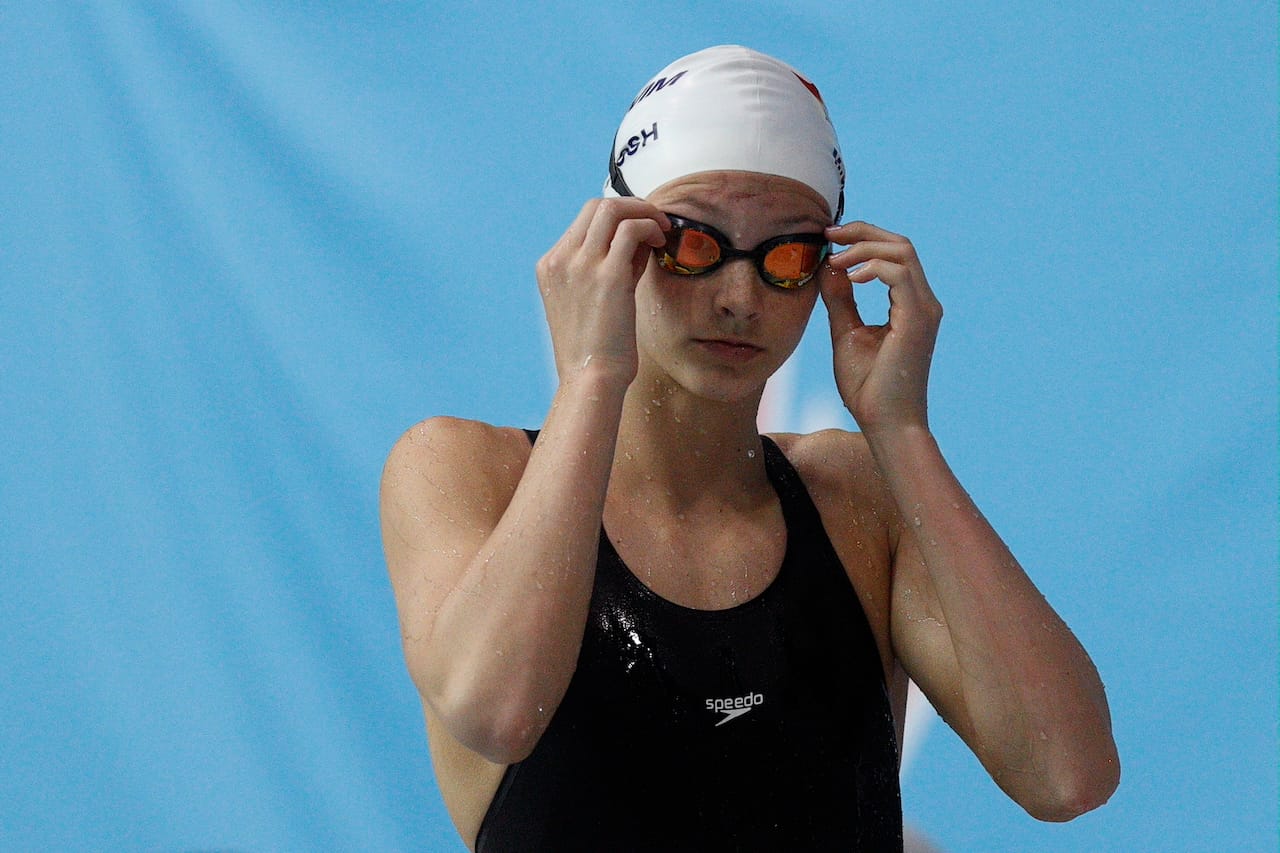
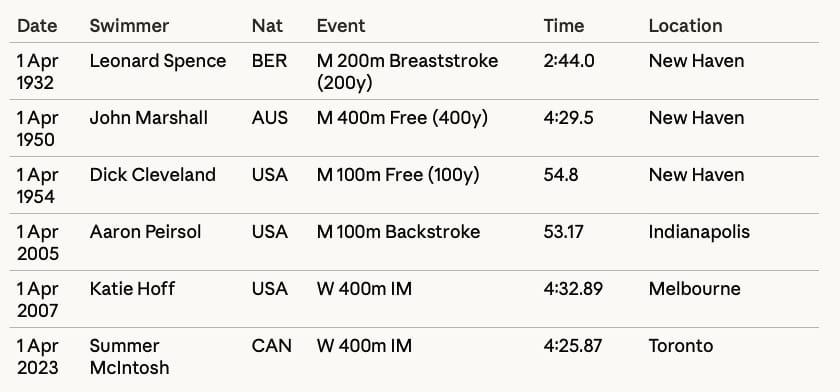
On this day in history, the following swimmers set world records:
At SOS, we place swimmers retired and still active in our Hall of Fame. We reserved the right to remove anyone who subsequently falls from grace in a way that taints their sporting achievements.
1932: Leonard Spence
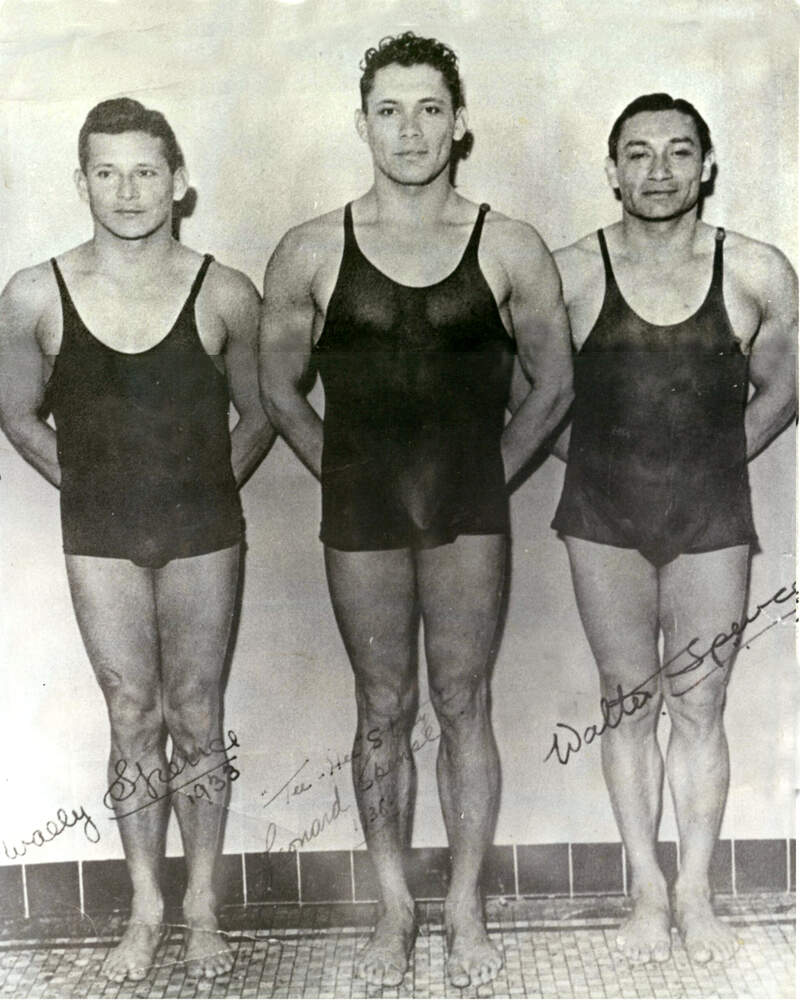
On April 2 and April 1, respectively in 1931–1932, Leonard Spence, of British Guiana, set two world records in the 200m breaststroke, but he did not compete at the Olympics until 1936, for two key reasons:
- In late 1931, illness - which would later turn out to be tuberculosis - hampered his ability to be at his best from time to time during his swimming days; and
- During the 1930s, British Guiana did not have its own National Olympic Committee (NOC) recognised by the International Olympic Committee. One was established in 1948. Consequently, citizens of British Guiana competed for other nations at the Olympic Games, most notably Canada, the country for which one of Leonard's two swimming brothers, Walter competed in Olympic waters and claimed Olympic silver with teammates in the 4x200m freestyle at Amsterdam 1928.
All three brothers, Walter, Wallace and Leonard left Guiana in the 1920s to attend college in the United States. Walter left for the USA in 1923, then sent for his brothers, Wallace in 1926, and Leonard in 1928, to follow him. They formed a 3×100 m medley team at Yale University and won the AAU championships in 1933, marking the only time in the history of college swimming that three brothers have emerged champions from the same relay race. They also raced in relays with Peter Fick at Yale, and in 1935 Walter and Leonard were on the team with the 100m free World record holder, when they became AAU champions in a 4x100m freestyle racing for the New York Athletic Club (NYAC):
 Craig Lord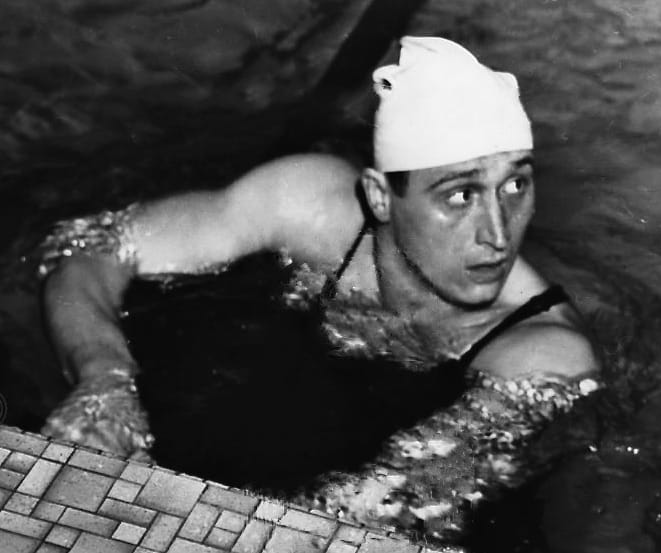
In 1925, Walter won the high-points trophy at the U.S. National AAU championships in San Francisco. He held several yards world standards during his career, which was long by standards of his day and by modern standards: In 1935, aged 34, he was NCAA high-point man for Rutgers, a feat that makes him the oldest intercollegiate swim champion to this day.
The brothers would set a world record in the yards medley relay together in the early 1930s at a time when that event existed on three strokes before the birth of official butterfly in the 1950s. The 3x100m relay would become obsolete at the end of 1952 as butterfly started to appear in medley events ahead of the first major international championship appearance at the 1954 European Championships, and the stroke started to appear in medley relays heading for official recognition as a 4x100m event.
In their era, for the reasons stated in the explanation box above, there were far more records to be had in the pool. On breaststroke in New York State and Metropolitan racing, the brothers Spence took turns in winning all races they entered for 13 years, and one member of the family or another owned the National AAU indoor breaststroke records for 11 years. The International Hall of Fame even claims that "Leonard held every breaststroke record from 100 yards to the mile", though the context was regional, not national and certainly not international.
So famous did their story become that reporter John Kieran of the New York Times wrote that the brothers all looked alike and asked if there really could be three of them, or was the world witnessing just the one superstar with aliases.
The Spences were born in Christianburg, British Guiana, Walter the oldest of eight children: four brothers and four sisters. Their father was Scottish and worked as a big game hunter and guide, while their mother was Indian. The Spence kids would swim in the Demerara River - accounting for why six family members bore scars from piranha bites.
If three brothers became champion swimmers, two of the four Spence sisters also swam competitively. The youngest of the brothers, Harold, was also a promising swimmer but was killed in action for the RAF in World War II before his athletic career could take off.
The Guianese were able to compete for their country at the British Empire Games (now the Commonwealth Games), from 1930, Walter claimed silver in the 220y breaststroke at the Sydney 1938 edition on the cusp of war as the only podium-placer from his country.
Some Guianese athletes also competed for Great Britain at the Olympics, but Leonard opted to race for Bermuda at the 1936 Berlin Games marked by the dominant presence of the Nazis and swastika-soaked venues in a city gearing up for war. By the time Berlin came round, Leonard was past his best in an event that had moved on since his last World-record swim this week 94 years ago.
Hubert Leonard Spence qualified for the semi-finals of the 200km breaststroke in 7th place but was disqualified in his semi. He also finished fourth in his heat of the 100m freestyle and did not progress to semis. In the heats of the 4x200m freestyle, he competed alongside Bermuda teammates Edmund Cooper, Dudley Spurling and John Young, finishing fifth run the first heat of two in 10:50.5, as the first team over the 10-minute mark, for with place overall.
Leonard contracted tuberculosis around 1931 - but the illness was only diagnosed or what it was six years later, after the Berlin Olympics. The condition knocked his health throughout the rest of his life, and he passed away at the age of 38 in New York on November 10, 1947.
2023:
There'll be a few more of these days before Summer McIntosh moves on...
 Craig Lord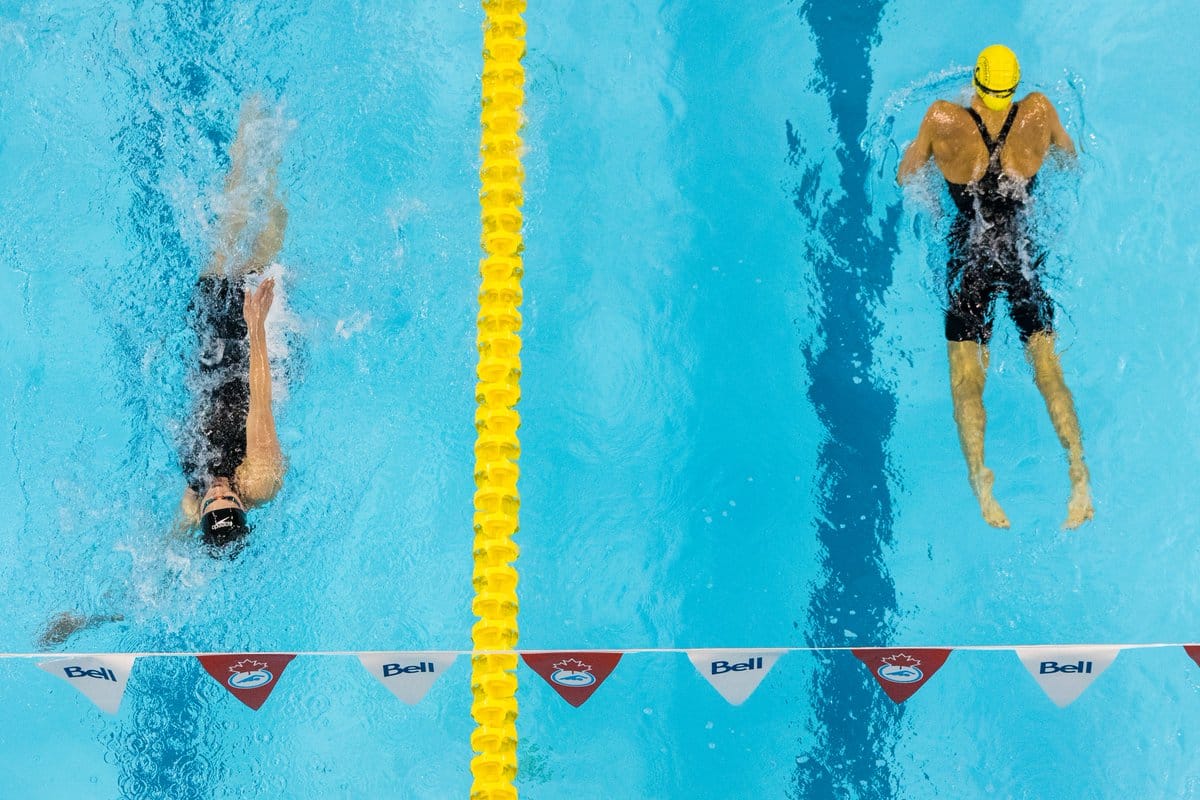
2007:
Katie Hoff was the global medley queen at 2005 and 2007 World Championships:
 Craig Lord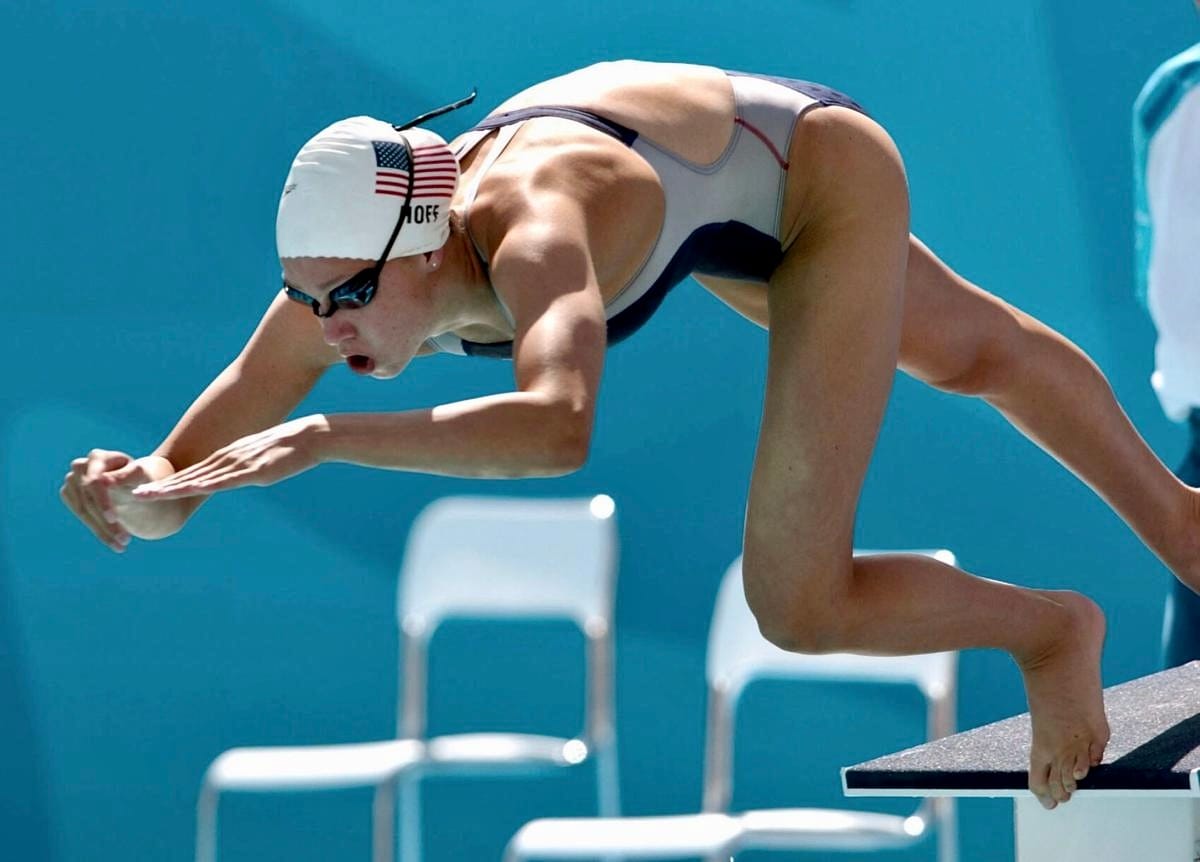
2005:
Here's a file that celebrates the career of Aaron Peirsol, filed on the 20th anniversary of his first of many World records:
 Craig Lord
xzxz


