Let’s Hear It For Alice Milliat, France’s Founding Mother of The Olympics
In March 2021, France honoured Alice Milliat with a statue at the Maison du Sport Français, all present wearing masks during the Covid pandemic. By then, women had been forced to wear varying layers of anonymity in Olympic sport since it all began in 1896. Time to Honour Alice Milliat


Archive, first published July 2024
There'll be much mention of the 'founding father' when France opens the Games of the 33rd Olympiad along the Seine on July 26 but it's the 'founding mother' Alice Milliat who ought to take centre stage at the "Paris Parity Games".
It was Milliat, not Pierre de Coubertin in a time when misogyny was the norm, who paved the way for the French capital to go from the host of Games at which only 2.2 per cent (1900) and 4.4 per cent (1924) of all athletes were women to a 2024 host that can boast 50:50 parity of the sexes for the first time in history.
Yes, it's taken 100 years! And we're still not there. while the numbers of participants will be a match for both sexes, men will have more medal chances and events to target at Paris 2024 than women, while the corridors of International Olympic Committee power can still very much be described as a Man's World, despite measures that seek to show 'progress'.
In March 2021, France honoured Alice Milliat with a statue at the Maison du Sport Français at Stade Charléty, all signatories, press and visitors wearing masks during the Covid pandemic. By then, women had been forced to wear varying layers of anonymity in Olympic sport since it all began in 1896.
Milliat's plinth stands not far from the one that's been in place for De Coubertin, for whom there are statues galore around the world, including those at IOC headquarters in Lausanne, Switzerland, and outside Olympic cents in several Games host cities.
A series of VIP speeches made at the unveiling of Milliat's statue in 2012 included a video message from Thomas Bach, the IOC President. Her said that Alice, who was born in Nantes in 1884 and died shortly after her 73rd birthday in Paris on May 19, 1957, would have been proud that the 2024 Games was on course to have perfect "gender equality". Make that sex. For it's sex that matters in sport, not gender, which is used liberally these days as a short-form for self-identity. In life, so what? In sport and female spaces and races? Unfair Play.
Milliat raised a lot of questions about fair play and equity in her day. Looking back down the decades as her legacy played out in the gains women have made in sport, it's fair to conclude that she's been largely ignored, particularly in official Olympic circles and ceremonies and by the IOC. Here's the kind of homage we can read on the French Baron at the official Games website:
Now tap Milliat into the search field on the same site. Rien. Even Edith Piaf would surely ask the IOC to regret that.
Go to La Fondation Alice Milliat or pick up the many books (like those pictured below, including the newly released La Vie Jamais Racontée - Alice Milliat - by Nancy Gillan) that women authors have penned about her and her campaigning life in service to women's rights and you can read a lot more about the women's sports pioneer who fought the Baron and his mates for female status and recognition.

It's to be hoped that Milliat will be celebrated every bit as much as the Baron as Paris 2024 and the IOC boast of parity. Some may well argue that she deserves the bigger fireworks because today we know what we know.
De Coubertin is celebrated at every opening ceremony as a great visionary, the founding father of the modern Olympics. The truth is that he was the father of men’s sport at the Games and the patriarch who effectively told women to clap and place garlands around the necks of their blokes before popping back to the kitchen to slip a pinny on.
In 1896, the Baron's vision allowed women to partake in Olympic festivities as long as they had ‘chaperones’ in tow. In Paris 1900, there were two women-only events, tennis and golf, and both required the athlete to wear a long frock, female ankles being so unseemly.
Sport was all about the athletic performance reflecting men’s "abilities, endurance, strength, virility and courage":.
But why can't women… elicited the following response from the baron: "Women have but one task, that of the role of crowning the winner with garlands. In public competitions, women’s participation must be absolutely prohibited. It is indecent that spectators would be exposed to the risk of seeing the body of a woman being smashed before their eyes."
That was in the early days and he was still wedded to sexist tropes in 1919, when women dared to suggest adding track and field and other events for women at the Olympics. Coubertin said 'non': it was "impractical, uninteresting, unaesthetic" and even "improper". Why a visionary.
Enter Alice Milliat. She met the IOC and the International Amateur Athletic Federation (IAAF), then an organisation of men for men, in that same year of repeat tropes, 1919, the Great War behind the world but it's discriminations far from over.
Could women please have … 'Encore: Non!" So Milliat founded the Fédération Sportive Féminine Internationale in October 1921. She organised the Women’s Olympic Games in Monte Carlo in the same year and then in 1922 she set up the Women’s World Games, which were held every four years until 1934.
Before he stepped down from the IOC presidency in 1925, the disgruntled Coubertin felt the way the wind was blow-ing and agreed to add fencing for women.
Readers of State of Swimming may wish to note, at this point, that women were allowed into the Olympic pool in 1912, courtesy off the forward-thinking Swedish organisers in Stockholm, who asked for several races for females. The IOC said "Non! - a token two will do". The 100 metres freestyle and the 4×100 metres freestyle relay compared to the six individual events on three strokes and a relay for the men.
Australian Fanny Durack was the first Olympic women's swimming champion but the voyage to Stockholm was more challenging than the race for gold. When she and fellow national swimming champion Wilhelmina ‘Mina’ Wylie said they wanted to race at the Olympics, the New South Wales Ladies Swimming Association (NSWLASA) passed on the bad news and instruction sent by the men in charge of the Australian Olympic Committee (AOC): the budget had been allocated to Bruce not Sheila, including the vast cost of a 21-day cruise to the Games.
Aussie women were having none of it. National scandal ensued. So the blokes in blazers 'compromised': Fanny and Mina could go to the Games if they paid for themselves and their obligatory chaperones. The women fought on: funds were raised and off went Fanny and Mina to the Games, where Wylie took silver behind her teammate and Britain’s Jennie Fletcher the bronze.
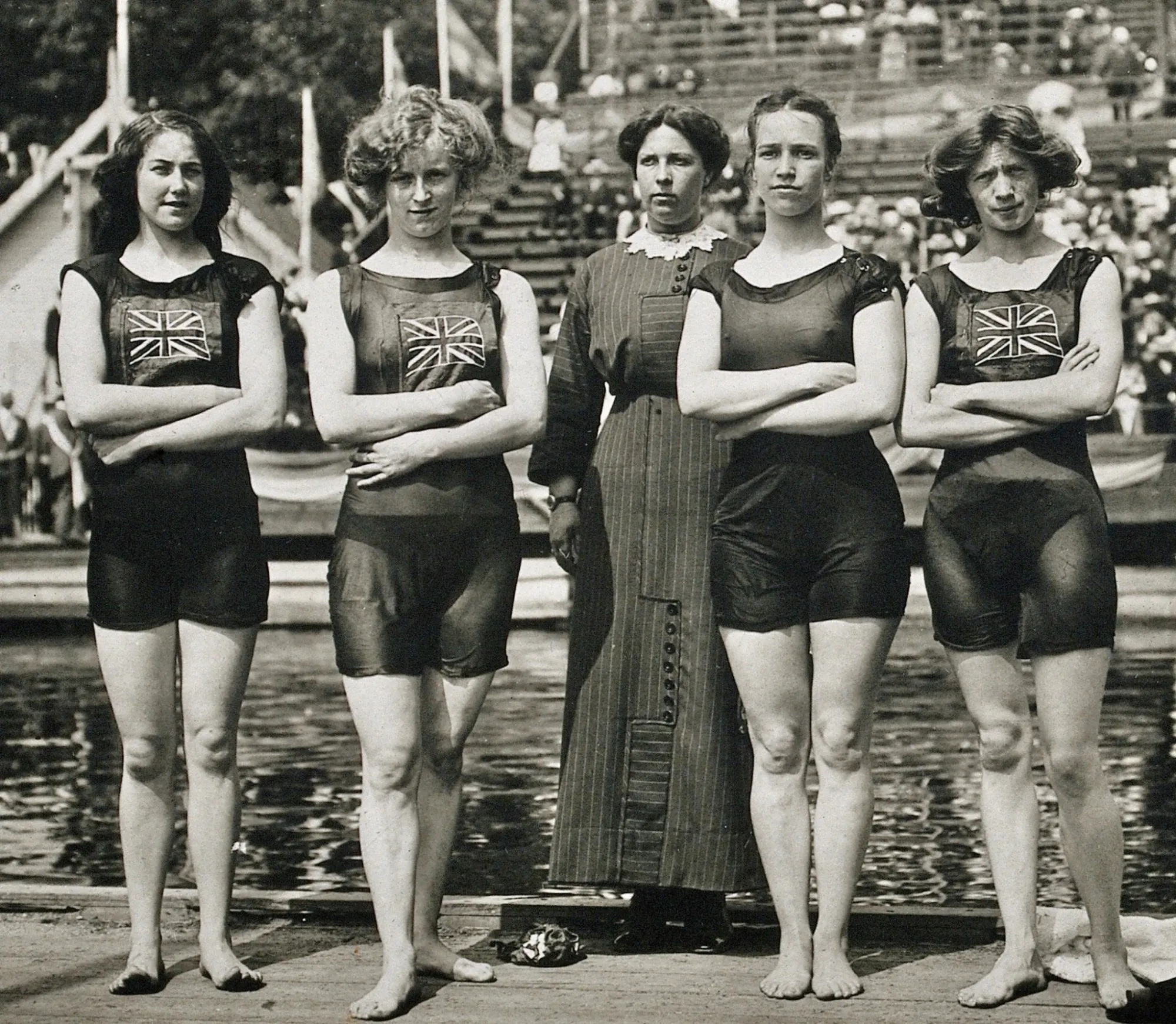
Jennie was then joined by teammates Isabella Moore, Annie Speirs and Irene Steer, and Britain took the first women’s swimming relay gold in history. A decade later, Jennie recalled: "We swam only after working hours and they were 12 hours a day, six days a week. We were told bathing suits were shocking and indecent and even when entering competition we were covered with a floor length cloak until we entered the water."
You can read much more on those any many other struggles for women in sport in "Unfair Play - The Battle For Women's Sport" by Sharron Davies, with this author - published by Swift Press and out today in paperback.
When we were working on the book, Sharron, the first woman home in the Olympic 400m medley final in 1980 unassisted by male steroids, wrote to Emmanuel Macron through the official channels open to anyone to do so. The letter noted that the letter should also go to the French Sports Minister Roxanna Marinaceanu.
You can read the full letter in our book but basically, it asks the French President and his then Minister and former World swimming champion to use Paris 2024 as an opportunity to celebrate the women who made it all happen for other women - and less so the misogynist so-called visionary, who blocked them.
Sharron also notes:

"We should not erase Coubertin from history and it’s hardly surprising that the IOC and France would wish to commemorate his founding-father status at an Olympiad held in Paris. At the same time, in 2024 we should also expect, at the very least, Coubertin’s regressive and sexist views to be recognised by the IOC and organisers. Let’s celebrate the women like Alice Milliat who fought for equal rights, M. Macron, not the misogynist who never included women in that famous French ‘liberté, égalité, fraternité’ of yours. The truth is that the spirit of that grand French national motto has only ever truly applied to men in sport." Sharron Davies - Unfair Play.
A response is promised by the Élysée Palace when you write to the official channel for handling letters to the President. It never came. Not a word.
Sharron, meanwhile, had plenty of words win there subject and much related to the experience off women in the Olympic Movement in Unfair Play:
 Craig Lord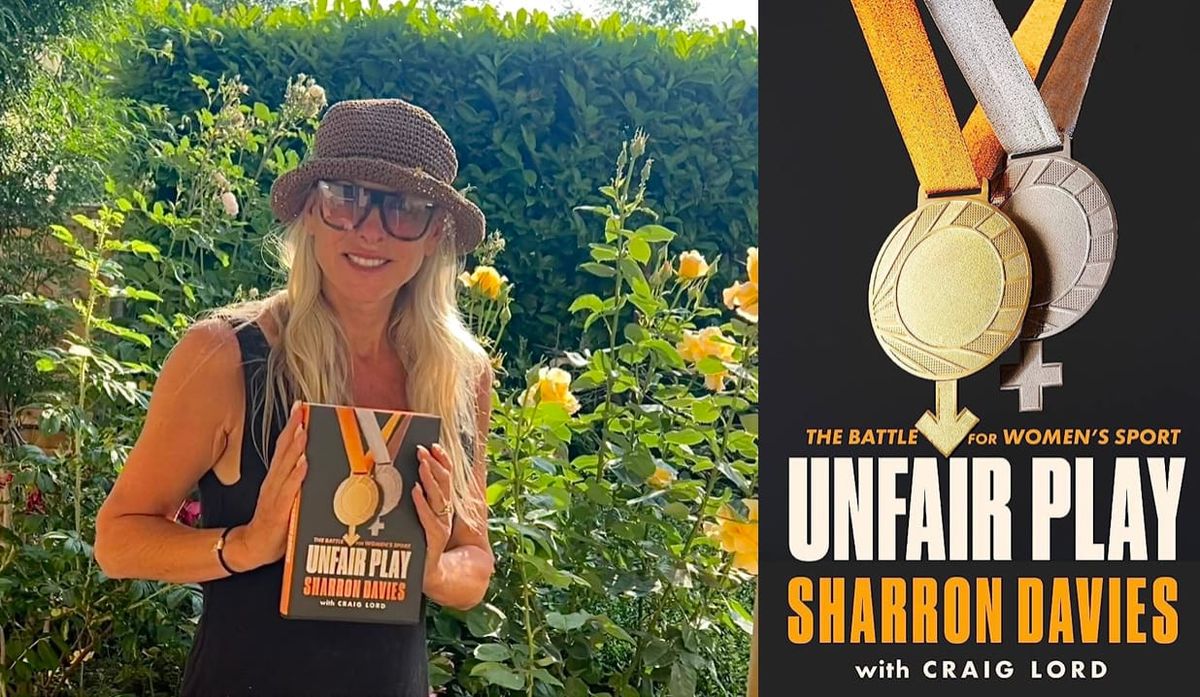
So, back to the 2021 unveiling of Milliat's statue. Standing 2.85m tall, it was designed by students at the National School of Applied Arts in the French capital.
Among those there for the unveiling was another women's sports pioneer Roxana Maracineanu, the 1998 World 200m backstroke champion who became France's Sports Minister. Whatever would De Coubertin have made of it!? Roxanna described Milliat as:

"... the activist of a just and salutary cause, that of giving women the right to play a sport... From Alice and thanks to Alice we have gone a long way but there is still to go so that women finally take all their place in the sports world."Roxana Maracineanu. Screenshot from Le Parisien on the day the Milliat Statue was unveiled in Paris
Brava!
The idea for the statue came from yet another pioneer in French women's sport, Béatrice Barbusse, the first female president of a professional male club, Ivry Handball, in France.
Women working for women. That's why Milliat, not De Coubertin should be on the billboard at the Paris Parity Games.
That article in Le Parisien that we use as a screenshot above concluded:

'An opponent of Pierre de Coubertin - Alice Milliat notably opposed the founder of the Modern Olympic Games Pierre de Coubertin, who declared a year before his death in 1937: “The only real Olympic hero is the individual male adult. Therefore, neither woman nor team sport." It was not until the resignation of Pierre de Coubertin in 1925 to obtain genuine progress: women were accepted at the Olympic Games in Amsterdam in 1928 in the flagship sport, athletics.'Le Parisien.
France should honour Alice Milliat every bit as loudly and proudly as the Baron of his age when the torch lights the flame on July 26.
NB, on Olympic Day June 2026, we can safely say that Alice, while mentioned, did not feature as prominently as the Baron nor was any 'mother of the Olympics' mentioned alongside the references of 'founding father' galore.
One positive note can be reported, of course: after Kirsty Coventry became the first female IOC president in history, she moved ahead with a reversal of policies that discriminated against women under the presidency of Thomas Bach. Males who identify as transwomen can no longer compete in the female category, after having been allowed for the best part of a decade of harm and a bitter struggle for truth to be told: male advantage in sport is real and constitutes unfair and sometimes unsafe play in all circumstances where it is allowed to enter women's races and spaces.


